One-Ring Circus
The Lord of the Rings stage show is a feast for the eyes, but it might make you sick to your stomach.
When it was announced that Peter Jackson had the green light to make J.R.R. Tolkien’s The Lord of the Rings into an epic film trilogy, it was tough to imagine him actually pulling it off. Other than the magnificently twisted Heavenly Creatures, Jackson was mainly known for his campy splatter flicks at that time. This skepticism just added to the awe-inspiring experience of watching the movies for the first time. Every frame of this exploration of Middle Earth is a testament not only to the talents of the filmmakers, but to their obvious adoration of the subject matter as well.
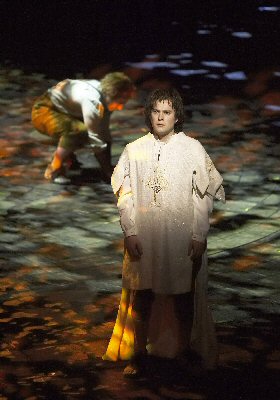
It’s a tall order to ask anybody to make a movie from Tolkien’s book, but nothing compares to the task of translating it into the format of musical theater. This is precisely what the Toronto-based Mirvish Productions has attempted, and their interpretation is full of beautiful costumes, sumptuous set designs and fantastic special effects. It’s also a muddled, trite and often ridiculous botch job. If you’re a theater buff who hasn’t read the book or seen the movies, you’re going to appreciate the spectacle but be hopelessly lost in the plot. If you’re strictly a Tolkien fan, you’re going to laugh your ass off.
I’m not going to lie; I really wanted to love this show, and when my wife and I entered the theater, it truly seemed like they got it right. The area around and above the stage was covered in gorgeous, intertwining tree roots, a testament to the story’s strong environmental message. 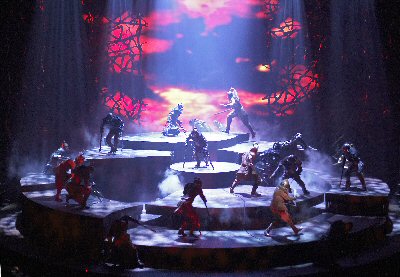 As people filed to their seats, a group of hobbits greeted them from the stage, singing, dancing, lazing about and catching fireflies. It really captured the sense of carefree innocence that makes characters like Bilbo, Frodo and Sam such lovable underdogs. Unfortunately, it was a poor sign of what was to come.
There are certain things about the three-act, three-and-a-half hour production that would be unfair to criticize, because they couldn’t be avoided. Huge chunks of the story were cut to fit the format, along with a few characters, and the sheer size of Middle Earth wasn’t conveyed. After all, director Matthew Warchus had a few hours and one stage to work with. But instead of minimizing these faults, Warchus and company shoves them in the audience’s face.
For example, eons of time are wasted on some seriously terrible songs, most of which do no justice to the lyrical passages of the books. While the score of the production is stylistically and emotionally appropriate, composer A.H. Rahman just had to throw in the kind of ham-handed ballads that made Andrew Lloyd Webber such a fat, rich bastard. As a result, the Lady Galadriel howls like Celine Dion for ten minutes, time that could have been spent explaining one of the gaping plot holes (i.e. What is Rohan? Why does Aragorn have to summon a ghost army? How did Gandalf come back from the dead?).
The show isn’t a complete waste of time. Certain characters and scenes are brilliantly executed, leaving one to wonder just how great the whole thing could be. 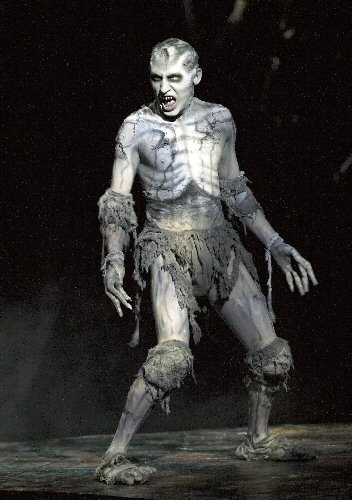 For instance, the insanely resilient actor Michael Therriault literally throws himself into his portrayal of the creature Gollum. His performance is so intense; I was left wondering how purple his bruises must be. The fall of Gandalf in Moria, which closes a very promising Act One, is a breathtaking, interactive audience experience. And the ominous, organic design of the giant spider Shelob is nothing short of a triumph; as it crept stealthily out of the darkness, you could hear the audience gasping as one.
Visually, LOTR is a landmark achievement, but enjoying all the eye candy is like spraying Febreze on a bag of garbage – once the sensation wears off, it starts to stink all over again. After the first act, which introduces the main characters in an efficient and entertaining fashion, the whole thing goes into the toilet, and hilarity ensues. It’s as if the director and playwright got sick, and the costume designer and choreographer took over. Even though I was fidgeting in my seat by the middle of Act Two, I was still trying to convince myself that I loved this show – until dance fever set in.
In the book, the demise of Boromir is a grave commentary on man’s self-destructive desire for power and material possessions. Here’s how they translated it to the stage: Boromir tries to wrest the ring from Frodo, who puts it on and escapes (his disappearance is an amazing stage trick). Embarrassed and alone, Boromir hears the approach of Saruman’s army. He screams, building tension for the battle to come. But instead of dreaded, bloodthirsty orcs, a dozen acrobats on pogo sticks hit the stage, and they do back flips and various dance moves to bad synth rock until one of them finally shoots Boromir with an arrow. By trying to combine gothic violence with Broadway glitz, this show has struck comic gold.
As my wife and I tried to swallow our laughter, it seemed like the show couldn’t get sillier. It did. The production’s takes on the Battle of Helm’s Deep and the war at the gates of Mordor are elaborately choreographed, bombastic jokes. In the former, where Aragorn leads a ragged company of soldiers to an impossible victory over the massive forces of Saruman, the good guys stand at the top of a rotating stage, waving their swords at the “attacking” orcs, who once again seem much more interested in posing and doing gymnastics than fighting for their dark lord. Not once do you fear for the safety of Aragorn, Legolas or Gimli – characters we’re supposed to love – because other than the threat of being poked in the eye by evil jazz hands, they aren't in any danger.
The final battle is probably one of the funniest things I’ve ever seen. On top of the now-familiar bouncing orc dancers, the knights of Aragorn’s army join in the fun, using their swords like Gene Kelly’s umbrella, twirling, swaying, posing and intermittently waving them at their dancing enemies. When the Lord of the Nazgûl kills King Theoden 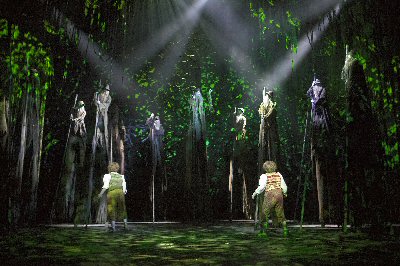 (two characters that the audience never gets to know), three of these soldiers continue to dance, while others mourn his death. It’s a final insult to Tolkien’s first-hand experience of the horrors of war, and the most poignant example of how the people behind this production either didn’t know or didn’t care about the basic morals of his story.
The Lord of the Rings is many things. It’s an epic love story, a profound allegory, an ominous warning, a reflection of a society forever changed by the industrial revolution and two World Wars. But first and foremost, it’s an adventure. And while the wondrous creatures and majestic settings make the book fantastic, it’s the basic story – two seemingly insignificant friends saving the world – that makes it universally great. The producers of the stage show were lost on this point. To them, LOTR was an excuse to create a lot of beautiful things, and they’ve done a better job than any stage show I’ve ever seen. For something like The Lion King, I have no problem valuing style over substance. But LOTR is different. It’s a cultural institution, a story close to my heart and the hearts of countless others. Peter Jackson understood this, which is why his films make you believe. Mirvish Productions just didn’t get it, which is why they’ve unwittingly done the bidding of the ring: “To bring them all, and in the darkness bind them.”
Appeared in the July/August 2006 issue of Buffalo Spree.