
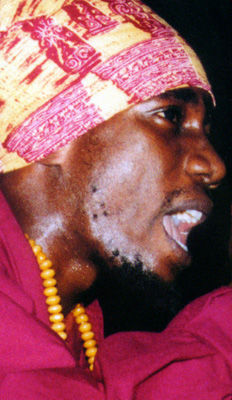
Sizzla, the self-appointed "Royal Son of Ethiopia", announces his brand
new album for '99. With an ever-increasing following and a string of releases
behind him, Sizzla is well on the way to claiming his rightful place in
the reggae Hall of Fame. He is a musical rarity, combining deep spirituality
with passionate lyrical styling and simple yet innovative rhythms. "Royal
Son of Ethiopia" is Sizzla at his best, reaching into the mind and stirring
up the soul.
Twenty-two year old Miguel Collins a.k.a Sizzla was born of Rastafarian
parents and raised in the close-knit community of August Town. He grew
up against the backdrop of eighties Jamaica and its burgeoning crack cocaine
scene. "Slackness" (vulgarity) characterised dancehall culture with its
fixation on gun lyrics. Sizzla watched these developments from the periphery,
using what he saw to feed his creative fire and fuel his cultural messages.
Taking the standard Jamaican route into music, he served his apprenticeship
with the Caveman Hi Fi sound system, "the poor man's radio station". According
to Sizzla, "Babylon (western) media never play the songs which have the
fire. Sound system play them 'cause the people love them vibes. Sound system
is still the main vehicle". Even at this early stage Sizzla was showing
his absolute commitment to music.
The first chapter of Sizzla's prolific recording career came in 1995
with his debut release through the Zagalou label, swiftly followed by a
clutch of singles with Bobby 'Digital' Dixon. Extensive touring with fellow
roots and culture master Luciano brought Sizzla wider critical acclaim
and another step closer to universal success. He teamed up with Phillip
'Fatis' Burrell of Jamaica's premier modern roots stable, Xterminator.
Boasting a cutting-edge roster that included the mighty singing talents
of Luciano and the cream of the island's up and coming artists, Xterminator
proved to be the natural choice for Sizzla. His relationship with Fatis
was a productive one from the outset, and a run of successful singles resulted
in his first album, "Burning Up" in 1996. Hot on its heels, and cementing
the Sizzla/Xterminator partnership, came "Praise Ye Jah" in 1997.
Now established as the principal voice of conscious reggae, Sizzla
continued his musical onslaught. With one foot remaining firmly in the
roots camp, he embraced the digital revolution, developing his unique style
and sound. Fiercely outspoken about his Rastafarian beliefs, Sizzla shattered
conventional boundaries, appealing to an audience searching for something
fresh and challenging. He didn't disappoint with 1997's release of the
seminal album, "Black Woman and Child". Produced at the Digital B studio
and displaying Bobby 'Digital's' trademark dancehall-influenced rhythms,
the album's impact was phenomenal. The beautiful simplicity of the title
track ensured it anthemic status. Sizzla earned a nomination for Best International
Reggae Artist for "Black Woman & Child" at the 1998 MOBO Awards, as
well as inclusion in various magazines' top 100 albums of the year.
Last year saw Sizzla record a further two albums, "Freedom Cry" (Xterminator)
and "Good Ways" (Bobby 'Digital' Dixon) plus a host of singles. In a global
music culture used to an artist working to a more sporadic release schedule,
such an abundance of material may seem daunting. But Sizzla has a lot to
say. This "Royal Son of Ethiopia" is a staunch advocate of black people's
rights; his songs are a call to arms, inspiration for others to redress
the balance upset by the West. A strikingly sartorial figure, draped in
long robes with a turban covering his dreadlocks, Sizzla commands attention.
An air of mystery surrounds him: notoriously publicity-shy, Sizzla rarely
allows himself to be interviewed or photographed. He lives according to
his Rastafarian principles and makes music to motivate and educate rather
than for profit or self-aggrandizement.
Whether you are pro-repatriation or not, you can't question Sizzla's
ability to combine these convictions with a virtuosity that belies his
young years. "Royal Son of Ethiopia" is the follow-up to his highly successful
'98 set, "Freedom Cry". With the distinctive Xterminator hallmark, "Royal
Son of Ethiopia" is a superbly crafted album from which singles are set
to follow. The tracks reflect themes common to Sizzla's songs: the corrupting
influence of Babylon and its enslaving attitude towards black people, poverty
of the ghetto youths, love for Jah and the teachings of the black prophets.
Sizzla's lyrical soundscapes are underpinned by deceptively simple rhythms,
lifted by acoustic guitar melodies and soaring saxophone riffs. The tracks
twist and weave from the fervent preaching of "Burn Dem Turf" to the soulful
hymn of hope, "In This Time", featuring Luciano.
There is no doubt that Sizzla is an artist unrivalled in his field.
We admire his courage to challenge opinion in the same way that we welcomed
Bob Dylan and Bob Marley. The buzz surrounding this young deejay is growing
fast. His albums are guaranteed the top slot of any reggae chart, as well
as the respect of the mainstream media.
"Royal Son of Ethiopia" is the reggae album of '99, so "put away your
distrust and your grudge" and let Sizzla speak to your soul.
