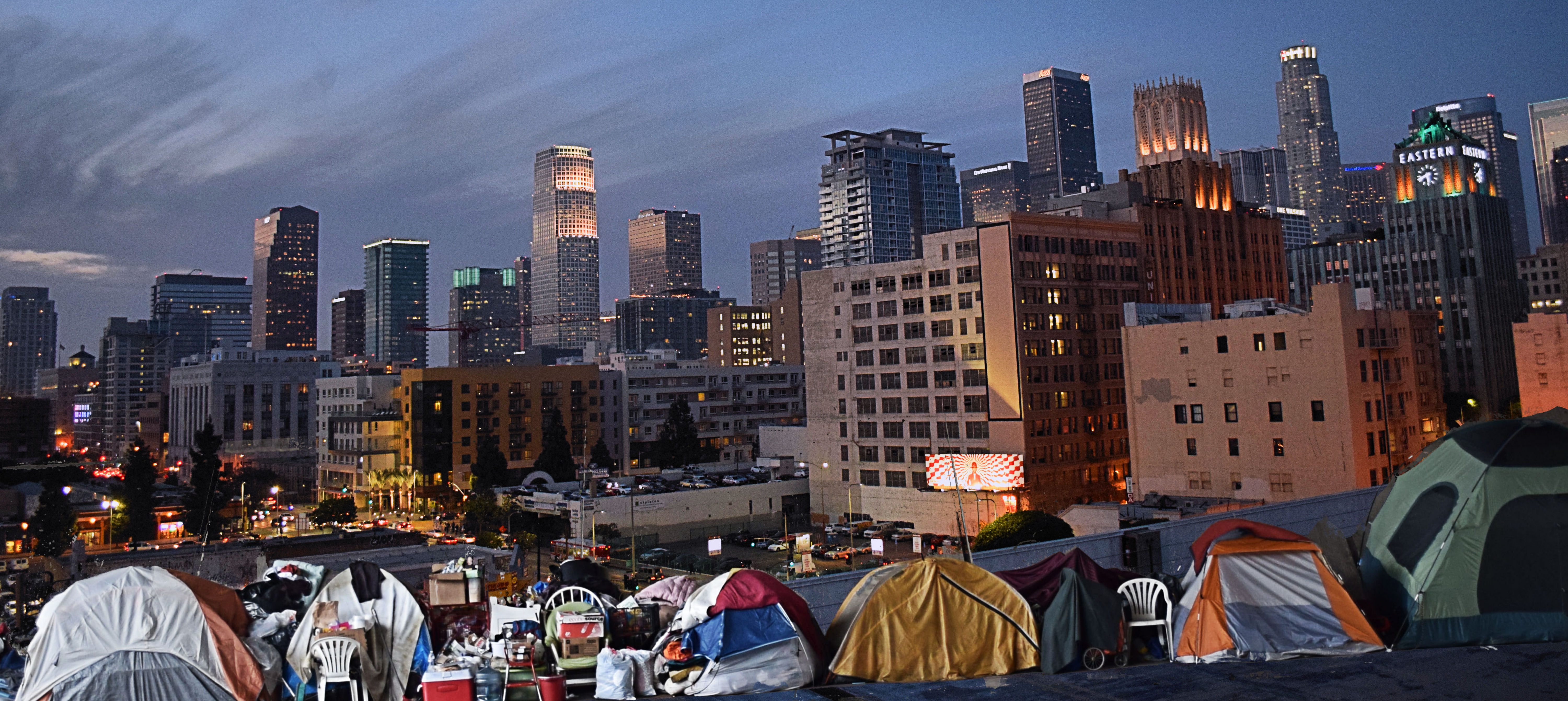
Homeless In L.A.
If you live in Los Angeles, or have visited the city recently, you have probably noticed the huge homeless population camped out on the streets - not just confined to the well known Skid Row north of downtown, near the river bridges, but under nearly every freeway overpass, behind your local supermarket or mini-mall and in your local park. Just to put some sort of scale on this observation, here are some statistics; there are about 9000 homeless people in the UK - that means all of England, Scotland, Wales and N. Ireland, and the main island is about the same area as California. In comparison, there are 60,000 homeless just in Los Angeles county.
We are not proud of these numbers, and City Hall is trying to address some of the issues which have contributed to the problem, which include lack of affordable housing, lack of employment, mental health issues and substance abuse. I don't have any quick solutions to the problem, but do have some ideas about how it happened, and a lot of sympathy for these sometimes faceless numbers in social workers' log books who often have to resort to seeking food and a bed at a local homeless shelter, accepting food from a local church, not having access to a bathroom or toilet, suffering from unhygienic conditions and the health risks they pose, loneliness, feelings of rejection, temptations of the street to take more drugs, prostitution, and a slow decline in mental health.
I recently spoke to one young homeless man, who I will call John, in my neighborhood, who was camped outside my local hardware store, along with three others, including a young woman. This young man did well in High School and had won a scholarship to one of Southern California's top universities. I asked John why he wasn't living with his parents - after all, many young adults live with their parents until they are able to afford their own accommodation, even if it is only in a converted basement or garage - and his reply did not shock me at all, because it was a very similar description to what has happened to several of my neighbor's adult children, and many of my friends' children. More of this idea later...
When young adults graduate from high school at 18 they are legally considered adult, having the right to vote, open a bank account, sign off on a student loan and purchase products as a responsible human being. But psychologically are 18 year-olds really ready for this huge shift?
In 2015 researchers at King's College London found that chronic use of marijuana by young adults was correlated with a five time increase in the onset of psychosis in teenagers and young adults in South London. In the US, these psychotic episodes are often given the diagnosis of Bipolar Disorder or Schizo-Affective disorder in order for the patients to receive insurance coverage for psychiatric treatment, or Supplementary Security Income to help with housing and food. Critics of this study suggest that these subjects had a "predisposition" to mental illness before they started smoking cannabis, but isn't this just a pseudo-scientific and rather cruel way of dismissing people whose physical bodies are not strong enough to withstand the extremely high levels of THC - 14% in today's Skunk, compared to 4% in 1960s/70s "hippie" weed - in today's mass-grown marijuana? But how are these facts linked to homelessness? The sad fact is that unless these young adults are able to overcome their addictions they are extremely difficult to live with, creating a huge burden for their parents or room-mates. Psychotic episodes, paranoia and visual or auditory hallucinations are frightening for families or friends to understand and deal with, so these people are usually asked to leave home or evicted.
I'm not claiming that every one of the 50,000 homeless people in Los Angeles has a similar story, but I do know that recent studies in Colorado, which was one of the first states in the US to legalize recreational marijuana, show a big increase in homelessness, with many moving to the state in the hope of finding work in the new cannabis industry, but left destitute when no work is available. Many people come to L.A. drawn by its warm climate, but homelessness is not easy even in the mild winters. In the summer, the temperatures can be in the 110s with many becoming dehydrated. And drug use is a bit of a vicious cycle; it might cause homelessness as described above, but once on the streets, the homeless person wonders what else to do all day long. Drug use becomes a way of combating boredom, and feelings of rejection, sometimes financed by Social Security disability payments or General Relief. And this story, or ones very similar are repeated in every other city in the US and Canada. The richest nation on earth will continue to have this embarrassing social problem, in my opinion, until there is a fundamental change in our attitude towards not only drugs and alcohol, but everything we chose to put into our bodies. For more on holistic mental health please see my previous blog Ask Your Real Doctor Part II.
Drugs are just material things, and being dependent on them to escape reality is not spiritual it all - it is just addiction. As Eckhart Tolle says in his book The Power Of The Now, we have to be fully in our bodies to cut through the illusion of time, and we do that through meditation, not escapism. As mentioned earlier, I do not have the solution to homelessness, but I can only hope that our current rational understanding of psychology, biology and politics will help anyone who has become homeless because of drug use.
Tweet
| Bobbi's Astro Blog |