Does Astrology Work, and If So, How?

Does Astrology Work, and If So, How?
Jupiter and Saturn rising above Elysian Park, Los Angeles, March 2020
In the 1990s when the internet was still very young and people still read books and magazines, I came across the magazine American Astrology at my local drugstore. I had already been studying Kaballah for over a decade so was familiar with how the three monotheistic religions all had links to astrology, but here in modern America was this magazine which every month brought the cosmic art down to earth with articles about celebrities and world events. I was a bit embarrassed to bring the magazine home at first in case my family thought I'd fallen for superstitious nonsense, but the more I learned, especially about my own birth chart, the more I could see striking correlations of events in my life so far with planetary aspects.
Having studied psychology at university I could see how I might just be picking out positive correlations while dismissing everything else, ie the process of Confirmation Bias, but still allowing for this, I decided to expand my education in the subject. I went to local astrology groups - which in Los Angeles were not hard to find, bought books by famous astrologers and then met someone who suggested that I try reading horoscopes for my friends and family. This lead to me working for one of the famous "Psychic" telephone lines in Los Angeles, where I looked at thousands of birthcharts over the next few years when my children were young and I had to juggle things like volunteering at their school, being a housewife and working part time.
The feedback I got from my readings made me realize that there is definitely something very insightful about the tool I was using. Some people have compared astrology to an X.ray one might get in a doctor's office, but this X-ray is of the soul, not the body. Every person has a unique horoscope or birthchart, which is like a blueprint of their metaphysical soul, and even identical twins have slightly different horoscopes due to the slightly different birth times.
Still, my younger self would remember my science A-levels and rigorous university degree in Experimental Psychology and remind me that all this "evidence" was totally subjective. It's not like a science experiment in a lab or even a statistical test. It still could all be people wanting astrology to work, to have a sense of the magical in their lives. Was there any hard core data analysis which would prove this correlation objectively, rather than it still just being an "oh gosh look at that coincidence sort of thing?
The editor of American Astrology magazine at the time, Kenneth Irving, had done a lot of research into the work of Michel Gauquelin, a French psychologist who had used statistical analysis of people's horoscopes trying to find some objective proof for some of astrology's claims. Actually, like any researcher who acts according to the Scientific Method, Gauquelin was trying to DISprove astrology, but ended up, some would say, somewhat proving it. His research was mainly focused on sports champions, wondering if their horoscopes would show a greater importance of the planwt Mars (traditionally associated with physical action, defense and aggression) than in non sports people. What Gauquelin found was a bit baffling, because although there was a higher percentage of sports chammpions with prominent Mars than non-sports champions, these placements of Mars were not in the houses one would expect with traditional Western astrology. I have an explanation why that might be, but it will have to wait for another time. You can see a compilation of Gauquelin research at the Planetos website, and an interview with Kenneth Irving here:
But even with this scientific/statistical approach, the sceptics were soon objecting, as they should. An aphorism which the astronomer Carl Sagan used was something like "extraordinary claims need extraordinary evidence", so astrologers would have to put up a more rational account of their art than had been understood by most people who just read newspaper daily horoscopes. One very embarrassing moment for astrologers was when the American skeptic James Randi went into a classroom of students and have them each an astrological account of their personality according to their Sun sign. Nearly everyone said that the account they had been given was accurate.
They had all been given the same account!
However another skeptic from the California movement actually tested an astrologer who gave full readings, not just Sun Signs. Michael Shermer , publisher of Skeptic Magazine did an experiment a few years ago testing astrology which conformed to all scientific protocols for eliminating bias. "Bias", caused by inside or extra information getting into a testing process is one of the main reasons why tests of astrology have met with so much criticism in the past, and the elimination of it was something that was taught to me in my course in Experimental Psychology at university.
Schermer tested Vedic astrologer Geoffrey Armstrong to see if he could correctly analyze horoscopes at a success rate better than what would be expected by chance. After controlling for bias with blind and double-blind tools, Shermer's results validated astrological analysis at a success rate of nearly70%, which is much better than chance.
Of course this doesn't prove that there is a causal mechanism for astrology, only that there is correlation, between the "above" (the sky)and the "below' (people's personalities on earth).
Whether Tropical or Sidereal, if these sorts of tests of personal horoscopes are not enough to convince people of the validity of astrology, perhaps the branch of astrology known as Mundane or World Astrology will be more convincing - that is big world events like wars, inventions, religious eras, pandemics and big cultural or political changes. I would look back at the history I learned at school and see correlations to major planetary conjunctions, oppositions and squares, and the discovery of the Outer Planets in the past 300 years. Some of these correlations were even from my lifetime, in particular the 1960s big revolution in culture. I've written about these in some detail here in my blogs on this website but the person who has really gone to town with this concept is esteemed historian Richard Tarnas in his book Cosmos and Psyche.

The Outer Planets, Uranus, Neptune and Pluto were discovered by astronomers at exactly the time in history when the mythical symbolism associated with their names (give by astronomers to correspond to the Greek pantheon of gods) was being recognized on a mass level. Uranus, for example, was discovered by Theodor Herschell in Bath in 1781, exactly in between the French and American revolutions, and freedom, individuality and rebelliousness have been found to be important traits associated with Uranus in personal charts. Neptune was discovered in 1846 when Marx was writing his manifesto, photography was invented and anesthetics were first used, along with other consciousness-altering drugs on a large scale. Pluto, the Greek Hades, ruler of the underworld, was discovered in 1930, at the beginning of the American Depression, right in between the two World Wars, the rise of psychology and psychiatry influenced by Freud and Jung, and most importantly, the rise of Fascism.
And then came 2020 and the Covid pandemic, strongly correlated to the Jupiter-Saturn-Pluto conjunction of that year, and in fact vaguely predicted by some Mundane astrologers.

Let's look at the past hundred years to see what happened at the other Saturn-Pluto or Jupiter-Pluto conjunctions:
1914 - First World War began (Saturn conjunct Pluto in Cancer)
1918 - Spanish Flu pandemic (Jupiter conjunct Pluto in Cancer)
1945 (Saturn and Pluto very widely approaching conjunction) - End of World War II with nuclear bombing of Hiroshima
1947/48 - India independence, establishment of the State of Israel (Saturn conjunct Pluto in Leo)
1981/82 - Global recession (Saturn conjunct Pluto in Libra)
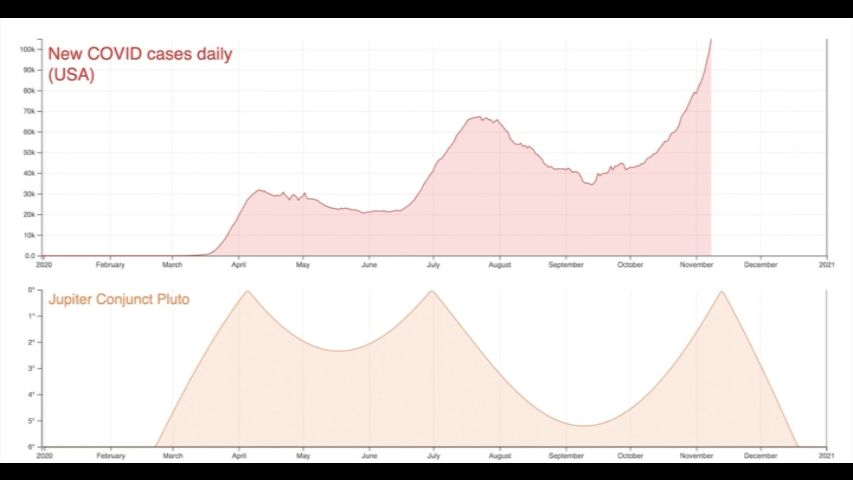
So the first criterion for making astrology rational does seem to have some foundation, and that is correlation. But the second criterion for establishing whether a belief is rational is that there should be a causal mechanism between the belief one is proposing and the effects that it supposedly has. In other words, IF astrology works, objectively, how does it work?
As yet, no one knows how astrology works. Barring the theory that people who believe in it are just deluded, no one has come up with a causal mechanism which would explain why certain transits to a person's birth chart are often accompanied by major life changes, noticed firstly on an inner emotional level, and consequently in an outer form in one's relationships, work and behavior, or how world historical events are often correlated to planetary aspects. One theory is that astronomical cycles of planets around our Sun correspond by ratio to cycles of psychological development, as put forward by the Developmental Psychologist Daniel Levinson. When it comes to world events, humans have a "mass mind" which responds to these events, and the astrology reflects this response to events, rather than the events themselves.
Another theory of a mechanism for astrology was put forward by astronomer Percy Seymour, who proposed that the Sun's electromagnetic energy is rather like a lather which is deflected by the planets and interacts with the earth's magnetic field. Seymour suggested that a baby developing in its mother's womb received a genetic imprint from this electromagnetic energy.
It's important to remember when considering these theories, that neither of them take away a person's free will, (or at least the illusion of free will) and are not fatalistic. Astrology is in some ways similar to the science of genetics, where just because someone may have a genetic predisposition to a disease does not mean that they will get that disease. What a person chooses to eat, and their general lifestyle can deflect natural predispositions.
The last causal theory of how astrology might work is the oldest, and perhaps the one which arouses so much objection from both astrologers and skeptics alike. It is the idea that stars and planets have a tendril-like physical influence on people and objects on earth. Although all electromagnetic radiation from stars ultimately must have some sort of effect on life on earth, it seems more logical to consider first the radiation from the star nearest to us, our sun.
Personally I am quite happy to accept that astrology will never qualify as a science, and that we will never find a causal mechanism for it, because if we did, astrology would be grossly misused, even allowing for the concept of free will, and people would feel very controlled and lacking in freedom. Unfortunately this is what happened in previous eras before people understood modern psychology. Perhaps the best we can do is adopt the age-old theory of theological correspondences, with a bit of quantum entanglement thrown in for good measure. But does that mean that astrology is stoll just Woo Woo and superstition? Or is it a language of philosophical and psychological symbolism which humans can use for their self improvement?

| Bobbi's Astro Blog |