|
WHY DO SOME PEOPLE OPPOSE
|
|
WHY
DO SOME PEOPLE OPPOSE AZADARI?
This is a good question. Why do some people (particularly, some Muslims) oppose Azadari?
To understand this issue one has to go back to the basic principles of Islam and the history of the Islamic movement in the very early years (first century Hijra).
The Prophet of Islam began his mission in Makkah. For twelve years his call was falling on deaf years. Then suddenly, the neighbouring town of Yathrib woke up to his call. The people of Aus and Khazraj, the two main Arab tribes inhabiting that city, invited him to come to them as their ruler, judge and teacher. The Prophet did not just accept the invitation. He placed a condition for his arrival in Yathrib and taking charge. He said: “I am an apostle of Allah, you will first have to acknowledge my apostleship and then I will accept your leadership. They accepted that condition and the Prophet of Islam began on setting up a city state in Madinah and also began giving them a new law which covered both the spiritual aspect of the religion as well as the worldly rule which included both a civil code as well as a criminal code. AT this point, all Muslims have to ask this question: What was more significant, the spiritual aspect or the worldly code of conduct in Islam?
Of course, the answer has to be that the spiritual aspect is more significant. This basic fact was totally lost on the coming generations of Muslims. They thought that the worldly rule was an integral part of Islam and not only that, the worldly rule was the more significant part of Islam. How and why did this misunderstanding took roots and became an integral part of Islamic philosophy?
This misunderstanding became hardened in the Muslim mind because they lost the basic premise of Islam. Islam had come to lift the human spirit and teach man his self-respect and his human self-esteem. It had not come to establish an empire. The fact that Muslims Arabs were able to establish an Arab empire within fifty years of the first call of LA ILAAHA ILLA ALLAH in Makkah was a byproduct of the movement not its main leitmotiv. Since the initial call in Makkah had had no success for the twelve years and the success only came in Yathrib where the first Muslim city state began, the confusion became even more hardened. If you follow the philosophy of leadership in Islam that misunderstanding will become clearer. Sunni scholars, who by far make the majority of Muslims in the world, have agreed upon the line of thinking that the most knowledgeable person after the Prophet was Abu Bakr, since he became the first Khaleefa, then it was Umar, since he was the second Khaleefa, and so on until Ali, who is only fourth in knowledge because he became the fourth Khaleefa. So, being knowledgeable became a function of political success. The hollowness of that claim becomes very clear when one looks at the intellectual contribution of those four august personalities in Islam. The basic element of Islamic faith is TAWHEED. While Nahjul-Balaagha, the book of Imam Ali’s sermons, sayings and letters, is replete with elaboration of that concept, one will be hard pressed to find one single statement from any of the first three Khaleefas on that topic. The worldly success in Madinah was necessary for the establishment of Islamic law. But it was not necessarily a basic requirement of Islam as a religious movement. That becomes very clear if we look at Qur’anic verses.
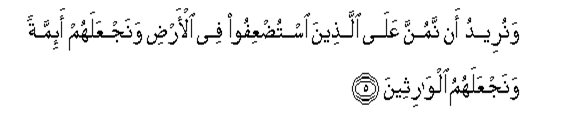
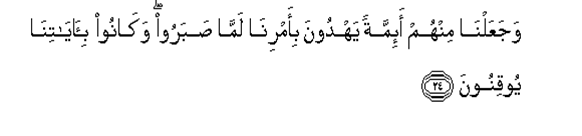
What the Qur’an is emphasizing here is that having worldly power does neither confirm the divine leadership nor does the lack of it negates divine leadership.
By virtue of being a powerful ruler in the kingdom of Islam, Yazeed was claiming to represent Islamic law in the kingdom. People like Abdulalh bin Umar were exhorting the Muslims in Madinah to accept Yazeed unconditionally and not start a controversy in Islam. Husayn had to stand up and expose the hypocrites in the Islamic society by declaring that the divine leadership (IMAMAT) belongs to the holy Ahlul-BAYT.
If Husayn had been successful in overthrowing YAZEED, that confusion that we pointed out in the beginning of this text, would have remained. It was therefore necessary that Husayn would rise in opposition to Yazeed, he would fight a desperate battle and he would be martyred in the cause of Islam. Ali Zayn-al-Abideen’s imprisonment, and his apparent public humiliation by the Umayyad armies, was the true mark of success of the Islamic philosophy. His own speech in the court of Yazeed, and several years later, the Qaseeda of Farazdaq in his praise, would show that Imamat, the divine leadership, was triumphant over the brute force and the worldly tyranny of Yazeed.
Now, AZADARI, is a symbol of that success of divine Imamat over the worldly tyranny, even if it may be disguised in the garb of KHILAFAT.
It is natural that those Muslims who have taken the institution of KHILAFAT to be the sole and complete representation of all Islamic philosophy would be wary of Azadari, and that is exactly what is happening. These Muslims think that if AZADRI became synonymous with Islam, the institution of Khilafat would be undermined. That, in their misguided opinion, is the death knell of Islam. And that is why they come out tooth and nail against the institution of Azadari. Imam al-Ghazali, a famous Sunni scholar and philosopher of Islam, was once asked as to whether or not Muslims should call Yazeed a tyrant and describe his ill-deeds as recorded in history. Al-Ghazali wrote a long reply to the person asking that question. The text of that letter runs into several pages. However, the bottom line fo Al-Ghazali’s reply can be summarized as follows:
“It is true that Yazeed was a tyrant and Husayn was right in standing up to him, but by saying bad things about Yazeed, some senior companions of the Prophet are also maligned and it creates hatred in the minds of the Muslims against the Sahaaba.”
On the one hand, Ghazali admits that Yazeed was bad, on the other hand, he also admits the fact that Yazeed’s becoming the Khaleefa of Islam actually reflects on the senior companions of the Prophet. So, to protect the Sahaaba, we have to hide the truth.
Azadari brings out that truth naked and undiluted.
Do you still wonder why some people oppose AZADARI?
Ed- It was an interesting and informative article and I thank you for it. I would like to comment on a paragraph in the text. Please correct me if I am wrong.
"It is natural that those Muslims who have taken the
institution of KHILAFAT to be the sole and complete representation of all
Islamic philosophy would be wary of Azadari, and that is exactly what
is Reply-
I would recommend readers to go through it. Syed Mohsin
Naquvi Updated Saturday, March 26, 2005 emtee creations © 2000 -2005
|