|

A
brief look at Kerbala
Yazid's Demand for Allegiance
In 50 A.H. when Imam
Hasan (A), the elder grandson of Prophet Muhammad (S) was poisoned, the duty
of Imamat became the responsibility of his younger brother Imam Hussain (A).
At the time, Muawiya
bin Abu Sufyan, the governor of Syria and arch-enemy of the family of the Holy
Prophet (S), was virtually the ruler of the whole Muslim Empire.
Muawiya, who had caused the poisoning of Imam Hasan (A), continued to disregard
the human rights of the people and employed gangs of criminals to terrorise
them. Imam Husain (A) was not frightened by the power of Muawiya, and openly
condemned him and criticised his actions in his letters, warning him against the
punishment of Allah.
Muawiya broke the conditions of the treaty he had signed with Imam Hasan (A) and
declared his evil son Yazid
as Caliph. In 60 A.H., news was conveyed to Walid, Yazid's governor in Madina,
about the death of Muawiya. At the same time, Yazid sent orders to Walid to
demand the oath of allegiance (Bay'at) from Imam Husain (A). The orders stated
that if Imam (A) refused, his head should be cut off and sent to Yazid in
Damascus.
On receipt of the letter of Yazid, Walid sent his servant to Imam (A),
requesting a meeting. It was night time and Imam (A) was in the mosque when
Walid's servant found him. When the servant informed him that Walid was calling
him, he at once exclaimed that Muawiya was dead. He then sent word to Walid that
it was late and he was in the mosque, and that he would visit him the next
morning.
When Imam (A) returned home to his family with the news of his invitation by the
governor, they were very worried. His sisters Lady
Zainab (A) and Lady Umme Kulthum (A) asked him to take along the youth of
Bani Hashim, especially Abbas (A), for protection. Imam (A) was reluctant to
take any one along, saying that he had been invited alone. He finally agreed to
allow some of the Hashimite youth, including his brother Abbas (A) and his son
Ali Akbar to accompany him.
When they reached the Government House the next morning, Imam (A) asked the men
to remain at the door, and only to come in if they heard his voice become
unusually loud.
Walid was well aware of the position of Imam (A) and greeted him with respect
and offered him a seat beside him. He then read out the letter he had received
from Yazid, and when he reached the part about sending the severed head of Imam
(A) if he refused to pay allegiance, he was too embarrassed to continue and
handed over the letter to Imam (A) to read.
Imam (A) read it and smiled and said: "O Walid, invite the Muslims of
Madina tomorrow and ask them if they say I should pay allegiance to Yazid, and
then let us decide."
Walid accepted this reply, but Marwan, the old enemy of Islam who the Holy
Prophet (S) had expelled from Madina, said, "Do not let Husain out of your
grip now. If the fox gets out of the four walls of your court you will not see
it again. Cut off his head here and now and do not let this opportunity pass or
you will not get it again."
When Imam (A) heard these insulting words of Marwan, he put his hand on his
sword and said aloud, "O enemy of Allah, will you or Walid touch my
head?" On hearing the raised voice of Imam (A), the young men of Bani
Hashim burst into the court room. Abbas
(A), who was well known for his skill in combat, had already drawn his
sword. Imam (A) managed to calm the boiling blood of his companions and averted
a situation which would have certainly resulted in a blood bath. The shaken and
cowardly Marwan took advantage of Imam's (A) mercy and quickly ran away from the
scene.
Imam (A) flatly refused to pay allegiance to Yazid, well knowing that giving 'Bay'at'
to him would leave Islam and the Muslims in ruins. His famous answer to the
governor of Yazid was, "A man like me can never give allegiance to a man
like him."
After this confrontation the life of Imam (A) was in danger, and with a heavy
heart he began to plan to leave Madina, the city of his beloved grandfather.
Imam Husain's (A) Departure from Madina
When Imam (A) announced that he was leaving Madina, the people of the city were
struck with grief. They could not bear the loss of their dear Imam (A) who
reminded them so much of the Holy Prophet (S) in his appearance, manner and
speech. Groups of people approached him asking him why he was leaving, and
begging him not to go. Imam (A) explained that Yazid had demanded his allegiance
and that because of his refusal, the tyrant would not hesitate to make Madina a
battlefield. Imam (A) did not want bloodshed of innocent Muslims in the city of
his grandfather. Therefore, he was going to Makka for pilgrimage and then he
would decide what to do.
Imam (A) then visited the graves of his grandfather, his mother Bibi Fatimah (A)
and his brother Imam Hasan (A). After this, he went home to make preparations
for the journey. Imam Husain's (A) sister Bibi Umme Kulthum (A) was a widow and
lived with him. His other sister Bibi Zainab (A) was married to Abdullah bin
Ja'far (R), and she asked her husband for permission to accompany her brother,
saying that she could not live without him in the city. Abdullah, who was ill
and could not travel, granted Bibi Zainab (A) his permission and told her to
take their two sons, Aun and Muhammad with her so they can also serve and help
Imam Husain (A). She returned to Imam (A) and prepared to leave with him. The
caravan began moving and Imam Husain (A) bid farewell to the people of Madina.
The people were weeping openly, wondering whether they would ever see him again.
Imam Husain (A) in Makka
Imam (A) arrived in Makka on 3rd Sha'baan 60 A.H. While he waited for the Haj
season, he pondered about his future action. He could not have continued to live
in Madina after refusing to pay Yazid the allegiance he demanded.
Had he stayed on in Madina, he would have undoubtedly been killed and his murder
would cause the clash of the loyal people of Madina, especially the Hashimites,
with the forces of Yazid.
This would result in the massacre of innocent people and destruction of the city
of his beloved grandfather, the Holy Prophet (S). Besides if he had stayed in
Madina, the world would always ask why he had not sought shelter elsewhere.
The whole empire was going through terrible times. Yazid's grip on the people
was absolute and anyone who dared to say anything against him was harshly dealt
with. Yazid favoured those worthless people who flattered him, and he installed
them as governors and leaders in the mosques.
The chastity of women was no longer safe, with their dignity at the mercy of
Yazid's brutal soldiers. Marriage lost its sanctity and protection to married
women. If a woman was desired by men of the government, deceitful measures were
adopted to force the husband to divorce his wife so that she could be made
available to these shameless men.
Human rights were deliberately denied and the laws of religion were openly
defied by Yazid, who remained in a constant state of intoxication. There was no
protection for life or property and looting and persecution was freely practised
in the political interests of the state.
At last, people could bear it no longer and messengers began to come to Imam
(A), with written requests to come to the rescue of Islam and the Muslims.
People wrote to Imam (A) saying that if he did not do something to defend the
religion of Allah from getting lost and the people from going astray, they would
complain about him to Allah and the Prophet (S) on the Day of Judgement.
Many of these desperate messages came from Kufa, begging Imam (A) to come to
their urgent aid. When Imam (A) received these calls for help in Makka, he had
to respond. However, he could not blindly accept the call from Kufa, because the
people of that city were well known for their fickle and unstable character and
conduct.
Therefore, he decided to send a deputy to Kufa who would write to him after
having studied the sincerity of the invitation.
Imam (A) sent his cousin Muslim bin Aqeel (R) to Kufa and asked him to report
from there. Muslim left for Kufa on the 14th of Ramadhan, along with his two
sons and two guides.
Meanwhile, Yazid received news in Damascus that Imam (A) was in Makka for Haj.
He therefore hired 30 men to disguise themselves as pilgrims and murder Imam
(A). These men entered Makka with daggers under their Ehram (special white robes
worn during Haj) with a view to kill Imam (A) even if he was within the
boundaries of the Holy Ka'ba.
At the same time, Imam (A) received a letter from Muslim bin Aqeel (R) that it
was safe for him to come to Kufa. Scores of people had assured Muslim (R) that
they would help and welcome Imam Husain (AS). He decided to leave for Kufa once
the Haj was over. However, he was then made aware of the presence of Yazid's
assassins in Makka.
On the eve of Haj, Imam (A) decided to change his intention to Umrah instead of
Haj, and leave Makka immediately to avoid bloodshed on the sacred ground of
Makka.
In response to the call of the people of Kufa, Imam (A) made his way towards
that city. By that time however, Muslim was in dreadful trouble in Kufa, where
after being welcomed, he was now having to fight for his very life. Although
Muslim desperately tried to send a message to Imam Husain (A) to avoid Kufa at
all costs, he was not successful.
Muslim bin Aqeel in Kufa
In Kufa, Muslim was given a very warm reception and thousands of people swore
the oath of allegiance to Imam Husain (A) at Muslim's hands. He was impressed,
and, guided by the enthusiasm and assurances of the people, he immediately wrote
a letter to Imam (A) advising him to come to Kufa.
When Yazid learnt of Muslim's arrival in Kufa and the reaction of the people, he
despatched Ubaidullah ibne Ziyad as his governor to Kufa with instructions to
force the people to withdraw their support of Muslim. Soon after his arrival,
the new governor had managed to bribe all the leading figures of Kufa to change
their allegiance. To the rest of the population a strong threat was issued. At
the time of evening prayers, the following message was announced: "The
Caliph Yazid will consider anyone who is found associating with Muslim bin Aqeel,
the Deputy of Husain bin Ali, to be a rebel. By way of punishment, such people
will be hanged, their families put to sword and their property confiscated. If
anyone has extended any help to him upto now, no harm will come to him as long
as the support is withdrawn immediately".
The time for prayers came and Muslim (R) rose to lead the congregation as he had
done since his arrival. When he completed his prayers, he turned back to find
the whole mosque deserted, except for Hani bin Urwah (R), at whose house Muslim
was a guest. The people of Kufa had all succumbed to the warning of the
governor, too cowardly to make a stand against this injustice and knowing that
they had effectively passed the death sentence on Muslim (R). These were the
same people who had deserted Imam Ali (A) and Imam Hasan (A) in their times of
need.
Both men realised that their first priority was to get a message to Imam Husain
(A) and warn him to turn away from Kufa. Hani knew the town better so they
decided that he should get away with the message.
With a quick farewell, Hani ran out. He knew that before he left Kufa he had to
do something to secure the safety of Muslim's two little boys. He rushed home
and told his wife to get the children out of the back door with instructions to
leave the city.
As Hani prepared to leave, his house was surrounded by armed soldiers. Hani drew
out his sword, determined not to give in easily. However, he was hopelessly
outnumbered and was overpowered, chained and taken to the governor. Meanwhile,
Muslim (R) left the mosque not knowing where to go. At last he rested against a
doorway, tired and thirsty. The door opened and an old lady stood there.
On learning his identity she quickly pushed him in, warning him that soldiers
everywhere were hunting for him. This pious lady, who's name was Tau'a (R), told
Muslim (R) to hide in her attic till it was safe to leave. Before retiring into
the attic, Muslim (R) told the old lady that he had to get an urgent message to
Imam Husain (A). She assured him that her son would soon return and he was a
noble young man who would do his best to help.
When Tau'a's son returned she explained the situation to him. The evil man
immediately thought of the reward being offered for Muslim's capture. He
cunningly assured his mother that he would make arrangements for Muslim's escape
the next day. In the morning the traitor went and informed the governor of
Muslim's whereabouts.
When Muslim (R) heard the approach of soldiers, he knew that he had been
betrayed and had to leave. He snatched a sword from the room and rushed out. The
soldiers, who were expecting a meek surrender, were surprised to see Muslim (R)
emerge from the house like an enraged lion. The lane outside was too narrow for
the soldiers to attack him in a group and Muslim (R) could thus fight in single
combat. Muslim (R) was no ordinary soldier. He had extensive experience and
skill in combat and the enemies began to fall back under his attack, dying and
being trampled by the hooves of the horses of their own men. The leader of the
soldiers sent word to the governor that they needed more men, a request that
astounded Ubaidullah. He tauntingly asked how many warriors they needed to
capture a single man. When it was suggested that perhaps he would like to go and
capture Muslim (R) himself, the coward backed away. Instead, he suggested that
it would be better to trap Muslim by foul means.
Accordingly, a trench was dug and then disguised with straw and sticks.
As Muslim surged forwards attacking the enemy, they broke away and he
unsuspectingly fell into the trench. Immediately, the cowards who had been
running from him, returned to pelt him with stones.
His head pouring with blood, Muslim (R) fell unconscious. He was dragged up,
chained and brought to Ubaidullah. When Muslim (R) was presented to Ubaidullah,
he stood erect with dignity. He was asked for his last wish before he joined
Hani (R), who had already been killed. Muslim (R) asked for a messenger to be
sent to Imam Husain (A). This request surprised the governor, who expected a
plea for mercy for Muslim's sons, who had also been found and captured. In any
case, he refused the request. Muslim (R) then asked for his armour to be sold
and his debts in Kufa be paid with the proceeds. Agreeing to this, Ubaidullah
then ordered that Muslim (R) be beheaded.
As the sword of the executioner fell on his neck, Muslim spoke his last prayer:
"O Holy Imam, pardon me for I was misled. O Allah!, let him know what has
happened here and not come to Kufa."
The Arrival in Karbala
When Imam Husain (A) left Makka for Kufa, a large group of people accompanied
him. Many of these people thought that if the grandson of the Holy Prophet (S)
was making a stand against Yazid, the whole Muslim world would support him and
Yazid would surely be toppled. They thought that they would be able to share in
the glory and war booty that would follow. Although Imam Husain (A) repeatedly
warned them that they were mistaken in their thinking, the crowd persisted in
travelling with him.
Imam Husain (A) continued on his journey towards Iraq until he neared Kufa. From
there he wrote a letter to the people of Kufa and sent it through Qays bin
Mashar Saidaawi (R). In the letter he informed the people of Kufa that he had
received Muslim's letter and that he was on his way to Kufa and would arrive
soon. Qays took the letter to Kufa but was arrested outside the city and taken
to the governor, Ubaidullah ibne Ziyad.
As he was led to the governor, Qays managed to tell some people where Imam
Husain (A) was, and the word spread secretly amongst the loyal Kufans, many of
whom managed to reach Imam (A) in Karbala.
The governor told Qays (R) that the only hope he had to save himself was to
mount the pulpit and publicly abuse Imam Husain (A). Qays (R) addressed the
people by first praising Alláh and then said, "O People, Husain (A) is the
best of men living at present and is the son of Fatima (A) the daughter of your
Prophet (S). I have been sent by him. All of you should rise and assist
him." He then cursed Ubaidullah and his father and praised Imam Ali (A). By
this time, the governor had heard enough and ordered that Qays be thrown down
from a high roof. Qays (R) did not survive this brutal treatment and was
martyred. His broken body was left on the ground where it fell.
Meanwhile, Imam Husain (A) continued his journey towards Kufa until he reached a
place called Zurud. There, he learnt about the martyrdom of Muslim (R) and Hani
(R) and said: "We are from Allah and to Him we all will return." He
prayed to Allah to bless them.
At the stopping place of Uzaybul Hajanaat, Imam Husain (A) received news about
Qays. When the caravan stopped at Zabala, he informed his companions of the
deaths of Muslim, Hani and Qays and the state of affairs in Kufa. Thereafter, he
said, "Our supporters have withdrawn their support from us. Whoever wishes
to leave us and go his own way should do so." At this time most of his
companions left and very few remained. These few were his sincere followers and
had not come with him for material gains. In response to the news of Imam
Husain's (A) approach, several military parties had been sent out to search the
desert and stop his advance. One such party, led by a famous commander, Hur ibne
Yazid ar-Riyahi, met the caravan of Imam Husain (A) on the 1st of Muharram 61
A.H.
Arrival of Hur
When they met, Hur's army was exhausted and desperately thirsty. Imam Husain (A)
instructed that water from their stores be provided to Hur's men and horses.
It was time for noon prayers. Imam Husain (A) led the Jamaat prayers and Hur's
army also prayed behind him. After the prayers were over, Imam Husain (A)
addressed Hur and his companions. He reminded them that he was only there in
response to their written invitations. He also explained that he was the
rightful Imam and that he was one of the people mentioned in the Holy Qur'an in
the verses relating to Mubahila (3:61) and Purification (33:33). He warned them
of the consequences of obeying a man like Yazid, and urged them to refrain from
staining their hands with the innocent blood of the family of the Holy Prophet
(S).
Hur did not accept these words of advice, and although there was no fighting, he
diverted the path of Imam Husain (A) away from Kufa and led him into the desert.
On Thursday, 2nd of Muharram 61 A.H., they reached a place where the horse of
Imam Husain (A) stopped. Although he changed horses several times, the animals
would not carry him further.
Gathering the people who lived there, Imam Husain (A) asked the name of the
place. Some said that it was called Naynava, others said it was also called
Mariya. Imam Husain (A) asked if there was any other name. Someone said it was
also known as Shattul Furaat. Then one old man came forward and said that he had
heard his ancestors say that one name for this area was Karbala.
When Imam Husain (A) heard this, he smiled and thanked Allah and then said,
"Surely this is the plain where my Holy Grandfather has prophesied that I,
with my faithful companions shall lay slain after suffering three days of hunger
and thirst. We will not move from here - we have reached our destination."
Imam Husain (A) then ordered for his caravan to stop and tents were pitched next
to the banks of the river Euphrates.
Events of the First Days in Karbala
The caravan of Imam Husain (A) had arrived in Karbala and their tents were
pitched next to the river Euphrates. As his companions settled down, Imam Husain
(A) took his brother Abbas (A) around the barren desert and pointed out the
various places where each of his comrades would fall and be slain on the Day of
Ashura.
The people living in the area were from the tribe of Bani Asad. Imam Husain (A)
purchased the land of Karbala from them and then gifted it back to them. He then
addressed the men of Bani Asad saying, "On the tenth of this month you will
see our dead bodies lying on this plain with our heads severed and taken away.
Please bury us, and when our devotees come to visit our graves, treat them with
honour and point out to them the places of our burial." He then turned to
the women of the tribe and said, "O virtuous ladies! If your husbands,
fearing Yazid, do not bury us, then please encourage them to do so or do it
yourselves." Finally, he turned to the children of Bani Asad and said,
"O innocent ones! If your parents, out of fear of the ruler, do not bury us
then, by way of playing, bring some earth and throw it on our bodies to hide
them." This heartrending appeal of Imam Husain (A) made all the listeners
weep.
When Ubaidullah ibne Ziyad, Yazid's governor in Kufa, learnt that Hur had
brought Imam Husain (A) and his companions to Karbala, he sent his troops to
surround them. The first man to arrive in Karbala on behalf of Yazid was Amr
ibne Sa'ad, who was the commander-in-chief of all the forces. He brought with
him 6,000 men. After that, regiment after regiment began to pour in onto the
plains of Karbala. Historians all agree that at least 33,000 of Yazid's men
gathered to fight Imam Husain (A), while some state that the figure was closer
to 900,000 men. This large army was bent on the massacre of Imam Husain (A) and
his companions for the sake of the rewards that Yazid had promised them. Many
amongst them were the same people of Kufa who had invited Imam Husain (A) to
come there in the first place.
The first act of the enemy was to order Imam Husain (A) to remove his tents from
near the river. Abbas (A) objected to this demand, claiming priority of
occupation and the right of the grandson of the Holy Prophet (S) to stay where
he had first camped.
When the enemy threatened to march towards their tents, the lion-hearted Abbas
(A) stood firm and drew out his sword shouting, "If anyone dares to advance
one more step forward, he shall lay headless on the ground." His bravery
was well known and none dared to step closer. However, Imam Husain (A) called to
his brother saying, "Brother Abbas, do not let the bloodshed be started by
our side. When Allah is with us, it does not matter how far the river is."
Imam Husain (A) then ordered for their camp to be moved further into the
interior of the desert.
In the days that followed there were several meetings between Imam Husain (A)
and Amr ibne Sa'ad. Amr kept on insisting that the only way to stop war was for
Imam Husain (A) to give the oath of allegiance to Yazid. He said that once the
allegiance was given, all worldly comforts would be at the disposal of Imam (A).
However, Imam (A) remained firm on his stand and replied: "I shall never
yield to the one who does not believe in Allah and one who defies Him, both by
words and actions. I am willing to meet any calamity but will never surrender
Truth to falsehood."
On the 7th of Muharram, Amr ibne Sa'ad received orders to block all sources of
supply of water to Imam Husain (A). From that day onwards, not a single drop of
water was allowed to reach the camp of Imam (A). The scorching desert sent heat
waves everywhere and the little children began to cry with intense thirst. Even
little babies could not receive milk, because their poor mothers were themselves
suffering from thirst.
The brave group of Imam Husain (A) suffered these tortures with patience as they
watched the enormous army that faced them prepare for war.
The Night of Ashura
On the 9th of Muharram, Shimr arrived in Karbala with orders from Ubaidullah
ibne Ziyad for Amr ibne Sa'ad. The orders stated that if Imam Husain (A) did not
surrender and give the oath of allegiance at once, he must be fought and killed
immediately.
On receipt of these orders, Amr rallied a part of his army and marched towards
the camp of Imam Husain (A). Abbas (A) advanced towards the enemy with 20
horsemen and enquired from them the reason for their sudden approach. When he
was told of the ultimatum, he said that he would inform Imam Husain (A) of the
position and bring back the reply.
When Abbas (A) briefed Imam Husain (A) of the situation, Imam (A) said to his
brother, "Go back to them, and if possible, ask for an extension of time
till tomorrow morning, so that tonight we may offer prayers to Allah, make Du'as
and ask for His forgiveness".
Amr granted them respite till the next morning with great reluctance. Now that
they knew that death was inevitable the next morning, the whole camp of Imam
Husain (A) readied themselves for martyrdom.
Imam Husain (A) gave a speech on the night of Ashura saying in part, "O
Lord! I thank You, because You have honoured us by means of Prophethood and
taught us the Qur'an, made us understand the religion and its commandments,
granted us eyes, ears and hearts, kept us free from the evils of idol-worship
and then enabled us to thank You for Your blessings. I am not aware of any
companions more faithful and honest than my companions, and any relatives more
righteous and kind than my relatives. May Allah grant you all a good reward. I
think the day of our fighting with this army has arrived. I permit you all to go
away, because the enemies are after me only. You are free to depart without any
restriction and can take advantage of the darkness of night".
The people who had come with the wrong intentions had already left before, and
the ones who remained were perfect in their faith and loyalty. The listeners all
rejected the option of abandoning Imam (A). One said, "Should we go away to
live after you? We pray to Allah that the time may not come when you may be
killed while we remain alive".
Thereafter the whole camp busied itself in preparation for the events of the
next day. The sound of prayers and supplications filled the air like the buzz of
hundreds of bees. Some soldiers checked their weapons, while others discussed
tactics of warfare that would allow them to cause the most damage to Yazid's
army. Mothers prepared their sons to lay down their lives with Imam Husain (A)
in the cause of Islam.
Imam Husain (A) went around the camp talking to his men as well as his family
and giving encouragement and last minute instructions. He consoled his sister
Bibi Zainab (A) and urged her to remain patient in the face of the hardship that
was to follow his martyrdom.
The night eventually came to an end and the morning of the day of great
sacrifices arrived. After reciting the dawn prayers, Imam Husain (A) arranged
his small army in readiness for the battle. Just about one hundred brave men
readied themselves to face the onslaught of thousands.
The Day of Ashura
The 10th of Muharram 61 A.H. is known as the day of Ashura. On this day in
Karbala, the army of Yazid fought the army of Imam Husain (A). On this day the
household of the Holy Prophet (S) was killed, alongside the faithful companions
of Imam (A).
Imam Husain (A) and his companions had spent the entire night in prayer. In the
morning Ali Akbar gave the Adhan. He resembled the Holy Prophet (S) greatly and
his recital reminded the people of the early days of Islam.
After the morning prayer, Imam's (A) followers took it in turns to come forward
to address Yazid's army. Many had relatives and friends in the enemy camp and
they tried to convince them of the terrible crime they were about to commit.
Finally, Imam Husain (A) came forward himself and addressed the enemy. He
introduced himself and informed them that he was a peaceful man, living quietly
in Madina and not harming anyone. He asked them why they were so bent on killing
the grandson of the Holy Prophet (S), in whom they all believed.
Hur bin Yazid ar-Riyahi meanwhile realised that he had committed a big sin by
siding with Yazid. He went to Imam Husain (A) and begged for forgiveness.
He stood before Hussain (A), eyes cast down, and asked him, "0! could I but
sacrifice myself for you, You son of the Messenger of Allah! I have been
stalking you all the way. It was me who prevented you from going back (to where
you came from), kept close watch on you, and roared on you in this place. I have
never thought that the people would not agree to your proposition. Oh Lord! I
turn to you in repentance for I frightened the hearts of Your friends, the
offspring of Your Messenger."
"Oh father of Abdullah! I seek penitence from Allah for what I did. Do you,
think that He will accept it? " Imam Husain (A) answered, "Yes, he
will accept your repentance".
Hur then addressed Yazid's army after taking permission from Imam Husain (A).
"Oh, people of Kufa! You called on this good servant of God; when he
responded you welcomed him and claimed that you do not mind getting killed to
spare him. Then you changed your minds, transgressing against him with a view to
killing him. You put a stranglehold on him, stretched his patience, and besieged
him to prevent him from seeking a safe haven in Allah's vast land. He became
like a hostage. You denied him, members of his household, and companions access
to the waters of the River Euphrates from which Jews, Christians, and fire
worshippers drink, and pigs and dogs wade in. Yet Husain, his family, and
companion, are dying of thirst. What misery you inherited the offspring of
Mohammad (S)! May Allah not give you drink on the day of thirst."
Seeing the result of the words of Imam Husain, Amr ibne Sa'ad, the commander of
Yazid's army, was concerned that the morale of his troops would be affected. He
therefore declared that all should witness that he was casting the first arrow
in battle and he shot an arrow towards Imam (A).
This was the beginning of the battle. Imam (A) had only 32 horsemen and about 72
to 110 soldiers in all. He had fortified his camp by locating it so that it was
enclosed by a chain of hills on three sides. This area is known as "Haa-yer"
and can be seen even today.
He pitched his tents close together and dug a ditch at the exposed rear. The
ditch was filled with firewood which was set alight when the enemy attacked the
camp.
After a few single combats, there was a general attack in the mid-morning.
Although the enemy was repulsed. Most of the army of Imam (A) was killed. By now
it was time for the Zuhr prayer. Imam (A) prayed Salatul Khawf (prayers under
attack) while the battle continued.
In the afternoon, it was the turn of the family of the Holy Prophet (S), the
Banu Hashim, to sacrifice themselves. Ali Akbar (A) was the first to go and
within an hour, no adult male remained alive in Imam's (A) camp except his ill
son Ali Zainul Abideen (A) and himself.
The mother of Ali Asghar, Imam Husain (A)'s six month-old child, requested the
Imam to ask Yazid's army for some water as the infant had been thirsty for three
days. The Imam held the child in his arms and brought him infront of Yazid's
army. Instead of providing him with water, Hurmala bin Kahil on orders of Omar
bin Sa'ad, shot the baby with an arrow, killing him in the arms of his father.
After burying the baby, it was Asr time when Imam Husain (A) bid the ladies and
children farewell and entered the battle-field. He gave his last speech, once
more urging the enemy to consider their actions. Yazid's army did not want to
listen. They wanted to fight. The Imam met in duel with many a man, killing them
all.
Thereupon Omar bin Sa'ad yelled at the crowd, "Mind! He is the son of the
exterminator of the Arabs. Set upon him from every direction." They rained
him with 4,000 arrows. The soldiers cut him off his camp. Imam Husain (A) fought
bravely, scattering them wherever he turned. The enemy could not stop him.
Finally, Imam (A) paused. He was dizzy with the loss of blood. He slid off his
horse in a little hollow. Here the enemy found him with his head in Sajdah. The
accursed Shimr committed the most terrible of crimes when he beheaded Imam (A).
Inna Lillahi wa Inna Ilayhi Raji'oon.
The Aftermath of Karbala
After the supreme sacrifice had been accepted and our Holy Imam Husain (A) had
been martyred, a gloomy silence hung over the battlefield of Karbala.
Every now and then the silence would be broken by the sound of drum-beating to
celebrate victory. Not content with spilling the innocent blood of Imam Husain
(A) and his companions, Amr ibne Sa'ad, the commander of Yazid's army, ordered
the horses to be shod afresh and then run over the bodies of the dead Muslims.
Although some people from his army objected to this gross disrespect to the
dead, he managed to enforce this horrible action. Having trampled over the
bodies of the martyrs, the enemy next turned their attention to the defenceless
camp of Imam Husain (A).
Yazid's soldiers marched into the camp where they subjected the grief-stricken
ladies to further torment and indignity. They had expected to find luxurious
articles in the tents of the family of the Holy Prophet (S), but all they found
were simple items and clothes, some of which had been stitched by Bibi Fatima
(A) with her own hands. The ruthless soldiers snatched away these few
possessions of sentimental value. They were angry at the lack of booty, and they
took the veils off the struggling ladies forcing them to expose their hair and
faces. This humiliation was almost too much to bear.
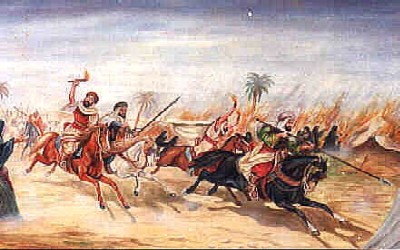
Not satisfied with this, the enemy set fire to the tents. The terrified ladies
of the prophet's family gathered their children and rushed from tent to tent,
trying to escape the burning flames. One young child was seen rushing out of a
tent with her clothes on fire. One of the enemy soldiers, seeing her pitiable
condition came forward and put out the flames. The child looked at him,
surprised at the unexpected kindness. Tearfully, the little child asked him,
"O Shaikh, do me one more kindness and tell me the way to Najaf." The
soldier was very surprised at this unusual request, and replied, "Najaf is
far away from here. Why do you want to know the way there?".
The child said with heartbreaking innocence, "I want to go to the grave of
my grandfather Imam Ali (A) and complain about what your people have done to us
- how our men were butchered and how our ladies have been whipped. I want to
tell him how the earrings were snatched from my cousin Sakina's ears, leaving
her earlobes torn and bleeding."
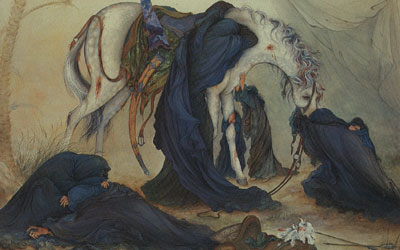
Bibi Zainab (A), who had been left in charge of the camp by Imam Husain (A), was
at a loss as to what to do. She went to the seriously ill Imam Ali Zainul
Abideen (A). He lay unconscious on the ground after the enemy had even robbed
the mattress on which he lay. She shook him urgently to ask his advice. He was
burning with fever but with a great effort he replied that it was compulsory on
them to save their lives and he asked her to get everyone out from the burning
tents into the open.
Soon the raging fires subsided leaving only one tent standing, although it was
also damaged by fire. The ladies and children salvaged whatever they could of
their few belongings and huddled together in that little shelter waiting for
nightfall.
The night following the day of Ashura is known as Shaam e Ghariban. It was the
night when the bereaved family of Prophet Muhammad (S), exhausted by the tragic
events of Ashura and after being looted by the Muslims, sat in loneliness, each
thinking about the loved ones they had lost in the unjust battle on that day.
Due to the illness of Imam Ali Zainul Abideen (A), Bibi Zainab (A) realised that
she would have to take care of the small group of women and children herself.
She called her sister Bibi Umme Kulthum (A) to help her and they decided to
count all the children to see that none had gone missing in the confusion of the
fire. To her horror and dismay Bibi Zaynab (A) found that Bibi Sakina (A), the
beloved daughter of Imam Husain (A), was not there.
The two ladies searched everywhere for the young girl but in vain. Finally, in
desperation, Bibi Zainab (A) went to the place where the body of her brother
Husain (A) lay and cried, "O my brother, Sakina, who you left in my care,
is nowhere to be found. Where shall I look for her in this wilderness?"
Just then, the moon came out from behind a cloud and Bibi Zainab (A) saw that
little Sakina (A) lay on her father, sleeping on his chest like she always used
to. She shook the child awake and said, "My child, how did you find your
father's beheaded body in this darkness?"
The little girl replied innocently, "I wanted to tell my father about what
the people had done to me. I wanted to tell him how Shimr had robbed the
earrings that my father had so lovingly given me. I wanted to tell him how he
had ripped them from my ears leaving my earlobes torn and bleeding. I wanted to
tell him how the beast had mercilessly slapped me when I cried in pain. When I
was running aimlessly in the desert I thought I heard my father's voice telling
me he was here. I followed the voice and I found him lying here. I told him
everything and then I felt like sleeping on his chest the way I always did, for
the last time. So I kept my head on his chest and slept till you came."
Bibi Zainab (A) took the little child's hand and led her back to the camp where
her mother Bibi Rubab waited anxiously. She had just returned the exhausted
child to her mother when she noticed that a group of people were advancing
towards the camp carrying flame torches. She thought that some soldiers had
returned to loot them and she hurried to stop them from disturbing the children
who had finally gone to sleep despite their hunger and thirst.
However, it turned out that the arrivals were a group of ladies, the wives of
some of the enemy soldiers. They were led by the widow of Hur, who had joined
Imam Husain's (A) army from the enemy camp.
Hur's widow said, "Dear lady, we have been asked to bring food and water
for the children and bereaved ladies of your camp." She continued sadly,
"I am the widow of Hur who died fighting for your brother. When the
soldiers of Amr ibne Sa'ad realised that all of you would perish of hunger and
thirst, and that they would not be able to take you back to Yazid according to
his command, they sent me to bring food and water to you."
Bibi Zainab (A) offered her condolences at the death of Hur and apologised that
they had not been able to offer him much hospitality. This remark prompted Hur's
widow to say, "My lady, I do not know how to offer you condolences, because
you lost not one, but 18 members of your family."
Bibi Zainab (A) supervised the feeding of all the children and ladies. She then
took a broken sword in her hands and began going around the camp ensuring that
the small group was safe from any further disturbances during that night.
The Journey to Damascus
On the morning of 11th Muharram, the army commander, Amr ibne Sa'ad called his
officers to decide what steps they should take next. It was decided that the
captives should be led through Kufa to Damascus to the court of Yazid. Amr ibne
Sa'ad marched directly on to Damascus to inform Yazid about the events of
Karbala, and to obtain his promised reward. He left Shimr and Khooli in charge
of the captives.
With these arrangements completed, some soldiers were appointed to bind the
ladies and children. They tied ropes and chains round their hands and feet. The
ladies were put on camels with no saddles. The hands of some of the ladies were
tied behind them and linked to the necks of the young children. Imam Ali Zainul
Abideen (A) was heavily chained and made to walk on foot, despite his weakened
condition. The heartless officers made the captives pass by the place where the
bodies of their loved ones lay, headless and without even shrouds over them.
Many of the ladies and children threw themselves down from the camels to the
bodies of their dead relatives, only to be whipped by the soldiers. Even the
innocent children were not spared the lashes.
Once the captives were made ready, the heads of all the martyrs were mounted on
spears. Every soldier who was given a severed head was made in charge of it and
marched at the front of the army. The head of Imam Husain (A) was given to
Khooli, who was a hard-hearted tyrant.
Finally the caravan got underway for Kufa. The pitiful condition of the little
children was such that they could not hold on to the camels due to their
inexperience and the rapid pace of the march. Many children fell to the ground
as a result. Despite the pleading of the mothers, the heartless soldiers would
not halt the march to remount a fallen child. Today, the road from Karbala to
Kufa has many graves of such children who were left to die in the hot desert.
Within a few hours, the caravan reached the outskirts of Kufa. Shimr decided to
send a messenger to inform the governor, Ubaidullah ibne Ziyad, of their
arrival. The messenger returned, saying that all preparations had been made, and
the captives should be marched through the main streets of the town.
The people of Kufa lined the streets and looked from the balconies of their
houses as the family of prophet Muhammad (S) was paraded in front of them. The
announcer was saying, "O people of Kufa, we are bringing you the
grand-daughters of the Prophet and other women and children of the family of
Husain son of Ali. Husain, who had risen in rebellion against our Caliph Yazid,
has been defeated and killed with his companions on the battlefield of Karbala.
The members of his family are now being taken to the court of Yazid, to face
whatever punishment he wishes to inflict upon them. People of Kufa, this is the
fate that awaits all those who question the authority of Yazid, and no person
who tries to rise against Yazid will be spared."
The people heard all this in astonishment. Not long ago Kufa was the capital of
Imam Ali (A), and they all remembered the kindness shown to them by him and his
sons and daughters. On seeing the pitiful condition of the captives, many were
crying, but none dared to raise their voice against the oppressors, in case a
similar fate befell them.
Finally the caravan reached the court of the governor. When he saw the condition
of the captives, he mockingly said that it seemed that some slave girls had been
brought before him, and not the grand-daughters of the Holy Prophet (S). This
remark made Bibi Zainab (A) lose her temper and she addressed Ubaidullah ibne
Ziyad with a fiery and eloquent speech.
Bibi Zainab (A) related the status of the Holy Prophet (S) and his Holy Ahlul
Bayt (A). She reminded him of the teachings of Islam about the considerations to
be given to prisoners, especially women and children. She warned him about the
temporary nature of his victory and the doom that he and his evil master Yazid
would soon face. She began to tell the assembled people about the inhuman crimes
committed against Imam Husain (A) and his companions.
As she spoke, the people were reminded of the eloquence of her father Imam Ali
(A). Ubaidullah became worried at the effect the speech of Bibi Zainab (A) was
having on the people. He tried to shout her down by threatening the worst
possible torture if she did not stop. Undaunted by his threats, the brave lady
continued and her words moved many to tears. One of the aged companions of the
Holy Prophet (S), Zaid bin Arkan, who was blind, rose up and protested at the
cruel treatment of the members of the family of the Holy Prophet (S).
Ubaidullah realised at once that the situation could get out of hand. The speech
of Bibi Zainab (A) could cause an uprising against him if he did not act
quickly. He ordered his men to get rid of the companion of the Holy Prophet (S)
and told Shimr and Khooli to get the captives out of Kufa immediately.
Arrangements were made for departure straight away, and Shimr chose the quietest
route to Damascus so that he would not face any surprise attacks from anyone
wishing to avenge the martyrs of Karbala. The caravan of the captive families of
Imam Husain (A) and his companions was led by Shimr through the deserts of Iraq
and Syria, from Kufa to Damascus (Sham).
Throughout the journey people noted with wonder that the lips of the cut head of
Imam Husain (A) kept on moving, reciting verses from the Holy Qur'an. Clearly
heard was the following verse:
Do you think that the people of the Cave and of the
Inscription were of Our wonderful miracles?
By reciting this verse, the Holy Imam (A) was calling the attention of the
people to the next verses of this chapter of the Holy Qur'an (18 : 9-14), where
Allah relates how He increased the guidance and strengthened the hearts of the
Companions of the Cave, when they stood up against the evil- doers. Even in
death, our Holy Imam (A) was pointing out the similarity of the message of his
stand in Karbala to the other event from ancient history.
The captives finally reached Damascus. On reaching the city gates, the caravan
was halted and Yazid was informed of their arrival and his permission was sought
to bring the captives into his court.
The Court of Yazid
By the time the captive ladies and children of prophet Muhammad's family reached
Damascus, they were in a terrible state. Their bodies were covered in dust,
their clothes were in rags and blood oozed from the wounds and cuts inflicted by
the tight ropes and whips.
As the caravan was paraded through the streets, majority of the people of
Damascus hurled stones at them. Some were moved by their pitiable condition.
They could not believe that these ladies, who were covering their faces with
their hair, were actually from the family of the Holy Prophet (S). They wondered
how Yazid had dared to humiliate these holy people in such a manner.
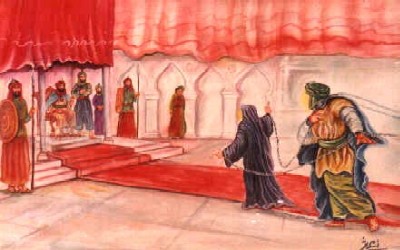
Finally, the prisoners arrived at the court of Yazid. After a wait of one full
hour under the scorching sun, the orders came from Yazid to admit the captives
into the court. As they entered they saw that Yazid sat on an elevated gold
throne while his courtiers and foreign envoys sat on gilded chairs around him.
Yazid was already quite drunk. What a terrible spectacle the poor prisoners had
to witness. They saw that the accursed oppressor had the head of Imam Husain (A)
on a tray at his feet and he was rattling a cane against the teeth and lips of
the Holy Imam (A). He was boasting, "Ah, aren't these the same lips that
received the kisses of Muhammad? How delighted will be my ancestors when they
see how I have taken revenge for their defeats in the battles of Badr and Hunayn."
In his drunk state, Yazid could not believe that the people he saw before him
were members of the family of the Holy Prophet (S). In a quivering rage he
accused Amr ibne Sa'ad of substituting slaves instead of the relatives of Imam
Husain (A).
Amr ibne Sa'ad knew that Yazid was more dangerous than normal when he was drunk
so he quickly reassured him and began to point out the ladies. He said, "O
Commander of the Faithful, your slave has done exactly what you asked. Those are
the sisters of Husain, Zainab and Umme Kulthum. The young girls are Sakina and
Rukayya, the daughters of Husain. That lady is Rubab, the widow of Husain, while
the others are orphans and widows of Husain's friends and relatives. The man
before you is Husain's son Ali."
Yazid turned his attention to the people that Amr ibne Sa'ad had identified. He
noticed that an old lady was standing in front of one of the lady prisoners, as
if shielding her from the gaze of Yazid. He pointed towards the direction of the
lady and shouted, "Who is that one sheltering behind the old woman, and
why?" Amr ibne Sa'ad replied, "Your Majesty, she is Zainab, daughter
of Ali and Fatima and the old woman standing in front of her is Fizza, the
Abyssinian princess, who calls herself the slave of Fatima and Zainab."
Yazid ordered Shimr, who was guarding the prisoners, to throw Fizza aside so he
could have a full view of Bibi Zainab (A). Seeing Shimr advance towards her,
Fizza turned to the Abyssinian slaves who stood armed behind Yazid as his
bodyguards, and said, "O brothers from my native country, will you watch
silently while an aged lady from your land is molested in this manner?"
Hearing the words of Fizza, some of the slaves stepped forward and warned Yazid,
saying, "Your Majesty, ask Shimr to step back from our lady Fizza. If he
does anything to her, blood will flow like water in your court."
Yazid was stunned at this threat and immediately stopped Shimr and assured his
bodyguards that he would not harm Fizza. However, he was furious at the fact
that he had been humiliated in this manner in front of everyone and he soon
wound up the court session, deciding to imprison the captives in the dark
dungeons of the fort of Damascus.
Updated
Saturday, March 12, 2005
emtee creations © 2000 -2005
|