Adventures in the Zine Trade
Adventures in the Zine Trade
For many, making a profit is not a priority, not possible or even not desirable yet the idea of making a living from it is a dream. This strange contradiction underpins what the small press is all about. It's a defiance against careerism (comic artists sometimes being an exception), capitalism (charging the minimum necessary to cover costs) and very obviously a reaction against 'mainstream' culture and 'bland' media.
Zines aren't much different from a 'demo tape' - you do it as well as possible within the constraints (yet often the inevitable 'lo-fi' quality becomes part of its appeal) - you intend to sell them/ use them as a platform to showcase your work but end up giving half of them away to mates and they're a lot more precious to you than those who receive them.
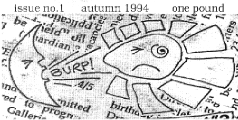
It was at animation college when I first started making zines. Frustrated with the snail's pace of traditional animation (four weeks work for 45 seconds of animation being a satisfying rate) I needed a quick and effective way to express my ideas. During the Summer before, I had been toying with the idea of a (maga)zine called "Burp" that could be photocopied and distributed cheaply. I wanted to publish some of my thoughts, poems and sketchpad work, express my distaste for 'mainstream' culture as well as providing a platform for what I considered important social issues.
First problem - I just wasn't sure how to do it. Where would I get it printed? How do I find out what the cheapest way is? How do I lay it out and compile it? How do I distribute it? etc. I had no idea of where to start or even that similar things had been done before by thousands of people: from the rebirth of the small press (such as Golden Cockerel Press) in the early 1900's, to the poetry chap-books of the '50s/'60s 'beat' poets, to the late '70s explosion in Punk fanzines and more recently indie comics.
A friend of mine provided me with the impetus to start, by way of example. He put together a small booklet (3 double sided, folded A4 photocopies) of his typewritten poetry with found text from newspapers and images from magazines and other sources. He did it over a weekend and put together about twenty copies. He showed it to me as proof of how easy it was and suggested I do one of my own so he could sell it alongside his on a stall that he took to various craft fairs and conventions.
So, armed with a manual typewriter, a gluestick, a snapshot camera and some change for the local 5p photocopier I finished 60% of it in a rough cut 'n' paste style, which when I got to college (and learnt basic DTP on the Macintosh) quickly finished and made a mock-up. I was now ready for the printers, except...
2nd Problem - the printers weren't ready for me! Due to the amount of black/grey I had used it would have to be photocopied instead. This meant that instead of under £40 for a run of 100 A5 zines (6 double sided, folded A4 pages per zine) it would now cost £60 including stapling; if I collated it myself (which was a mammoth effort but worth the saving). As I didn't want to price my zine over £1 this meant I would now struggle to break even. The standard split from Sale Or Return in a shop is usually around 60 to you / 40 to the shop. Selling them by post I could still make 20p profit on each one to pay for flyers. I was originally hoping that I could make enough profit to fund 'review' copies. This was now looking unlikely.
3rd problem - how would I distribute them? My friend was carrying a few copies for me on his stall, I was selling the odd copy at gigs and I had a few places in town willing to stock them - small comic shops, independent bookshops and occasionally a few other places, but it was really slow and interest was thin. Comics are generally easier to sell because everyone knows what they are, but zines are a bit of an unknown quantity - unless they're a fanzine for a band, which are for a very specific but already primed audience.
Then I discovered 'Bypass' magazine. It was just in the process of being taken over by Slab-O-Concrete (a comics label in Hove) and was subtitled 'the zine review zine'. It was great. From 'Bypass' I discovered there was a thriving underground network of zine-makers, sellers and traders out there. I ended up ordering hundreds of zines on various themes and selling a good percentage of mine. It was like Alice in Wonderland, stumbling by chance upon a whole new world I never knew was there but always wanted to be.
I started work on a follow-up zine; raiding friends' private sketchpad work along with my own work. By the time 'Burp 2' came out I was getting quite a lot of mail - offers of contributions, subscriptions, swaps, flyers, reviews, letters etc. This time I sold a lot more and to my surprise, got some good reviews.
4th Problem - I finished college before I could finish 'burp 3' and suddenly had no more computer access but, encouraged by my experience on the Mac, I decided to complete it using the trusty Scotch tape and manual typewriter technique! Mainly due to this, my zines became more lo-fi and experimental in nature, starting with a booklet of poetry (designed by Denude Studios in Manchester - a contact I had made through the zine network) and going through many different papers, sizes, formats and methods of presentation; from a mini-zine in a box with a tape of cut-up sound experiments to an angry A6 zine inspired by Chris Morris' "Blue Jam" radio series.
Due to lack of money, by now I was just photocopying them as orders came in. Suddenly nothing was happening anymore. I felt that the zines I was doing were better than before, yet few people were interested in stocking them. The postal zine network seemed to be really suffering and 'Bypass' (where I got most of my publicity) had simply died.
I had given up placing my zines in shops. One comic shop owner (which I was pleased to see later went bust) refused to give me my money, telling me that although I had a receipt for them that it was too old and he couldn't remember if he'd sold or lost them. He ignored my reasonable plea that they were sale or return and that if he couldn't return my zines then he should give me my cut. Another shop mast-headed my remaining copies. (A procedure for Sale Or Return magazines where they cut and send back the top 25% of the front cover and dispose of the rest!) They did eventually give me my money 'though.
I decided on a return to structure with 'Kino Therapy' - a zine about film-making, cinema and media. This was the most successful zine in terms of contributions but I couldn't afford to print any review copies so very few people knew about it. It ended up making a massive loss because the large number of contributors (who all get a free copy) made it expensive and despite a good response I didn't manage to sell many copies due to the apparent decreasing interest in zines. By this time I was also involved in many other projects and couldn't put the time and energy into producing zines.
Despite the struggle, the small press is well worth getting involved in. The main challenge is to get access to equipment (eg. free photocopiers) and to find a platform to advertise your work. With comics it's a bit easier because a strong audience already exists. With zines it is literally what you make it. You need to create your own hype. If you make the effort, you can get a lot out of it: access to small press stuff that you wouldn't otherwise have found; meet some cool people; practise your craft and if you're really successful, you might break even!
Vincent Pollard
(ithinkx productions)
June 2001
ithinkx@hotmail.com
http://zen.sunderland.ac.uk/~aa0vpo/splash/index.html