

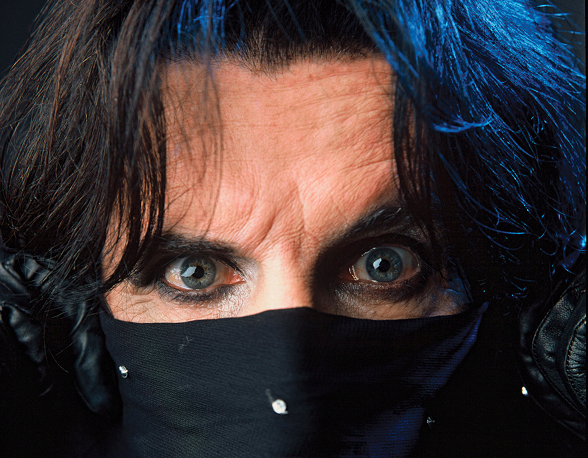
**Born: Vincent Damon Furnier on February 04, 1948 in Detroit, MI**
Furnier formed his first group, the Earwigs,
as an Arizona teenager in the early '60s. Changing the band's name to the Spiders in 1965.
According to band legend, the name came to Furnier during a ouija board session,
where he was told he was the reincarnation of a 17th-century witch of the same name.
First and foremost of these is the story of what happened late one night while the group
was visiting Dick Phillips (aka Dick Christian), their manager at the time.
Phillips, a colorful character in his own right, had been urging the group
to break out of their run-of-the-mill mold.
That evening, just for laughs, his mother pulled out a Ouija board to do a reading.
As soon as it began, however, the letter indicator began wildly skipping across the board,
spelling out the name A-L-I-C-E C-O-O-P-E-R.
From that little incident, the boys concocted a tale that would only serve
to enhance the Alice Cooper legend in the years to come:
that Vince was the reincarnation of a young woman of the very same name--
a woman who had been burned alive at the stake hundreds of years ago for being a witch!
Comprised of vocalist Furnier — who would soon begin calling himself Alice Cooper —
guitarist Mike Bruce, guitarist Glen Buxton, bassist Dennis Dunaway,
and drummer Neal Smith, the group moved to California in 1968.
Alice Cooper released their first album, Pretties for You, in 1969.
Easy Action followed early in 1970, yet it failed to chart.
The group's reputation in Los Angeles was slowly shrinking,
so the band moved to Furnier's hometown of Detroit.
For the next year, the group refined their bizarre stage show.
By this point, Cooper was wearing makeup and living out his darkest fantasies onstage.
Mock hangings, guillotines, movie monsters, and gallons of fake blood were the norm,
inspiring such later shock-rockers as Kiss, White Zombie, and Gwar.
Alice Cooper developed their classic heavy metal crunch on 1971's Love It to Death,
which featured the number 21 hit single "Eighteen";
the album peaked at number 35 and went gold.
Killer, released late in 1971, was another gold album.
Released in the summer of 1972, School's Out was Alice Cooper's breakthrough record,
peaking at number two and selling over a million copies.
Billion Dollar Babies, released the following year,
was the group's biggest hit, reaching number one in both America and Britain.
Muscle of Love appeared late in 1973, yet it failed to capitalize on the success of Billion Dollar Babies.
After Muscle of Love, Furnier and the rest of Alice Cooper parted ways to pursue other projects.
Solo projects include:
Alice's solo albums
"Just because I cut the heads off dolls, they say I must hate babies. But it's not true. I just hate dolls."
--Alice Cooper

"The sicker our fans get, the sicker we'll get."
--Alice Cooper
Of course, when Alice said that, he knew full well that he was sowing the seeds
not only of North America's cultural demise but also of the world's. Laugh if you will,
but once you've finished drying your eyes,
take a good look at what's going on around you and try telling me that Alice Cooper wasn't there first.
Sex and violence? Are you kidding?
Everyone takes a back seat to Alice when he unleashes the dark
and sinister side of his personality, everyone.
When's the last time you saw anyone else chopping up babies with an axe?
Or defiling a deceased dame in front of an open fridge?
Face it: there are few trends in modern music that Alice Cooper didn't anticipate;
fewer still that weren't incorporated by this innovative showman into
one of the most bizarre and entertaining rock attractions of all time.
The audacious, precedent-shattering, inspirational, taboo-defiling
hoodlum flamboyance of Alice Cooper did more than forever
alter the face of rock 'n' roll as we now know it.
He virtually invented rock as theater, created new fashion trends,
sparked a new sexual revolution, established higher standards for teenage decadence,
and found time on top of all this to write and record a library of classic rock 'n' roll albums.
The fact that Alice Cooper is rock 'n' roll's foremost
legendary statesman of outrage is far beyond reproach.
Any act worth its weight in rock 'n' roll, theatrics, makeup, and in-your-face,
kick-ass punk attitude owes more than just a passing nod of respect
in the direction of this malignantly macabre culprit.
Click for more ALICE!!!



