
During the creation of my online portfolio, I used many online resources, various websites, as well as print resources, the classroom textbook, as way of gathering information. The source I found most useful was Dr. Helen Barrett’s “Electronic Portfolio Development” website. She talks about a 5 stages of developing an effective online portfolio. I used this 5-stage process in creating my online portfolio. The 5-stage process is as follows:
Decide/Assess- “In the first stage, in the case of a multimedia presentation, the focus is on a needs assessment of the potential audience, the presentation goals, and the tools that may be most appropriate for the presentation context. When developing an electronic portfolio, the focus is on the audience for the portfolio, the learner goals that the portfolio should be demonstrating. These goals should follow from national, state, or local standards and their associated evaluation rubrics or performance indicators. This stage in the portfolio development process should identify and describe the assessment context.”
During the Decide/Assess stage I focused on the goals of my online portfolio and meeting the needs of my audience. I wanted to make sure I had effective instructional text to communicate information and ideas to meet my audiences needs (pg 139). I asked myself the following questions- Who was my targeted audience? What was the purpose of creating this portfolio? What and who needs do I need to meet? (Designer constructed Nodes, pg 80)
As I pondered on the reason why I was creating an electronic portfolio, I thought to myself, “Why are portfolios an essential tool for teachers?” A portfolio can serve many needs. It can serve as a sort of expanded resume, to help in attaining a job or just simply as a way of presenting ones teaching abilities or credentials. A variety of items can be included in your portfolio like a resume, sample lesson plans, sample student work, ones educational philosophy, and many more items.
Once I organized what should be included in the portfolio, my next subject matter was the audience I was marketing. My targeted audience was educators, parents and educational administrators. I hope to meet their needs by placing items in my portfolio of interests. Using the readings from my classroom text and online resources, I realized I had a lot of preplanning to do. This all lead into the next part Design/Plan.
Design/Plan: “In the second stage of multimedia development, the focus is on organizing or designing the presentation. The focus is on determining audience-appropriate content and presentation sequence, constructing flowcharts, writing storyboards. This is also the time to determine audience-appropriate software, storage and presentation medium. When developing an electronic portfolio, the focus is also on describing the audience(s) for the portfolio, whether they be the student, parent, college, community, or any other stakeholder in the assessment process. Now is the time to determine content of portfolio items (by context) and the type of evidence to be collected; determine which software tools are most appropriate for the portfolio context; and determine which storage and presentation medium is most appropriate for the situation.”
During this stage of design I focused on creating a sort of storyboard of what will go onto my portfolio. I decided on portfolio content, research and collected some materials, organized my materials then began working on the design on my page. I then had to decide what software to use to create my portfolio and what website I was going to use host my online portfolio. I decided to use FrontPage to create my web pages and use Angel fire to host my webpage. After a frustrating period trying to post my FrontPage web pages onto Angel fire, I decided to just learn HTML coding and do everything from scratch. This was when I utilized the Internet and taught myself HTML coding and created my pages directly onto Angel fire.
Develop: “In this third stage of multimedia development, the focus is on gathering multimedia materials to include in the presentation, organizing the materials into a sequence (or with hypermedia links) for the best presentation of the material, using an appropriate multimedia authoring program. When developing an electronic portfolio, the focus is on gathering multimedia materials that represent a learners achievement and including those artifacts in the portfolio. This is where the artifacts can be linked to standards, preferably in a relational database. In electronic portfolio development, students also record their self-reflections on their own work and achievement of the goals/standards. Teachers record feedback on student work and achievement of goals/standards. The final part of this stage is to organize the material using hypertext links between goals/standards, student work samples, rubrics and assessments.”
During the Develop stage, I proceeded to gather all of my materials and make websites for each topic. I broke down my topics into eight different areas (using labeling, word buttons, pg. 91), which include:
Biography- I included my biography to make my online portfolio more personal. My biography was short and simple and detailed a few meaningful things to me.
Resume- My resume serves as my way to highlight my experiences, skills, achievements, education, and accomplishments.
Philosophy- My educational philosophy is a personal expression of my teaching beliefs and what I expect and demand of myself as a teacher and what I hope my students will accomplish.
Educational Websites- I have complied a list of educational web sites as a guide for specialist teachers, which are those teachers teaching special subject classes, to use as a resource. These specialist teachers can find sample lesson plans, clipart, educational readings, or just about anything they desire in their subject area.
Lessons- Here I placed a PDF file of few sample lesson plans used in my classroom to share with fellow educators or for parents to view.
Collaborative project- The collaborative project was a requirement for my Advance Hypermedia class. The collaborative project required both a partner and I to create a lesson plan and project related to a specific topic. Both my partner and I created a collaborative project based on the Salem Witch Trials, which is linked on the web page.
Application Paper- My application paper serves as a tool on how and what resources I used in creating my online portfolio.
Webliography- The purpose of the webliography is to serve sort of as a works cited. It is a collection of hypertext links to different web sites that I utilized for information or clipart in creating my online portfolio.
Implement: “In this fourth stage of multimedia development, the developer gives the presentation. In electronic portfolio development, the portfolio is recorded to appropriate presentation and storage medium. The electronic portfolio is also presented to an appropriate audience, by the student in age-appropriate situations.”
During the implement stage I took the time to put my portfolio together onto my storage medium- Angel fire. I set up my page as an invisible table with two sides, one side with Hyperlinks to all eight of my topics and the other side as my welcome page. As seen in the image below. I hoped to make the homepage (first page) simple, I was striving fo balance, harmony and most of all simplicity (pg. 141).
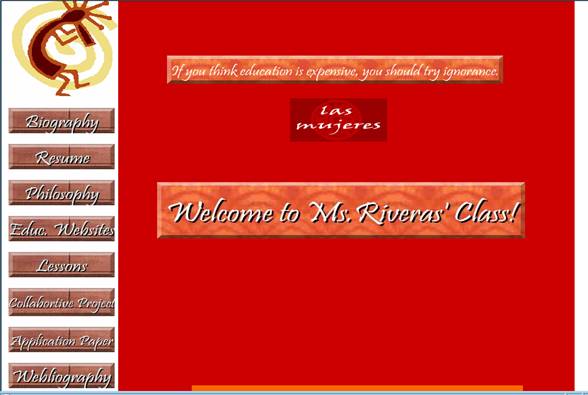
On the left hand side I placed hyperlinks to the eight important topics and when clicked on, the viewer is brought to that specific area of interest. I tried making my page cultural, as to represent both my diverse background as well as my students. I placed a positive affirmation on the right top hand side of my page, and then I proceeded to place a woman’s symbol, followed by my name. It all came together once I was able to get every hyperlink to work correctly and all on my information and background colors were in place. I was concerned with legibility and visibility (pg 138).
Evaluate: “In this final stage of multimedia development, the focus is on evaluating the presentation’s effectiveness. In electronic portfolio development, we not only evaluate the portfolio’s effectiveness in light of its purpose and the assessment context; we also use the portfolio evidence to make instruction/learning decisions. In some cases, we may collect exemplary portfolio artifacts for comparison purposes.”
During this final stage of evaluation, once my final product was completed I took the time to allow fellow collogues to view my online portfolio and give me critical feedback. Also during the process of creating my portfolio I view some of the web sites recommended by my fellow classmates on the web board. I compared and contrasted, as well as used some ideas off of other successful portfolios.
When creating my online portfolio I used a number of resources varying from, websites to our class textbook. Some of the websites I used are:
http://www.electricteacher.com/onlineportfolio/
http://www.ash.udel.edu/ash/teacher/portfolio.html
http://electronicportfolios.com/portfolios/iste2k.html
http://www.ericfacility.net/databases/ERIC_Digests/ed390377.html
http://www.educationworld.com/a_tech/tech/tech111.shtml
http://ali.apple.com/ali_sites/ali/exhibits/1000156/
My online portfolio is now completed. I hope you enjoy it.
