Biology: Photosynthesis
Ok, Photosynthesis. Quite a complicated thing when you go into detail. Just as complex as Cellular Respiration. This part of the site was put up as I was doing my Summative project for SBI4U. Hopefully, slowly, I'll be able to add the other chapters if I have time before exams, to help me study for it. So all the pics you find here so far, are all scanned out of the textbook: Nelson Biology 12. Well, here goes.

|
Plainly put, photosynthesis is the process by which plants collect light energy and transform it into usable energy. In turn, we (non-photosynthetic organisms) use that energy created as our energy supply. Chlorophyll absorbs light energy and begins the process of photosynthesis. The two most common types are clorophyll a (blue-green) and chlorophyll b (yellow-green). Both molecules are composed of a porphyrin ring attached to a long hydro-carbon tail. The porphyrin ring contains a Magnesium atom at it's center surrounded by a hydrocarbon ring with alternating single and double bonds. Delocalized electrons in the alternating single-double bonds in the ring absorb light energy and begin the photosynthetic process. The only difference between chlorophyll a and b is that a contains a methyl group (-CH3) at R and b contains an aldehyde group (-COH) at R. This difference affects the type of light energy that the molecules can absorb. The hydrocarbon tail (a.k.a. Phytol tail or phytol chain) anchors the chlorophyll molecule in a membrane by associating with the hydrophobic regions of the phospholipid bilayer. All photosynthetic organisms primarily use chlorophyll a. The picture on the left is the chemical composition of a chlorophyll molecule. You can click on it, or here to get a larger version and explanation of it's composition. |

Cuticle:A coat uniformly spread over the surface of a leaf. It is water-resistant and protects the leaf from excessive absorption of light and evaporation.
Epidermis Layer:the transparent, colorless layer of cells below the curicle of a leaf, root or stem.
Mesophyll Layers:he photosynthetic cells (containing most of the chloroplasts) that form the bulk of a plant leaf.
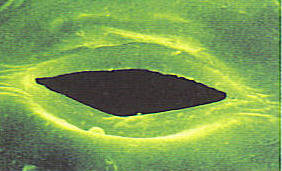
Guard Cells:cells that form the microscopic openings in the epidermis called stomata (stoma). They regulate the size of stomata and open or close them to control the exchange of gases threw the leaf. |
Stomata (stoma):Opening (controled by guard cells) on the surface of a leaf that allow for the exchange of gases between air spaces in the leaf interior and the atmosphere. Also allows water vapour to escape by transpiration.
Transpiration:The loss of water vapour from plant tissues, primarily through stomata.
Vascular bundles:Also called veins, a system of tubes and cells that trnasport water and minerals from the roots to the leaf cells and carry cabohydrates from the leaves to other parts of a plant, including the roots.
|
Transpiration aids the photosynthetic process in two ways. First, it creates a transpiration pull (transport chain) that helps move water, minerals and other substances from roots, where they are absorbed, to leaves, where they are used. Secondly, it produces an evaporative cooling effect that prevents leaves from heating to temperatures that could inhibit or even denature the enzymes that catalyze the reaction of photosynthesis.
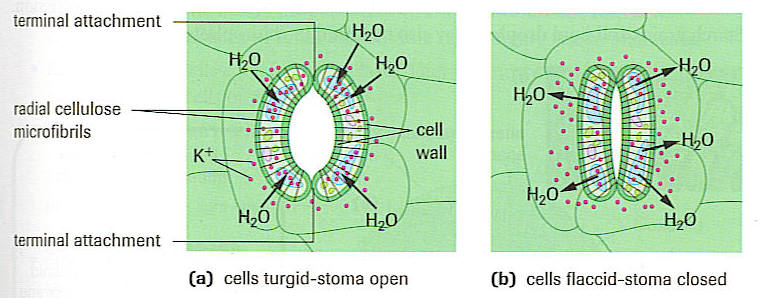
Transpiration occurs threw the stomata which are controled by the guard cells. Guard cells control the size of a stoma by changing their shape in response to changes in environmental conditions. The stoma is open when the guard cells are turged (swollen) and closed when guard cells are flaccid (limp). The guard cells change their size when water moves by osmosis into or out of the cell. The direction of osmosis follows the diffusion of potassium ions, K+, across the guard cell's plasma membrane. The movement of K+ is coupled with the transport of H+ ions through membrane associated proton pumps. This means that the size of the stomata are dependent on the availability of ATP, a product of photosynthesis.

| Back to Biology | Back to Sciences | Back to Main Page |