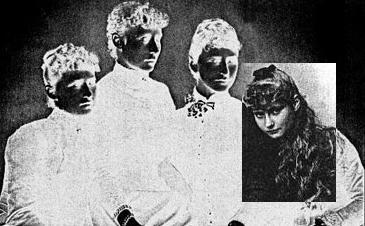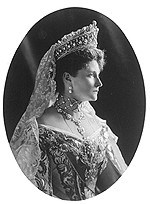
Alix was born in Germany on the 6th of June, 1872. Her early life was spent in Darmstadt and at the New Palace, but she also traveled to other countries such as Great Britain to visit her Grandmother, Queen Victoria. It was her Grandmother that gave Alix a formal education in literature, geography, music, history, arithmetic, religion, and languages. Then sadly, in 1873, her brother Friedrich died at the age of three due to hemophilia. Then five years later, her mother, Alice and her sister, Marie, died from diphtheria.
In 1884, Alix met and fell in love with Tsarevich Nicholas Romanov at her sister's wedding to Nicholas' uncle in St. Petersburg, Russia. Then five years later in 1889, they met again, this time at the Belossievsky Palace in St. Petersburg. From that point forward, Alix and Nicholas would stay in contact by sending letters to eachother. They became engaged on April 20, 1894, in Coburg, Germany. They married on November 26, 1894, at the Winter Palace in Sankt-Peterburg. It was from marrying Nicholas that Alix became Alexandra Feodorovna Romanov.
On the 1st of November, 1894, Nicholas’ father, Alexander III, died. This meant that it was now time for Alexandra to become Empress of all Russia and she made many great changes. She worked continuously to improve the poorer classes' conditions, created some professional girls schools, helped build workhouses for the poor, created a school for nurses and housemaids, founded other schools and hospitals, and headed the Red Cross and all other charitable organizations.
Alexandra was put under a lot of pressure because she had produced four daughters, but no son (Paul I detested his mother (Catherine the Great) so much that he eliminated females from the line of succession to the throne back in the late 1700's, early 1800's). In July 1904, Alexandra finally provided Russia with an heir to their throne, but sadly the boy inherited haemophelia through Alexandra from his maternal Great-Grandmother, Queen Victoria. Criticised by the Russian Court for so long in not providing a male heir, she was now to "blame" for making him an "invalid". Therefore the illness was kept a state secret. Many doctors were summoned to find a cure, but as today, nearly 100 years later, there is none.
Alexandra was a passionate woman as evidenced by her published diary. She used flowery descriptions of emotions, people, and even the weather. This passion turned to obsession when it came to Alexei. When doctors could not help, she turned to a mystical starets named Rasputin, who had a reputation for being a healer. Rasputin, with his hypnotic eyes, would pray at the foot of the boy's bed. Miraculously, Alexei appeared healed, much to the disbelief of doctors. Thus, Alexandra felt that Rasputin was key to the health of her beloved son and subsequently to the future of the Romanov dynasty and Russia herself. Because Alexei's condition was a state secret, the people of Russia did not understand why a filthy, over-sexed, verbally abusive alcoholic (who would defame the name of the Empress herself in public) was permitted to be so close to the Tsar and Tsarista. This increased the hatred of the misunderstood woman, who was accused of betraying Russia and the Tsar.