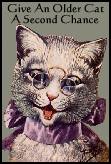
Problems and Solutions for Older Cats
by Mewsette
This book is about some of the problems of older or elderly cats, with some solutions for those problems.
We cats are living to very advanced ages these days due to the good care we are getting! So I don't think of cats as being "old" at the age of 9 or 10 as some do. I am 15 myself, and I'm not elderly, not in my view! My mothercat is elderly, though. at the age of 19.
Though we may have different opinions of when a cat is elderly, I think we would all agree that old age in cats can present problems.
I am not a vet, goodness knows, I am only a kitty. If you have problems in your old age that cause you to be ill, you should go to a vet and let him help you. My book is just about general problems, and any discussion of illness is only from my own experience or point of view.

Chapter One: Common Problems
1. Grooming
Sad to say, sometimes elderly cats just don't have the energy to groom themselves very well any more. Their joints may be painful from arthritis, and they can't stretch as easily to do a good job. If other cats in the house are closely bonded with the elderly one, they will help her out with grooming. But if she has no one to help, she may look a little scruffy, and she doesn't like to.
Solution (for your human):
Brush your elderly cat more often, but carefully, because her skin becomes more fragile with age. This will help distribute her natural oils through her fur. Our skin gets dryer as we age, and we can get a little flaky. A good way to remove flaky "dandruff" is to use a close-toothed flea comb, combing slowly and gently through small patches of fur at a time. Wipe the flakes off on a tissue as you go. That's a waste product, and it isn't good for her to consume it. She will appreciate the brushing a lot, and probably let you do it much longer than she did when she was young. We do become more patient as we age. But if she leaves a dingy spot on the furniture or sheds too much old fur, just put a towel over her place for her to lie on. She won't mind.
2. Forgetfulness and sleepiness:
Very old cats can become forgetful the same as very old humans. In fact, they can sit right in the middle of a room and forget where they are, and yowl. Older cats tend to sleep a lot more, too. This is not a problem unless she sleeps right through dinner time and the other kitties already ate.
Solution (for your human):
Sometimes you can just call to the kitty so she knows where you are, but sometimes you may need to go to her and comfort her so she doesn't feel lost.
You may have to feed her at some odd times, when she does wake up and feel like eating. Her inner clock isn't working as well, so you might want to just forget about clocks too.
3. Being Cold
An elderly cat needs more warmth than she used to, especially in winter. She loses body heat more rapidly. Humans don't like to keep their houses overly warm, for many good reasons, so the cat will seek warmer places to lie. She may get under a lamp or into a sunny window, if she can still jump up to it. If a fireplace or woodburning stove is in the house, she will adopt it. But most likely she is going to plaster herself right over the central heat vent and completely block the flow of heat into the room.
Solution (for your human):
Well, she needs the heat worse than the room does. It would be good to provide an extra-warm bed for her with a whole blanket in it, in a warm place, all year long. Yes, even in summer, because she doesn't want to be air-conditioned at her age. But if she spends the winter blocking the heat vent, please don't fuss at her. She'd rather be in your lap or on your foot, but she's cold.
4. Muscle Weakness
Many older cats simply lose a little of our natural grace as we age, and we get embarrassed if we stumble on a step or run into a wall. But sometimes the cat cannot jump up to places she likes to be any more, due to weakness or arthritis, which makes her joints painful and stiff. And sometimes she will try anyway, because we cats believe in doing as we please, but then holler in pain after she jumps.
Solution (for your human):
There is not much that can be done for arthritis in cats, but the vet may be able to help with some medication that isn't toxic to the cat, as so many are. There are good holistic remedies available too, which I am not qualified to discuss. A human named Anitra Frazier wrote a very good book about that called "The New Natural Cat". But you can help your cat get to the places she wants to be. Put a low stool or sturdy box or step of wood next to her favorite chair, or the window seat, or your bed, to help her get up there. She may not use it. Some of us are stubborn and would rather jump and holler or sit and look pitiful. But you won't know unless you give her some steps. If she does use them, she will like them so much! It took my mothercat a solid year to stop being stubborn and use her steps. So be patient.
5. Failing Vision
Cats have wonderful eyesight as a rule, but often it begins to fail when we get older. We may develop a visible film over our eyes, and our pupils may look more black and dilated all the time, to let in more light. But our sensitive whiskers do such a good job of helping us "see", and all of our senses are normally so acute, that sometimes our human doesn't even realize we can't actually see very well any more!
Solution (for your human):
If your older kitty is hesitant to go all over the house like she used to and seems to stick to one or two rooms, this could be her problem. It may not cause her as much distress as knowing it may cause you, but it's best to be aware. Since she may be moving slower as well as seeing less, you will be more careful not to step on her or fall over her. Try to play with her each day with any sort of toy on a wand, so you can judge by her actions how well she can see. It is best not to move anything of hers, food and water dishes, litter box, bed, etc., from where she is used to finding it now.

Chapter Two: Difficult Problems
There are two more difficult problems I'd like to discuss. You know, the more serious a problem is, the more different solutions it may have. It just might be harder to find the right one.
1. Changes in appetite
Many cats, even if they grew quite full-figured in their middle years as my mothercat did, begin to lose weight and eat a lot less when they are very old. Sometimes her appetite is just not what it used to be. But it is a mistake to assume a cat doesn't eat as much and loses weight just because she is getting old.
An elderly cat who is losing weight, or not eating normally, needs to go to the Vet to find out why. She should have blood tests to check for kidney disease and other illnesses. If the weight loss is accompanied by the cat drinking lots and lots of water, it is most urgent to get her to the Vet, because she may already be in kidney failure. This is the most common cause of death in elderly cats. If you catch it in time, it is not untreatable. Incurable, yes.
Dear human, once your kitty is diagnosed with kidney disease, your life and hers are going to be different from then on. But with an appropriate diet, carefully watching her for signs of dehydration, and good loving care, she may continue happily on for a long time. Many cats do!
This is not a time to talk about "putting her down" just because she is ill. If your old human grandmother got kidney disease, nobody would say "put her down." They would get her medicine, and a special diet, and take care of her. It might seem more hopeless in cats, but who is to say? No, this is a time when the solution is to love your kitty.
2. Changes in litter box habits
We all know this one thing is the worst common problem to humans, and one of the worst serious ones as well, because it causes more cats with homes to be discarded by humans than any other one thing.
No cat stops using the litterbox out of spite or contrariness. We don't do that. There is always a reason or an explanation, though it is often hard to figure out. The first thing to suspect if any cat, young or old, soils outside the litterbox, is illness. The kitty needs to go to the Vet and have a blood test to check for kidney disease, and a urine test to check for a urinary tract infection. This applies to any cat of any age.
But if an elderly cat stops using the litter box, and illness has either been ruled out or identified, remember that elderly cats have other problems that can cause this too. Sometimes she has a weak bladder. It is a muscle too, and lots of her muscles may be weaker. Sometimes she has arthritis, making it painful for her to get in the box. Or sometimes she may forget, or not find her way to the box in time. If she can stop in the middle of a room and forget where she is, she can forget where her box is, too. And, sad to say, if it is due to kidney disease or some other serious illness, this is part of what you will have to deal with during the illness.
Cleaning the soiled area with a good enzyme cleaner and covering it with tinfoil may keep her from returning there and may not. Covering it with an old sheet or tablecloth that can be bleached is better, but may or may not prevent her from doing it again. If you can close off the target room, that is good. If no one is home during the day, you might close the cat in one room, with her food and water, litter box, and warm bed. Elderly cats usually don't mind being in a smaller place.
I believe the best solution is to put another litter box exactly where she is soiling. I don't care if it's in the middle of the guest room or corner of the dining room or what. Put one there, please. It will not offend humans as much as having the carpet smell, and what if it does, anyway? You can block it from view with a piece of furniture or by turning a light folding table on its side, if there is room. And I know I needn't remind you to be sure it is kept cleaned. Sometimes older cats are less willing to make do with a box that really needs cleaning if they are not feeling good anyway.
Any of these solutions might work and might not. But it is no solution to talk about "putting the cat down" for this or any other unacceptable behavior. That is a reaction, not a solution. If your 90 year old human grandpa had Alzheimers and soiled his bedding, nobody would say "put him down". His loved ones would take care of him. Isn't that right? This is another time when the solution is to love your kitty.
This little book cannot begin to address all the problems, large and small, that older cats may have. And, of course, some older cats may have none of them! I only tried to cover common problems, and show that there are solutions for them. But you may notice that if solutions fail, as they sometimes do, I only give one answer, love the kitty. That is not because I can't think of another answer. That is because it's the one that matters most.
Love the kitty.
Graphics by

|