

The vampire legend has been around since at least Roman times, with the specifics changing somewhat with each culture. Because of this, various vampire lore and legends can be contradictory. Ancient Roman "striges" could change into owls and drink the blood of babies. In medieval Eastern European countries, folklore of vampires as well as vampire slayers was common. The vampire legend was strengthened in 14th century Europe with the brutal deeds of Vlad Tepes Dracula. Bram Soker's 1897 novel Dracula reinforced some vampire lore by putting it into mass print.
Vampire Lore & Legend:
Becoming a vampire:
Vampires are dead beings that come back to life.
In some legends the vampire becomes a vampire only after death.
In other legends the vampire is born a vampire.
To be born a vampire the child may be the child or grandchild of a vampire.
A child may be born a vampire if it has a caul or alternately a dark caul.
People usually become vampires by being bitten, but not killed, by a vampire.
Some legends have corpses becoming vampires when a cat or dog jumps over it.
Other legends say that a Witch becomes a vampire when s/he dies.
blood:
Vampires usually need or crave blood, frequently human.
Vampires usually obtain blood by biting a victim's neck and drinking the blood.
In some legends they suck the blood through long, hollow front incisors.
In other legends the incisors are not hollow, but long and sharp to pierce the victim.
Fending off and destroying a vampire:
Legend usually states that a wooden stake through a vampire's heart will kill it.
In some versions the vampire needs to be dormant for this to work.
The stake may need to be a certain type of wood, such as hawthorn.
Vampires usually can not tolerate sunlight or fire.
Some legends have vampires warded off by crucifixes, holy water, or garlic.
Vampires may not be able to cross moving water.
Some legends say that a vampire can not enter a building or a room without first being asked.
Some legends say that vampires dislike the sound of bells ringing, especially church bells.
Vampire dormancy:
Vampires usually sleep during the day and come out only at night.
Vampires may also come out right at 12 noon for a brief period.
Vampires usually spend the day in a coffin or buried in the ground.
Etceteras:
Some legends state that vampires can turn themselves into bats or wolves.
Some legends state that mirrors will not reflect vampires.
Vampires are usually said to be very charming.
Vampires may be compulsive liars.
Some legends state that a vampire's fingernails have a glass-like appearance.
Three medical conditions may have led to people being inaccurately identified as vampires: (1). Anemia causes a pale skin complexion. This may have looked like vampirism. (2). Catalepsy can cause a death-like state for a short time to several days. A person coming out of this state will appear to be rising from the dead. (3). Porphyia is a rare genetic blood disease. It causes pale skin, sensitivity to light, and makes the incisors look bigger. Porphyia almost certainly influenced the vampire legend.
There is great interest by some people in living as a vampire. The role-playing game "Vampire: the Masquerade (TM)" by White Wolf (see links) has local chapters all over the world. The "game" is fairly complex, with many books available from White Wolf to guide play. Other people are very intent on a vampiric appearance. They may even get permanent extensions on their incisors or have their skin bleached.
Vampires are a big selling subject in books, movies, and television shows. Bram Stoker's 1897 novel "Dracula" increased the popularity of the vampire legend. The author Anne Rice has written extremely popular novels about vampires. Vampires are the subject of the T.V. series "Buffy the Vampire Slayer".
Comparing vampires in literature, film, and television shows the great diversity in vampire lore.
In Anne Rice's classic novel "Interview With the Vampire" the character Louis suffers because he is a vampire who retains his human soul. The vampire Angel on "Buffy the Vampire Slayer" suffers similarly.
In Bram Stoker's Dracula, in Anne Rice's books and on Buffy, vampires are destroyed by sunlight and fire.
The older a vampire is the stronger they become in Dracula, Anne Rice's books, and on Buffy.
Dracula and Buffy vampires will turn to ash when decapitated or stabbed with a stake to the heart. Anne Rice's vampires are not destroyed, however, by a stake to the heart. Anne Rice vampires are only temporarily destroyed by decapitation or dismemberment. Rejoining of the pieces will result in the reanimation of an Anne Rice vampire.
Anne Rice vampires are not harmed by holy water or crucifixes. Buffy vampires can be killed with enough holy water, and touching a crucifix will burn a vampire. Dracula vampires do not like crucifixes. This may be because, in Dracula and on Buffy, vampires are "evil" and in Anne Rice's books they are not.
There are no natural born vampire slayers in Dracula or the Anne Rice books. Buffy is a natural born vampire slayer.
It is believed by some that Lilith was the first vampire, though others consider her a demoness or succubus. It is said that Lilith searched for men who were sleeping alone and then seduced them and sucked their blood. She was also considered a great danger to children as well, especially boys under the age of eight or girls less than twenty days old. According to one of the creation theories, Lilith was believed to be Adam's first wife. Alas, the couple did not get along... Lilith considered herself Adam's equal and objected to lying under Adam while making love. When Adam insisted, she left him and was next found by the Red Sea carrying on with a horde of lewd demons. Lilith refused to return to Adam, but she did promise that if she saw the angel messengers' names written anywhere near a newborn, she would spare the baby's life.
Lilith had an equally ancient counterpart known as Lamia, a cave dwelling vampire who made her first appearance in Greek mythology. Lamia was the Queen of Lybia and a beautiful woman by whom Zeus had fathered children. When Hera, the wife of Zeus, found out, she forced the queen to devour her own children. Though she dare not refuse the empress of the gods, from that moment forward she haunted the nights, robbing other mothers of their children. She would rake them with her claw like nails before draining their bodies of blood. Once a beautiful queen, Lamia had become a hideous beast with the ability to change shape at will. Over time, her name came to refer to witches and female demons who stole children and seduced men and drained them of their blood after their passion had been spent.
Though legends of vampires can be found world wide, much of the lore of the vampire, as we now know it, is of eastern European descent. Bram Stoker, who wrote Dracula, borrowed parts of his story and background from the tales of Vlad Tepes of Transylvania, the original Count Drakul. Vlad the Impaler, as he became known, came to power by way of the brutal assassination of his father and brother. He ensured the obedience of his subjects through sheer terror. Anyone that dared to provoke the Count's wrath was impaled on a long sharp pole. It is believed that over 100,000 people were impaled during Vlad's reign. Another example is Countess Bathory, who is infamous for her bloodthirsty and sadistic deeds. The Countess is reputed to have tortured and murdered close to 700 young girls and women in the belief that their blood would keep her young. From these gruesome accounts, the vampire legend, as we know it, began and grew.
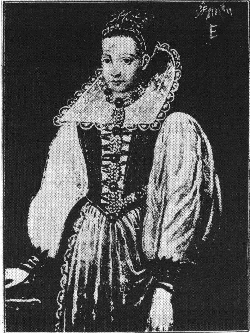
There are many legends about vampires. However, there are official documents proving the existence of an authentic seventeenth-century countess, Elizabeth Bathory, who was the most bloodthirsty vampiress of all time!!!
Elizabeth Bathory was born in 1560 into one of the oldest and wealthiest families in Transylvania. She had many powerful relatives - a cardinal, princes, and a cousin who was prime minister of Hungary. The most famous Bathory was King Steven of Poland. 1575-86.
Elizabeth was married to Count Ferencz Nasdasdy when she was 15, he was 26. The count added her surname to his, so the countess kept her name. They lived at Castle Csejthe in the Nyitra country of Hungary. The count spent a great deal of time away from home fighting. His nickname was "The Black Hero of Hungary". While he was away, Elizabeth's manservant Thorko introduced her to the occult.
Elizabeth eloped with a dark stranger briefly, but came home. Luckily the count forgave her. Back at the castle, Elizabeth couldn't stand her domineering mother-in-law. She began torturing the servant girls with the help of her old nurse Iloona Joo. Her other accomplices included the major-domo Johannes Ujvary, Thorko, a forest witch named Darvula and a witch Dorottya Szentes.
In 1600 Ferencz died and Elizabeth's period of real atrocities began. First, she sent her hated mother-in-law away. Elizabeth was very vain and afraid of getting old and losing her beauty. One day a servant girl accidentially pulled her hair while combing it -- Elizabeth slapped the girl's hand so hard she drew blood, which fell onto her own hand. She immediately though her skin took on the freshness of that of her young maid. She was sure she found the secret of eternal youthful skin!!! She had her major-domo and Thorko strip the maid, cut her and drain her blood into a huge vat. Elizabeth bathed in it to beautify her entire body.
Over the next 10 years Elizabeth's evil henchmen provided her with new girls for the blood-draining ritual and her blood baths. But one of her intended victims escaped and told the authorities about what was happening at Castle Csejthe. King Mathias of Hungary ordered Elizabeth's own cousin, Count Cuyorgy Thurzo, governor of the province to raid the castle. On December 30, 1610 they raided Castle Csejthe. They were horrified by the terrible sights in the castle - one dead girl in the main room, drained of blood and another alive whose body had been pierced with holes; in the dungeon they discoverd several living girls, some of whose bodies had been pierced. Below the castle, they exhumed the bodies of some 50 girls.
Elizabeth was put under house arrest. A trial was held in 1611 at Bitcse. She refused to plead guilty or innocent and never appeared at the trial. A complete transcript of the trial was made at the time and it survices today in Hungary! Johannes Ujvary, major-domo, testified that about 37 unmarried girls has been killed, six of whom he had personally recruited to work at the castle. The victims were tied up and cut with scissors. Sometimes the two witches tortured these girls, or the Countess herself. Elizabeth's old nurse testified that about 40 girls had been tortured and killed.
All the people involved in the killings, except the Countess Bathory and the two witches were beheaded and cremated. The tow accomplices had their fingers torn out and were burned alive. The court never convicted Countess Elizabeth of any crime. Stonemasons were brought to Castle Csejthe to wall up the windows and doors of the bedchamber with the Countess inside. They left a small hole through which food could be passed. King Mathias II demanded the death penalty for Elizabeth but because of her cousin, the prime minister, he agreed to an indefinitely delayed sentence, which really meant solitary confinement for life.
In 1614, four years after she was walled in, one of the guards wanted a look at this famous beauty. He saw her lying face down on the floor. Elizabeth Bathory, the "Blood Countess" was dead.
There are some connections between the Bathorys and the Draculas. The commander of the expedition that helped Dracula regain his throne in 1476 was Prince Steven Bathory. A Dracula fief, Castle Fagaras, became a Bathory possession during the time of Elizabeth. Both families had a dragon design on their family crests.
One thing I found out was that the Countess, as a small child (4 or 5) used to have quite violent seizures where she would pass out. I do not think this was epilepsy, but most likely some other neurological disorder that may help to explain her horrific behvior as a young woman.
The second thing is that when her husband, the Count, was alive, he loaned a large sum of money to the government. After his death, and once the discovery of Elizabeth's grisley activities was made, the government decided that another reason to wall her up in her castle was to avoid having to pay back the debt they owned to her estate.
 Bathory Crest
In 12th century France there has been another Blood Countess, one that you may not have heard about. She was a French countess who lived in an old castle called the Chateau de Deux-Forts, situated north of Menat, close to Chateau-Gaillard, a small village in the Auvergne. The story goes as follows:
One night, when the Comtesse was preparing herself to go to bed, she discovered a strange brownish spot on her belly. She told her servants to scrub it off, first with cold water, then with hot water. But no matter how much they tried, the spot could not be removed. The next morning, much to the Comtesse's annoyance, the ugly spot was still there. It even looked as if it had grown a little larger.
A medical man was summoned to come to the castle. He examined the Comtesse and had a good long look at the spot. He shook his head, cleared his throat, and solemnly declared that the lady was suffering from leprosy. On hearing this unwelcome news, the Comtesse grabbed the doctor's arm and hissed in his ear that she would order her servants to skin him alive if he would fail to find a cure for her disease.
Perhaps it was this threat that inspired the desperate physician to suggest the following remedy. There was only one thing, the doctor said, that could cure the Comtesse from her terrible infliction. She needed to bathe herself in fresh human blood. That, he said, was the only way she could hope to get rid of her leprosy. She had to bathe herself in blood. And so she did.
From that day on, children started to disappear throughout the region. And soon it was whispered in the villages of the Valley of the Sioule that the Comtesse of Deux-Forts was an evil ogre who ate little children. Guillaume VIII, the Count of Auvergne, decided to report the disturbing rumours to the king, and so did the clerical authority of Clermont. An investigation revealed the bloody crimes of the Comtesse. It was soon to be followed by her trial.
The doctor and all the servants were duly hanged. The Comtesse was sentenced to be "quartered" with the help of four horses. Afterwards a stone cross was erected to mark the place of execution. The place where it all happened can still be seen today and it is called: la Croix de Male Mort.
A one-story home in Croglin Grange was rented to a two brothers and their sister. One summer night, when the heat from the day still clung to the air, the sister was looking out her window at the stars. It was too hot to sleep. Suddenly, she noticed two lights that flickered in and out of the group of trees that lay beyond her window.
She watched the lights as they emerged from the trees. She had a sense of something dark and foreboding. Frightened, she ran to the door.
As she unlocked the door, she heard scratching at the window, and then pecking, as though someone were trying to get inside. With a start she realized that fingers were unpicking the lead from the window. The window glass crashed crashed into the room and the creature climbed in.
Long bony fingers twisted in her hair as she felt teeth pierce her neck. She screamed aloud. Her scream woke her brothers and they scrambled to break down the locked door to her bedroom to come to her aid. By the time the brothers got through the door, the sister was already unconscious on the bed, and the creature had fled. Although one brother gave chase, the creature eluded him.
The family moved away to help the sister to heal; seven years later they returned to face their demons. That March, the sister heard scratching again at the bedroom window. She screamed as loudly as she could.
One brother managed to wound the creature in the foreleg with a pistol but the creature still escaped into an old family crypt that had been in Croglin Grange for centuries.
The next day one of the brothers summoned everyone in Croglin Grange to the crypt and opened the vault. Inside, all coffins but one had been broken. One was intact with only the lid skewed to one side. Within, the townspeople found a withered, mummified corpse with a fresh bullet wound in the foreleg.
Disturbed, the villagers removed the corpse and burnt it atop a pyre; and the vampire of Croglin Grange was no more.
Although his actual birth date is unknown, historians estimate that Vlad Tepes (the Impaler) was born in 1430 in Schaassburg, a town in Transylvania. His father, Vlad Dracul, was the Prince of Wallachia.
Vlad was imprisoned (along with his family) by the Turks in 1438. This was meant to guarantee his father's loyalty to the sultan. It was during this imprisonment that he developed the "cynicism so evident in his approach to life and infused in him a Machiavellian attitude toward political matters."
After his father's death in 1447, Vlad was unable to take the throne that was rightfully his thanks to the political machinations of the governor of Hungary and other ruling families in Wallachia. Eventually, though, he would retake the throne and rule Wallachia for several years.
During this time he fought against the Turks as well as built Castle Dracula with slave labour. However, it was his brutal methods of seeking revenge against his enemies that earned him the title of the Impaler. Battlefields would become littered with bodies of dead and dying turks, impaled on a long stake that was driven into the ground.
Other brutal acts only served to heighten his reputation as a savage dictator. People were burned, impaled, and tortured - often without good reason, according to some. "He had a good meal prepared for all the beggars in his land. After the meal he had them locked up in the sheds in which they had eaten, and burned them all. He felt they were eating the people's food for nothing and could not repay it."
After death, Vlad has continued to fascinate. Although there is some uncertainty about its historical accuracy, Vlad is believed to have been buried at the Snagov monastery. Not all historians believe this, however. "His headless body was buried at Snagiv, near Bucharest, but tales persisted that the grave was empty, Vlad having risen."
Vlad's reputation grew even larger when historians and scholars began to speculate that Bram Stoker used the historical figure of the Impaler as the basis for the main character in his novel, Dracula. This topic has stirred a great deal of debate between scholars. It is a commonly held belief that Stoker's character shares at least some traits (particularly geography) with the famous villain, Dracula. In the film, Bram Stoker's Dracula (1992), director Francis Ford Coppola went to great lengths to portray the early Dracula as Vlad the Impaler himself.
Whether Stoker actually used Vlad as a template for his character or not may always be in debate. But as the historical character becomes embroiled in the debate, his story passes forever into the annals of vampire lore.
The story of Arnold Paole is one of the few vampire histories that has been sufficiently documented over the years to lend it historical validity. In the spring of 1727, Arnod Paole returned from service in the military to settle in his home town of Meduegna, near Belgrade. He bought some land, built a home and established himself in the community. After a short time, he was betrothed to a local girl whose father's land bordered his, and the two were wed.
Paole told his wife that he was haunted by fears of an early death. In the military, he had been stationed in Greece. Local beliefs were that the dead come back to haunt the living in the form of revenants or vampires. While he was stationed there, he told his wife he had been visited by an undead being. Afterwards, he hunted down the unholy grave from which the undead being had come, as was the local custom. He extracted his revenge upon the vampire by burning the corpse. However, the incident affected him so greatly that against the advice of his superior officers, he resigned from the military and came back to Meduegna.
Shortly after his marriage, Paole fell from a great height while working on the farm, and was brought, unconscious, back to his home. He must have sustained internal injuries with the fall, for within a few days, Paole died and was buried in the town cemetery. A month after he died, there were several reports from people around the township who had seen Paole. A few had even seen him in their own home, although these reports do not clearly state what he did while in these homes. For the most part, however, there was little panic stemming from these reports until a short time later. Several weeks after the initial reports, most of the people who had claimed Paole had visited their home turned up dead for inexplicable reasons, and a group was assembled to exhume the body of Arnod Paole.
The group consisted of two military officers, two army surgeons, and a priest from the local church. When the group exhumed the body, they found a fresh corpse. There was no decomposition of the body whatsoever, and in fact the old skin and nails had fallen off, and new ones had grown to take their place! The final insult was the fresh blood that rested on the lips of the deceased Paole. When one member of the group staked the body, it cried out and fresh blood spilled from the wound. The group then scattered garlic around the remains, and did the same to each of the graves whereto Paole had sent his newest victims.
All was quiet in Meduegna for several years until 1732, when there was another spate of inexplicable deaths. This time, the town took no chances and immediately sent out a group to the graveyard to investigate. The resultant report has ended up in many history books over time. It was signed by three renowned army surgeons and cosigned by a lieutenant-colonel and a sub-lieutenant. Of all the body they disinterred during the investigation, they once again found no less than 11 corpses which displayed the same marked traits as the Paole corpse. No decomposition, (although many had been interred several months previous to their inquiry), fresh skin grown, fresh blood in the arteries and in the heart. The complete medical report is available in many modern vampire histories. No explanation has been given for the later outbreak of vampirism, although one theory holds that Paole had feasted on local cattle as well as people during his vampiric reign. Then, the theory states, as time passed and the cows were killed for their meat, the vampire qualities were passed on to anyone who ate the meat.
In the halls of vampiric crime, few names stand out like that of John George Haigh. Half a century ago, England's newspapers screamed, "Vampire!" The trial of "The Acid Bath Vampire", one of England's most infamous serial killers, was about to begin.
Haigh grew up in Wakefield, England. His parents were deeply religious members of a faith called the "Plymouth Brethren". In order to rebel against the strict teachings of his parents and their faith, Haigh joined the Church of England while he was still a boy. He was a devout follower and spent a great deal of time there as a youngster.
Throughout his life, Haigh suffered from a recurring dream. He spoke of a forest of crucifixes in the dream that would gradually turn into trees that dripped blood. He would see a man collecting the blood into a cup. The man would offer the cup to Haigh, but he always awakened before he could take a drink.
It was the dream, Haigh would confess to the police after his arrest, that made him believe he needed blood in order to live.
Early adulthood was a problematic time at best for Haigh. He was imprisoned several times for fraud and forgery. But his true criminal nature began to manifest in middle adulthood, just after World War II had ended.
In 1944 Haigh rented a basement in London to use as a workshop. It would soon become the grisly testament to his growing need for blood. He killed his first victim in that basement on September 9, 1944. He drained the fresh corpse (William Donald McSwan) of enough blood to fill a cup, and drank it. To dispose of the body, Haigh placed it in a tub and proceeded to pour buckets of acid over it. When the remains had been reduced to sludge, he poured the rest down a manhole in the workshop floor.
That night set the pattern for the future. Victim after victim was killed for blood (and profit, as Haigh tended to commandeer what he could of his victims' wealth) and disposed of in an acid bath. His ever increasing orders for acid and acid bath tanks grew large enough for suppliers to grow curious.
After an extraordinary amount of time, some of Haigh's victims were missed by their friends and family, and the police began an investigation. Eventually, he was arrested by the police. Once in custody he confessed to everything, including his need for blood and why he had killed his many victims.
The press took the idea and ran with it. The words "Acid Bath Vampire" screamed from all the headlines as Haigh was brought to trial. After only 15 minutes of deliberation, the jury returned a verdict of guilty. His sentence of death by hanging was carried out on August 10, 1949.
