
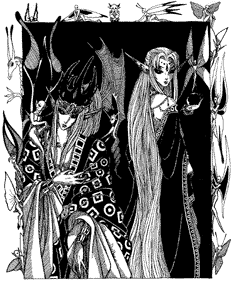
Did you know that the "Wee Folk" or our "Good Neighbors" don't like to be called "Faeries"? "Fairy" has been mis-used throughout history by the English speaking human folk. It is believed that the word "fairy" is a late term, being that after the middle ages was equated with the meaning of mortal women who had magical powers. The French "fai" comes the Latin "fatae" meaning "fairy ladies who visited the household at birth and pronounced the future of the baby, as the Three Fates do." "Fairy" originally meant "fai-erie" - as "state of enchantment and that was transferred from the object to the agent." The faerie are a "wee people" who carry great power and prestige, particularly in the Celtic and Irish lands. Of Irish descent, faeries are the descendants of the original Irish, the Tuatha de Danaan.
They are most properly referred to as the "Daoine Sidhe" or the "Sidhe" (pronounced "Shee") in Ireland, the "Sith" in the Highlands, the "pisgies" in Cornwall, and the "elves" in Scotland/ England. According to some researchers, the best english term for these people we encounter, regardless of ethnicity, is "Elf". Though even the term"Elf" is open for controversy, for according to the authors Poortvliet and Huygen, "Elves" are airy spirits of nature, who love carefree dancing and playing of stringed instruments. "They also can live underground, in/on water, in the air, and most have wings). Even though Elf is generic for "all little people", other terms commonly used are "sprite", "pixie", "nixie", "fauns", "brownies", "dwarves", "leprechauns", and "fairy".
"Sprite" is a generic term for "little people" as is "pixies", "Spirit" refers to "wood, water, or nature spirits, elves of Celtic origin are called "Faeries". "Dwarf" usually applies to "Dark Elves", but the best preferred generic term they like is "The Good Neighbors". Some other names that they supposedly prefer are: "The Seelie Court", "Them Ones", "the Strangers", "The Little People", "the Fair Folk", "the Good Folk", "the Forgetful Folk", "The Hidden Folk", "Them", "Mother's Blessing", "the Lovers", "the Night Folk", "the Little Darlings", etc. There is some controversy amongst researchers on who the Good Neighbors really are ... or in better terms, what they are. When the question is passed around for discussion, we usually get multiple responses, but most human minds conceptualize them as "wee" or "little" people. To many of the folklorists who research this phenomenon though, this is not the case. Many researchers declare that the descriptions of these tiny people with insect wings is simply a modern evolution of the lore, earlier accounts simply do not depict them as small nor tiny but actually quite human-sized.
As to the question of whether or not they exist, all you need to do is ask an Irish person who would simply reply, "I don't believe in fairies, but they're there." Many Christians believe them to be angels who revolted in heaven and were thrown out - and since they were not bad enough for hell, they were sent to live forever on the Earth and that is why they can act so angelic or devilish. Many believe the artistic portrayal of fairies with wings is by Christianity's merging of them with angels. However, in my experience, I have found them as a variety of "wee people with insect wings, human-sized, ghostly apparitions, half-animal/ half-human, and ultimately divine. In some cases, quite human." In fact, I truly believe that at least two of my good human friends (or so the world believe them to be human) are really of the "good folk". Every culture has experienced them or at least likenesses of them. These Good Folk flourished during the old days when everything around was given a spirit or a name.
The Tree or rock down the road named "Fred" or "Krystal" was part of the common folk's everyday lives. So too were the "Good Folk". They were addressed by name and played a great role in everyone's lives. But this was a time when everyone believed in multiple Gods, Goddesses, spirits, ancestors, and beings. In today's time and age, if one claims to believe in fairies they are often sent to a shrink. "So if they exist, why can't we see them?" is the question that is probably running through your mind at this very moment. Since they are "nature spirits", are happy, sad, mad, glad, spritely, vengeful, morose, friendly, loving, and hating as is "nature herself" - they take many different forms as do the energies of the Earth Mother - "Warmth, storm, earthquake, glimmers, serenity, peace, or destruction."
Elves can take many forms, as iridescent beauties, sex goddesses, old hags, crippled men with hunchbacks, goats, cows, pigs, witches, caterpillars, butterflies, cats, stones, leaves, plants, spider webs, or even gusts of wind. They range in height from an insect to those larger than a human. They are unstable and transmutative in shape and nature, and cannot always be distinguished from one another. They are not bound to our earthly world, for they can bounce between the worlds with the snap of a finger or the twinkle of their nose. They possess natural magical skill to make themselves immediately invisible and are never able to be seen by the human eye unless they desire to be seen. It is because of these abilities that us human folk cannot see them. Though a lot of that has to do with our upbringing and our mental blockage of "us allowing ourselves" to see them. Since children have not yet destroyed nor limited their minds in this fashion, they often can see them without difficulty and will tell their tales of their sightings with pride (until of course their parents begin suppressing their "imaginary friends" and making them feel foolish for believing in such beings.) Those in tune with the magical energies of the web of life can also see them very easily, such individuals are usually poets, seers, musicians, healers, clairvoyants, and naturalists. Hallucinogenic and poisonous drugs, magic rites, and altered states have also allowed many human folk to see them. It is believed though that the main pre-requisite for relations with them is to have an emotional affinity or a "blood relationship" with them. Relationships with them are supposedly very difficult to maintain, especially sexual relations, and both are usually bound by great numbers of taboos.
A brilliant movie was produced in 1993 for children called "Fern Gully". This film gives a good and detailed account of the separation between the Faery and Human Realms. While it does carry elements of Hollywood's fantasy, animation, patriarchal biases, and imagery - it does carry the heart and true spirit of the wood. The Good Folk were placed here on Mother Earth's body to help the plants grow. They are the protectors and guardians of the wood. They are also protectors of nature - whether rock, land, sea, or sky. They are Mother Nature's children who are supposed to be watched over by us. Somewhere along the way our connections were broken.
So where do they hide out? While most of the wee folk have evacuated the human world, escaping to Fairyland (called "Elfame") spottings still occur in the country, abandoned houses, mountain tops, rivers, and open fields. Depending on the type and variety will be where you can find them.
Elves (airy spirits of nature)
Nancy Arrowsmith, author of "A Field Guide to the Little People" divides elves up into three main categories: Light Elves (shape changers, travelers amongst the four known dimensions, evanescent beauties, best-natured of the Little Folk, and the least seen); Dark Elves (earth dwellers, color changers - chameleon quality in grays-browns-blacks-reds, house dwellers, lovers of dark corners, appearing at noon or late night); and Dusky Elves (most numerous, tied to the environment, lives defined by laws of time-space-place, easily recognized by humans, and usually tied to their native tree, herb, brook, mound, or pond.)
Goblins (malevolent dark little men dressed in black with small pointed caps full of mischief and hate)
house ghosts (shape-changing/invisible/ transparent/ or translucent physical or apparitions who can be mischievous, friendly, haunting creatures who love to steal, play, tease, and torture beings)
Dwarfs (close to extinct forest/mountain dweller - miners, metalworkers, and almost always found in groups - happy and friendly small men)
River spirits - Wood - Mountain Nymphs (shape changers often invisible, powerful magicians, good or ill- natured, often connected to or attached to trees, plants, mountains, woods, or springs/ rivers/ lakes)
Uldras (underground gnome-like beings living in large families / tribes, dominators of big wild animals, and are friendly, day-blind and vengeful)
Gnomes (miniature human-like beings, similar in culture to humans, found throughout the world, and in deep relation with nature)
Alvens (Light Elves - air travelers, miniature/insect sized, powerful, water-commanders, plant tenders, shape changers - though often translucent / transparent, and able to change size from insect to monster - habitats of fish ponds or small mounds)
Sidhe (Faeries - aristocrats, beautiful, great size, great age, great power, beautiful musicians, domestic, malevolent if harmed / disturbed, thin , up to six feet in height, handsome, youthful, shadowy, soft-skinned, long flowing hair, and if clothed - blindingly white, and live under faerie hills or on floating islands)
Fylgiar (sprite formed from the caul or membrane born with some children, attendant spirit, controlled by human master, takes form of masters totem animal or acts as his/her double, shadows, seen only by their masters of those with second sight)
Ellefolk (another term for Trolls - thought best Danish Elves: females are young beautiful, seductive, and posess hollow backs - long drooping breasts, loose blonde hair, and a little above four feet in height with soft, gentle voices, males are shorter than females and wear broad-brimmed hats as old men or naked youths. They live in ellemoors, next to rivers, under hills, and in marshes)
