

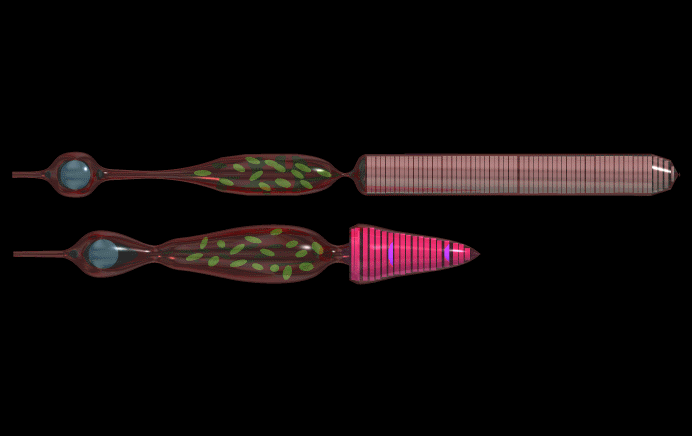
They're named after the way they look, as you can see.
Photoreceptors are what convert light into an electrical impulses that are sent to our brain (neuronal signals) to make us interoperate pictures.
Light hits a rod or cone cell. Light hits the lamellae (in the outer segment) in the rod and cone cells. Lamellae is what's special about these cells in perticular. That's the part of the cell that receives light. Lamellae makes it so there is quite a bit more plasma membrane.
The amount of signals a cell can put out is limited. The more membrane you have the more you can send out so the rod and cone cells make a lot of it to be more efficient.
Rods and cones are the two types of photoreceptors. Each person has about 120 million rods and 6 million cones arranged side by side in each eye.

Rods and cones both have two main parts, an outer segment and an inner segment. They are covered by a highly modified cilium that is largely expanded in size. The two are connected by a comparatively thin cilium.
Both rods and cones also contain things of a regular cell such as...a nucleus, mitochondria, golgi and lamellae.
For those of you that don't know...
A nucleus is a cellular organelle of eukaryotes that is responsible for cell function.
Mitochondria is are organelles that produce energy for the cell through cellular respiration, and are rich in fats, proteins, and enzymes.
Golgi is a cytoplasmic organelle that consists of a stack of smooth membranous saccules and associated vesicles and that is active in the modification and transport of proteins.
lamellae are thin flat scales, membranes, or layers.
