
Back to Hustonian Institute
Back to Movie Reviews
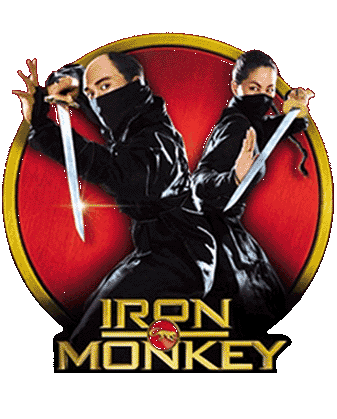
If you liked Crouching Tiger…
Whether you like this movie or not might be gauged by how much (and/or why) you liked Crouching Tiger, Hidden Dragon, because this movie (“from the creators of Crouching Tiger”, as billed) has some striking similarities (which usually separates those who like it from those who don’t), but also some significant differences that make it an admirable, enjoyable, and unique experience, and a must see if you did like Crouching Tiger. If you didn’t like it, you may still like Iron Monkey if you like these kinds of films but had artistic reasons (as opposed to genre reasons) for disliking it, because the story here is very different, the characters and relationships very different, and the actors, though widely unknown, are charismatic and capable.
I know of at least one critic that likened his Crouching Tiger experience to his Star Wars experience in being emotionally and sensually swept into it. For me, it wasn’t exactly that (and I think perhaps it may have been due, in part, to not having viewed it in the theater), though I loved it, but Iron Monkey came close to that experience I had in ’77 with Star Wars. I doubt seriously if any experience will match that one, but, of course, would love to be proven wrong, and came close to being such with Iron Monkey.
First released in 1993, Miramax gives it a wide release now amid a growing appeal for such movies with the success of Crouching Tiger and rising stars like Jet Li, and steady ones like Jackie Chan.
Who are these guys, anyway?
One of the things that made this movie so enjoyable and refreshing is the cast of veritable unknowns. Considering the movie is a good eight years old, one wonders why (and is oddly glad that) none of these people have been in anything more high profile since then. One hopes that will now be amended. But this is a classic example of George Lucas’ (apparently defunct) penchant for using “no names” to avoid distraction from the story he was telling. Star Wars didn’t have Harrison Ford “the star”; it (along with Indiana Jones) made him one. Watching Iron Monkey made me wish a few of these actors could join the likes of Jet Li and Chow Yun Fat in high profile U.S. cinema. Most of their acting through the film was believable and compelling with only a few instances of brief melodrama (partly due to cinematography) easily forgivable. Whether we like the idea or not, an actor’s charisma plays a significant role in the character’s successful expression. This cast has all the charisma it needs to sell its characters. The heroic protagonists are admirable and inspiring, the real antagonists powerful and intimidating. Perhaps the acting falls short of Crouching Tiger, but it matches it in sufficient quantity to make it enthralling and moving, and the story perhaps even more so. So, while Crouching Tiger may have been “perfect” in its acting, Iron Monkey shows us perfection isn’t necessarily necessary (except, perhaps, in winning awards).
Just how fast a film are you using?
Probably the most significant aspect of Iron Monkey that shows its age and that may give critics just cause to rank it below Crouching Tiger (at least in this aspect) is its presentation. Even with LucasFilm at the helm of post-production sound, the sound (perhaps intentionally), along with the other aspects of production seem to be more on the par of the typical “straight from Hong Kong” kung fu movies like Tai Chi Master. It doesn’t have the Hollywood-esque finish and texture to it that Crouching Tiger has in almost every aspect of production from design, to sound, right down to the actual film stock itself. The cinematography does have some noticeably comic book-like angles to it, ala The Matrix, which were brilliant, though they aren’t as frequent or obvious (which I happened to find refreshing and effective) as The Matrix. Over all, this is the only point on which I’m willing to concede Crouching Tiger's edge in excellence (and well it should since it was made 8 years later), but that shouldn’t be inferred as a criticism of Iron Monkey's production value, which I found appropriate, effective, and enjoyable.
Kicking us out of the shadows.
The martial arts choreography and execution is second to none and ahead of its time (remembering its original release date). Miramax does well (beyond the marketing benefit) to let us know it’s from the Crouching Tiger people, so U.S. viewers aren’t as justified at rolling their eyes at scant few obvious similarities (exclusively in the martial arts choreography), but it is a bit misleading. Many may not be aware that this is an eight-year old movie and will probably not stick around to the end of the credits to see the surprising copyright date (1993) significantly pre-dating Crouching Tiger, which makes Iron Monkey more impressive and original. With a relatively high profile name like Ang Lee attached, this movie might well have enjoyed the same initial success that Crouching Tiger has, but it is, thankfully, enjoying a bit more success now.
Whether by the same Crouching Tiger people or not, whether pre-dating it or not, the similarities might be justifiably criticized as being too similar in significant ways to be accepted by a U.S. audience after seeing Crouching Tiger, but the style is distinct enough to warrant some defense, enjoyment, and admiration. Most seasoned kung-fu film fans will find quibbling about it unthinkable, though, and discerning ones will have plenty to giddily savor. This martial arts director’s style is distinct, easily recognizable (The Matrix (as kung fu choreographer), Tai Chi Master (a.k.a. Twin Warriors), Drunken Master), which would be a criticism if the director were not talented enough to arrange and decorate it differently each time. Fortunately, Woo-Ping Yuen appears well equipped for the task. It helps, though, too, that different directors are at the main helm. Lee’s Crouching Tiger is distinctly Lee’s. Iron Monkey is distinctly Yuen’s, and the similarities should hardly be addressed seriously.
While many may find it blasphemous (considering the professional respect Ang Lee has garnered as well as his Crouching Tiger) to dub this one the superior film of the two, I have to admit that that is my opinion. Ultimately, though, they are very different movies and, as such, being so well executed, are both worthy of a place of admiration in the hearts of fans of this type and caliber of movie.
Final Score: 92.
2001 copyright Christopher Ryan Huston
