|
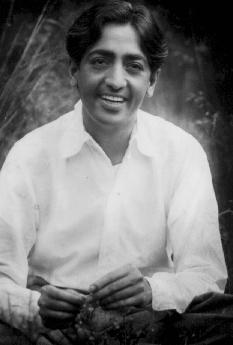
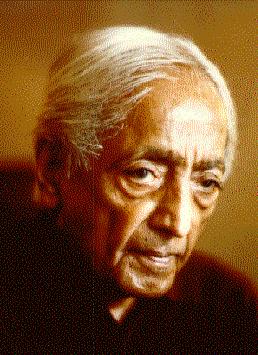
Jiddu Krishnamurti was born on 11 May, 1895, at Madanapalle, a small village in south India. Soon
after moving to Madras with his family in 1909, Krishnamurti was adopted by Mrs. Annie Besant,
President of the Theosophical Society. She was convinced that he was to become a great spiritual
teacher. Three years later she took him to England to be educated in preparation for his future role. An
organization was set up to promote this role. In 1929, after many years of questioning himself and the
destiny imposed upon him, Krishnamurti disbanded this organisation, turning away all followers
saying:
‘Truth is a pathless land, and you cannot approach it by any path whatsoever, by any religion, by
any sect. Truth, being limitless, unconditioned, unapproachable by any path whatsoever, cannot be
organized; nor should any organisation be formed to lead or to coerce people along any particular
path.’
From that time until his death in February 1986 at the age of ninety, he travelled round the world
speaking as a private person, teaching – giving talks and having discussions.
The Core of Krishnamurti's Teaching
The core of Krishnamurti's teaching is contained in the statement he
made in 1929
when he said: "Truth is a Pathless land." Man cannot come to it through any
organization, through any creed, through any dogma, priest or ritual, not through any
philosophic knowledge or psychological technique. He has to find it through the mirror of
relationship, through the understanding of the contents of his own mind, through
observation and not through intellectual analysis or introspective dissection.
Man has built in himself images as a fence of security--religious,
political, personal. These manifest as symbols, ideas, beliefs. The burden of these images
dominates man's thinking, his relationships and his daily life. These images are the
causes of our problems for they divide man from man. His perception of life is shaped by
the concepts already established in his mind. The content of his consciousness is his
entire existence. This content is common to all humanity. The individuality is the name,
the form and superficial culture he acquires from tradition and environment. The
uniqueness of man does not lie in the superficial but in complete freedom from the content
of his consciousness, which is common to all mankind. So he is not an individual.
When man becomes aware of the movement of his own thoughts he will see the division
between the thinker and the thought, the observer and the observed, the experiencer and
the experience. He will discover that this division is an illusion. Then only is there
pure observation which is insight without any shadow of the past or of time. This timeless
insight brings about a deep radical mutation in the mind.
Thought is time. Thought is born of experience and knowledge which are
inseparable from time and the past. Time is the psychological enemy of man. Our action is
based on knowledge and therefore time, so man is always a slave to the past. Thought is
ever-limited and so we live in constant conflict and struggle. There is no psychological
evolution.
Freedom is not a reaction: freedom is not choice. It is man's pretence
that because he has choice he is free. Freedom is pure observation without direction,
without fear of punishment and reward. Freedom is without motive; freedom is not at the
end of the evolution of man but lies in the first step of his existence. In observation
one begins to discover the lack of freedom. Freedom is found in the choiceless awareness
of our daily existence and activity.
Quotes from Krishnamurti Works, or related.
When you call yourself an Indian or a Muslim or a Christian
or a European, or anything else, you are being violent. Do you see why it is violent?
Because you are separating yourself from the rest of mankind. When you separate yourself
by belief, by nationality, by tradition, it breeds violence. So a man who is seeking to
understand violence does not belong to any country, to any religion, to any political
party or partial system; he is concerned with the total understanding of mankind.
-- J. Krishnamurti, Freedom from the Known, pp. 51-52
All authority of any kind, especially in the field of
thought and understanding, is the most destructive, evil thing. Leaders destroy the
followers and followers destroy the leaders. You have to be your own teacher and your own
disciple. You have to question everything that man has accepted as valuable, as necessary.
-- J. Krishnamurti, Freedom from the Known, p. 21
To be free of all authority, of your own and that of another, is to die to everything of
yesterday, so that your mind is always fresh, always young, innocent, full of vigour and
passion. It is only in that state that one learns and observes. And for this a great deal
of awareness is required, actual awareness of what is going on inside yourself, without
correcting it or telling it what it should or should not be, because the moment you
correct it you have established another authority, a censor.
-- J.
Krishnamurti, Freedom from the Known, pp. 19-20
Truth is a pathless land. You cannot approach it by any
religion, any sect. You are accustomed to being told how far you have advanced, what your
spiritual state is. How childish. Who but yourself can tell whether you are beautiful or
ugly within?
-- J. Krishnamurti, Holland, 1929
The primary cause of disorder in ourselves is the seeking of reality promised by another .
. . It is a most extraordinary thing that although most of us are opposed to political
tyranny and dictatorship, we inwardly accept the authority, the tyranny, of another to
twist our minds and our way of life.
-- J. Krishnamurti, Freedom from the Known, p. 10
. . . it is important to understand, not intellectually but actually in your daily life,
how you have built images about your wife, your husband, your neighbor, your child, your
country, your leaders, your politicians, your gods--you have nothing but images.
The images create the space between you and what you observe and in that space there is
conflict, so what we are going to find out now together is whether it is possible to be
free of the space we create, not only outside ourselves but in ourselves, the space which
divides people in all their relationships.
Now the very attention you give to a problem is the energy that solves that problem. When
you give your complete attention--I mean with everything in you--there is no observer at
all. There is only the state of attention which is total energy, and that total energy is
the highest form of intelligence. Naturally that state of mind must be completely silent
and that silence, that stillness, comes when there is total attention, not disciplined
stillness. That total silence in which there is neither the observer nor the thing
observed is the highest form of a religious mind. But what takes place in that state
cannot be put into words because what is said in words is not the fact. To find out for
yourself you have to go through it.
-- J. Krishnamurti, Freedom from the Known, pp. 92-93
Understanding of the self only arises in relationship, in
watching yourself in relationship to people, ideas, and things; to trees, the earth, and
the world around you and within you. Relationship is the mirror in which the self is
revealed. Without self-knowledge there is no basis for right thought and action.
-- J. Krishnamurti, Krishnamurti, A Biography by Pupul
Jayakar, p.
It is tradition, the accumulation of experience, the ashes of memory, that make the mind
old. The mind that dies every day to the memories of yesterday, to all the joys and
sorrows of the past--such a mind is fresh, innocent, it has no age; and without that
innocence, whether you are ten or sixty, you will not find God.
-- J. Krishnamurti, Think on These
Things
We think that living is always in the present and that dying is something that awaits us
at a distant time. But we have never questioned whether this battle of everyday life is
living at all. We want to know the truth about reincarnation, we want proof of the
survival of the soul, we listen to the assertion of clairvoyants and to the conclusions of
psychical research, but we never ask, never, how to live--to live with delight, with
enchantment, with beauty every day. We have accepted life as it is with all its agony and
despair and have got used to it, and think of death as something to be carefully avoided.
But death is extraordinarily like life when we know how to live. You cannot live without
dying. You cannot live if you do not die psychologically every minute. This is not an
intellectual paradox. To live completely, wholly, every day as if it were a new
loveliness, there must be dying to everything of yesterday, otherwise you live
mechanically, and a mechanical mind can never know what love is or what freedom is.
-- Krishnamurti, Freedom From The Known, p. 76-77
We are always comparing what we are with what we should be.
The should-be is a projection of what we think we ought to be. Contradiction exists when
there is comparison, not only with something or somebody, but with what you were
yesterday, and hence there is conflict between what has been and what is. There is what is
only when there is no comparison at all, and to live with what is, is to be peaceful. Then
you can give your whole attention without any distraction to what is within
yourself--whether it be despair, ugliness, brutality, fear, anxiety, loneliness--and live
with it completely; then there is no contradiction and hence no conflict.
-- Krishnamurti, Freedom From The Known, p. 63
It is always difficult to keep simple and clear. The world worships success, the bigger
the better; the greater the audience the greater the speaker; the colossal super
buildings, cars, aeroplanes and people. Simplicity is lost. The successful people are not
the ones who are building a new world. To be a real revolutionary requires a complete
change of heart and mind, and how few want to free themselves. One cuts the surface roots;
but to cut the deep feeding roots of mediocrity, success, needs something more than words,
methods, compulsions. There seem to be few, but they are the real builders--the rest labor
in vain.
One is everlastingly comparing oneself with another, with what one is, with what one
should be, with someone who is more fortunate. This comparison really kills. Comparison is
degrading, it perverts one's outlook. And on comparison one is brought up. All our
education is based on it and so is our culture. So there is everlasting struggle to be
something other than what one is. The understanding of what one is uncovers creativeness,
but comparison breeds competitiveness, ruthlessness, ambition, which we think brings about
progress. Progress has only led so far to more ruthless wars and misery than the world has
ever known. To bring up children without comparison is true education.
-- J. Krishnamurti, Krishnamurti, A Biography,
by Pupul Jayakar, pp. 255-256
To allow the free flow of life, without any residue being
left, is real awareness. The human mind is like a sieve which holds some things and lets
others go. What it holds is the size of its own desires; and desires, however profound,
vast noble, are small, are petty, for desire is a thing of the mind. Not to retain, but to
have the freedom of life to flow without restraint, without choice, is complete awareness.
We are always choosing or holding, choosing the things that have significance and
everlastingly holding on to them. This we call experience, and the multiplication of
experiences we call the richness of life. The richness of life is the freedom from the
accumulation of experience.
The experience that remains, that is held, prevents that state in which the known is not.
The known is not the treasure, but the mind clings to it and thereby destroys or defiles
the unknown. Life is a strange business. Happy is the man who is nothing. . . .
Don't let problems take root. Go through them rapidly, cut through them as through butter.
Don't let them leave a mark, finish with them as they arise. You can't help having
problems, but finish with them immediately.
-- J. Krishnamurti, Krishnamurti, A Biography,
by Pupul Jayakar, pp. 263, 273
As most of our education is the acquisition of knowledge,
it is making us more and more mechanical: our minds are functioning along narrow grooves,
whether it be scientific, philosophic, religious, business or technological knowledge that
we are acquiring. Our ways of life, both at home and outside it, and our specialising in a
particular career, are making our minds more and more narrow, limited and incomplete. All
this leads to a mechanistic way of life, a mental standardisation, and so gradually the
State, even a democratic State, dictates what we should become. Most thoughtful people are
naturally aware of this but unfortunately they seem to accept it and live with it.
So this has become a danger to freedom. Freedom is a very complex issue and to
understand the complexity of it the flowering of the mind is necessary. Each one will
naturally give a different definition of the flowering of man depending on his culture, on
his so called education, experience, religious superstition - that is, on his
conditioning. Here we are not dealing with opinion or prejudice, but rather with a
non-verbal understanding of the implications and consequences of the flowering of the
mind. This flowering is the total unfoldment and cultivation of our minds, our hearts and
our physical well-being. That is, to live in complete harmony in which there is no
opposition or contradiction between them. The flowering of the mind can take place only
when there is clear perception, objective, non-personal, unburdened by any kind of
imposition upon it. It is not what to think but how to think clearly. We have been for
centuries, through propaganda and so on, encouraged in what to think. Most modern
education is that and not the investigation of the whole movement of thought. The
flowering implies freedom: like any plant it requires freedom to grow.
J. Krishnamurti, Letters To The Schools, Volume 1 pp. 10-11
Why has humanity given such extraordinary importance to
thought? Is it because it is the only thing we have, even though it is activated through
senses? Is it because thought has been able to dominate nature, dominate its surroundings,
has brought about some physical security? Is it because it is the greatest instrument
through which man operates, lives and benefits? Is it because thought has made the gods,
the saviours, the super- consciousness, forgetting the anxiety, the fear, the sorrow, the
envy, the guilt? Is it because it holds people together as a nation, as a group, as a
sect? Is it because it offers hope to a dark life? Is it because it gives an opening to
escape from the daily boring ways of our life? Is it because not knowing what the future
is, it offers the security of the past, its arrogance, its insistence on experience? Is it
because in knowledge there is stability, the avoidance of fear in the certainty of the
known? Is it because thought in itself has assumed an invulnerable position, taken a stand
against the unknown? Is it because love is unaccountable, not measurable, while thought is
measured and resists the changeless movement of love?
We have never questioned the very nature of thought. We have accepted thought as
inevitable, as our eyes and legs. We have never probed to the very depth of thought: and
because we have never questioned it, it has assumed preeminence. It is the tyrant of our
life and tyrants are rarely challenged.
-- Krishnamurti, Letters To The Schools, Volume 1, 15th March, 1979
The tendency to endow with special interest institutions in which men become mere machines
in the service of an idea, is fatal.
Anyone who accepts this state of affairs loses his integrity as a result and the love of
man is destroyed.
-- J. Krishnamurti, 1932
|