|
|
|
MUSKEGON COUNTY SHERIFF'S DIVE TEAM GENERAL OPERATING GUIDELINES Effective November 5, 1992 (Revised January 9, 2000 ) OBJECTIVES: Dive team members and Sheriff's Department liaisons should be thoroughly familiar with the operating guidelines and forms contained within this manual. The following are general guidelines that the team shall follow while functioning as a search and recovery unit. It must be stressed that because of the nature of the work, no hard and fast rules can be applied in all situations. Authority to deviate from these guidelines rests with the Chief Diver/Assistant Chief Diver or on scene highest trained senior diver. TABLE OF CONTENTS CHIEF DIVER.................................................................................................MCSDT GOG-01 ASSISTANT CHIEF DIVER..........................................................................MCSDT GOG-02 DIVE TEAM MEMBER.................................................................................MCSDT GOG-03 LINE TENDERS..............................................................................................MCSDT GOG-04 RECORDER.....................................................................................................MCSDT GOG-05 SAFETY DIVER..............................................................................................MCSDT GOG-06 RELIEF DIVER.............................................................................................. MCSDT GOG-07 SHERIFF'S DEPT. LIASION.........................................................................MCSDT GOG-08 RESPONSE.......................................................................................................MCSDT GOG-09 SCENE EVALUATION...................................................................................MCSDT GOG-10 DETERMINING THE LOCATION OF A VICTIM IN MOVING WATER.....................................................................MCSDT GOG-11 ICE DIVING.....................................................................................................MCSDT GOG-12 LINE SIGNALS................................................................................................MCSDT GOG-13 NEUROLOGICAL ASSESSMENT................................................................MCSDT GOG-14 FIRST AID FOR DECOMPRESSION ILLNESS.........................................MCSDT GOG-15 POST DIVE ANALYSIS..................................................................................MCSDT GOG-16 DIVE SAFETY OFFICER...............................................................................MCSDT GOG-17 MCSDT GOG-01 CHIEF DIVER: 01.00 The Chief diver shall take command of dive operations upon arrival at the scene. 01.01 They shall evaluate the situation, set up and implement a program for locating the object of the search, using appropriate search patterns and techniques. 01.02 The Chief diver shall take into consideration existing conditions and coordinate the operation with activities in the vicinity. 01.03 The Chief diver has the right/responsibility to refuse or abort a dive at any time they feel the conditions are no longer safe for the dive team. 01.04 They shall be designated "In Charge" of all aspects of the diving operation affecting the health of a dive team member. 01.05 The Chief diver shall hold a pre-dive briefing after witnesses have been interviewed and all information has been gathered. They will describe the task to be undertaken, guidelines to be followed, and any unusual hazards or conditions. 01.06 The Chief diver or line tender shall be satisfied that each diver is wearing the required equipment. 01.07 The Chief diver shall insure that safe diving guidelines are followed by all personnel involved in the diving operation. 01.08 The Chief diver or recorder shall see that the appropriate forms for each member and dive is maintained during a dive operation. 01.09 The Chief diver has control of the diving operations and will control all actions of the divers while in the water. This guideline shall take effect immediately and shall remain in effect until superseded. SIGNED:__________________________________ DATE:__________________ CHIEF DIVER
MCSDT GOG-02 ASSISTANT CHIEF DIVER: 02.00 The Assistant Chief diver shall assume all duties of the Chief diver in the event that the Chief diver is absent or incapacitated in any way. 02.01 They shall assist in the planning and implementation of training and actual dive operations. This guideline shall take effect immediately and shall remain in effect until superseded. SIGNED:__________________________________ DATE:__________________ CHIEF DIVER
MCSDT GOG-03 DIVE TEAM MEMBERS: 03.00 Dive team members shall make every effort to respond, with the appropriate equipment for the dive, when called. 03.01 Members shall conduct themselves in a professional manner with due respect for the situation and for friends and family of the victims at the scene. 03.02 Divers will provide their own diving equipment in accordance with good diving practices. 03.03 A member shall notify the Chief diver if they have consumed any alcoholic beverages within twelve (12) previous hours. 03.04 Any team member that feels conditions are unsafe to dive in, shall report their concerns to the Chief diver. 03.05 Any team member has the right to refuse to dive in conditions they feel are unsafe. This guideline shall take effect immediately and shall remain in effect until superseded. SIGNED:__________________________________ DATE:__________________ CHIEF DIVER
MCSDT GOG-04 LINE TENDERS: 04.00 Must be trained and qualified to independently tend divers and to operate surface support equipment. 04.01 They shall be dive team members. 04.02 Tenders shall keep the Chief diver informed of progress of dive and/or emergencies. 04.03 Tenders shall check divers for proper equipment. 04.04 Tenders or recorder will log the results of the pre and post neurological checks, name of divers, time diver enters water, PSI in tank (at both start and end of dive), time diver exits water and depth of dive. (See log sheet). 04.05 After completion, this form will be given to the Chief diver who will make a photo copy, retain one for dive team records and deliver the other to the Sheriff's Department.) 04.06 Tenders will always watch bubbles and line to divers to know their location. They will record, any recovered items or victims. They will also tie two handles in the line to determine area and distance searched. 04.07 All attention shall be given to the diver. This guideline shall take effect immediately and shall remain in effect until superseded. SIGNED:__________________________________ DATE:__________________ CHIEF DIVER
MUSKEGON COUNTY DIVE TEAM LOG SHEET Dive No. ______ ______________________________ Date ______ Chief Diver/Senior Diver Current ______ Water temp ______ _______________________________ Visibility ______ Recorder Wind Speed ______ Wind Direction______ ________________________ ________________________ Line Tender #1 Line Tender #2 ________________________ ________________________ Diver #1 Safety Diver Pre Neuro P ____________ Pre Neuro P ____________ Time in ____________ Time in ____________ Time out ____________ Time out ____________ Max. Depth ____________ Max. Depth ____________ PSI Begining ____________ PSI Begining ____________ PSI Ending ____________ PSI Ending ____________ Post Neuro P ____________ Post Neuro P ____________ Additional Comments: Additional Divers on Site ________________________ ________________________ ________________________ ________________________ ________________________
Nearest Recompression Chamber LINE SIGNALS: DAN 1-919-684-8111 24 Hrs. Tender to Diver Air Transport 2 tugs - Stop, change direction take Aero-Med 1-800-862-0921 out line. Care Flight 1-616-341-8555 3 tugs - Come to surface. Dispatch Diver to Tender 1-800-328-0911 2 tugs - Need more line. Coast Guard (Grand Haven) 3 tugs - Found object
MCSDT GOG-05 RECORDER: 05.00 Recorder or tender will log the results of the pre and post neurological checks, name of divers, time diver enters water, PSI in tank (at both start and end of dive), time diver exits water and depth of dive. (See log sheet). 05.01 After completion, this form will be given to the Chief diver who will make a photo copy, retain one for dive team records and deliver the other to the Sheriff's Department.) 05.02 Keeps extra equipment and supplies ready and prepared to be utilized, replaced, repaired, etc. 05.03 Is directly responsible to the Chief diver for advising bottom times, PSI minimums, repetitive dive calculations, and all other aspects regarding the execution of the dive plan and safety margins. This guideline shall take effect immediately and shall remain in effect until superseded. SIGNED:__________________________________ DATE:__________________ CHIEF DIVER
MCSDT GOG-06 SAFETY DIVER: 06.00 Remains suited and ready to dive immediately during the entire mission to rescue or aid divers down, if necessary. 06.01 Should not be assigned any other responsibilities that would require absence from a ready position or condition. 06.02 There must be a safety diver on all operations. 06.03 Will be equipped with an auxiliary air supply fully operational to give to the diver down in the event of a rescue situation. This guideline shall take effect immediately and shall remain in effect until superseded. SIGNED:__________________________________ DATE:__________________ CHIEF DIVER
MCSDT GOG-07 RELIEF DIVER: 07.00 Relieves any other position, as necessary, at the discretion of the Chief diver. 07.01 This depends on the number of members on the scene. 07.02 They should be partially suited (all but scuba, weights, and fins which are in the ready position at the waters edge). 07.03 There can be any number of relief divers, depending on the size of the operation, duration and conditions. 07.04 They could serve as the line tender or be assigned any other job at the Chief divers discretion. This guideline shall take effect immediately and shall remain in effect until superseded. SIGNED:__________________________________ DATE:__________________ CHIEF DIVER
MCSDT GOG-08 SHERIFF'S DEPARTMENT LIAISON: 08.00 Marine Division Officer and Chief diver will meet to discuss operations, etc. (Chief diver has the final say over deployment of dive team). 08.01 The Muskegon County Sheriff Department (hereafter MCSD) officer will notify central dispatch when there is a need for the team. 08.02 The team will then be notified via pagers. 08.03 Only dive team members will be called in an operation. 08.04 The MCSD officer will operate the watercraft assigned to the team. 08.05 The MCSD officer shall secure the dive area and have the area roped off as necessary. 08.06 Only authorized personnel approved by the Chief diver and/or Marine Division officer will be allowed within the dive area. 08.07 The MCSD officer controls, records, and secures any physical evidence collected. 08.08 MCSD will provide the following: a. Watercraft b. Air fills c. Meals (when members are not able to attend regular meals at home.)
This guideline shall take effect immediately and shall remain in effect until superseded. SIGNED:__________________________________ DATE:__________________ CHIEF DIVER
MCSDT GOG-09 RESPONSE: 09.00 Chain of command will be used in all diving operations. 09.01 If the Chief or Assistant Chief diver is not on scene the most senior diver will assume command. This shall be quickly established. 09.02 P.F.D.'s (Personal Floatation Device) shall be worn by all surface support personnel on all dive operations. 09.03 Risk/Benefit Factor - When there is a chance to save a life then the potential benefit will be considered high and a certain amount of risk is justified. 09.04 Quick decisions must be made, brief witness interviews conducted and initiate the running of search patterns. 09.05 When human life is not involved, i.e. body has been in the water over 1 hour, articles or vehicles are being recovered, the operation shall be conducted at a slower, more deliberate pace. This guideline shall take effect immediately and shall remain in effect until superseded. SIGNED:__________________________________ DATE:__________________ CHIEF DIVER
MCSDT GOG-10 SCENE EVALUATION: 10.00 The dive team has a primary objective when responding to a call - the establishment of the last-seen-point. 10.01 There are three basic components to establish this: a.) Witness Interviews b.) Use of Reference Points and Reference Objects. c.) Physical Evidence. 10.02 We must consider every available witness as a potential resource. 10.03 If there is more than one witness, separate them to obtain individual accounts. 10.04 Take the witness to their exact point at the time of the incident. 10.05 Place a reference object in the water as close as size and shape to the object of the search. 10.06 Move the reference object by asking the witness open ended questions such as "Do we need to move the (swimmer, boat, etc.) to the left or to the right, further in or further out?" 10.07 Before witnesses are allowed to leave the scene, be sure to obtain complete information on where they can be contacted in the event of a long drawn out operation. 10.08 Ask them to produce a legal I.D., do not take their word of who they are. Be suspect of anyone who cannot produce an I.D., always keep in mind this may be a crime scene. 10.09 If no witnesses are present, physical evidence sometimes give clues to a victims location. Look for footprints on the shore, clothing, etc. Observe for damage to manmade structures or natural objects if looking for a vehicle in the water. This guideline shall take effect immediately and shall remain in effect until superseded. SIGNED:__________________________________ DATE:__________________ CHIEF DIVER MCSDT GOG-11 PAGE 1 OF 2 DETERMINING THE LOCATION OF A VICTIM IN MOVING WATER: 11.00 After the location that a body was last seen has been determined, you can, by using the following information, figure approximately where the body will be located on the bottom. 11.01 YOU MUST KNOW the SPEED and DEPTH of the water plus the LAST-SEEN- POINT of the victim. 11.02 To figure the speed of the current, mark a spot on the riverbank, walk 50 feet upstream (about 20 paces) throw a closed styrofoam cup or tennis ball into the current. 11.03 Time how long it takes the floater to reach your marker. If it takes: 60 seconds, the current is .5 knot. = (.83 feet per second) 30 seconds, the current is 1 knot. = (1.6 fps) 20 seconds, the current is 1.5 knots. = (2.5 fps) 15 seconds, the current is 2 knots. = (3.3 fps) 11.04 The formula is as follows: Depth - divided by - body descent rate (2) - multiplied by - fps (current) = approximate location where victim will be located. 11.05 NOTE: A BODY DESCENDS AT 2 - 2.5 FEET PER SECOND EXAMPLE: 20' Depth divided by 2 Body descent rate = 10 multiplied by 2.5 fps (current is 1.5 knot) equals 25' The victim should be approximately 25 feet from last seen point. SEE NEXT PAGE FOR A COMPLETED CHART
MCSDT GOG-11 PAGE 2 OF 2 DETERMINING THE LOCATION OF A VICTIM IN MOVING WATER CHART C U R R E N T (KNOTS) 0 0.5 1 1.5 2 5' 0 1.6 4 6 8 D 10' 0 4 8 12.5 16.5 E 15' 0 6 12 19 25 P 20' 0 8.3 17 25 33 T 25' 0 10 20 31 41 H 30' 0 12.5 25 38 50 35' 0 14 28 44 58 40' 0 16.5 33 50 66 45' 0 18 36 56 74 50' 0 21 42 62.5 83
Example for using chart: 11.06 NOTES OF INTEREST: A half knot current moves at 50 feet per minute. A one knot current moves at 100 feet per minute. A one and one half knot moves at 150 feet per minute. A two knot current moves at 200 feet per minute. This guideline shall take effect immediately and shall remain in effect until superseded. SIGNED:__________________________________ DATE:__________________ CHIEF DIVER
MCSDT GOG-12 ICE DIVING: 12.00 Breathing from the regulator in a subfreezing atmosphere prior to submergence adds to the freezing problem. 12.01 It is recommended that the diver not breath from the regulator until it is just below the surface. 12.02 In the event of an uncontrolled ascent the diver shall exhale and place their hands overhead to break the impact with the underside of the ice. 12.03 The diver shall not detach their safety line while under the ice unless there is an emergency situation and a safety diver is with them. 12.04 In the event of unattached tether line the diver shall look above for the hole. If it is not in sight, ascend to the underside of the ice and hang vertical. DO NOT PANIC, STAY PUT. 12.05 Bang your cylinder with your knife. 12.06 Look below your fins in case a slack safety diver (polypropoline) line passes below. 12.067 If the line tender observes the line is no longer attached or the diver appears to be entangled, they shall notify the chief/senior diver. 12.08 They shall note the direction and amount of line out prior to pulling any in. 12.09 The safety diver shall enter the water 30 degrees to the left and 25 feet beyond the last known position. 12.10 They shall stay just below the ice and scan in all directions. 12.11 If they reach the end of the allowed line without locating the lost diver, they shall start a clockwise search, keeping the line taut. 12.12 If they complete a full circle the tender will signal them, more line will be let out for a second sweep. 12.13 If the lost diver is not located by the second sweep, the diver will continue circles but moving back towards the hole. 12.14 If the ice is relatively thin, clear and not snow covered, surface personnel shall walk a search line across the ice looking for the diver. 12.15 Additional holes may be cut beyond the distance being covered by the safety diver to facilitate search efforts.
This guideline shall take effect immediately and shall remain in effect until superseded. SIGNED:__________________________________ DATE:__________________ CHIEF DIVER
MCSDT GOG-13 LINE SIGNALS: 13.00 The following are the general line signals that shall be used by the MCSDT. 13.01 Tender to Diver 2 tugs - Stop, change direction, take out line. 3 tugs - Come to surface. 13.02 Diver to Tender 2 tugs - Need more line. 3 tugs - Found object. 4 or more tugs - Need help. 13.03 If at anytime the tender does not understand the signals they are receiving from the diver they shall pull the diver in.
This guideline shall take effect immediately and shall remain in effect until superseded. SIGNED:__________________________________ DATE:__________________ CHIEF DIVER
MCSDT GOG-14 NEUROLOGICAL ASSESSMENT: 14.00 Prior to and after each dive, each diver will undergo a pre and post dive neuro assessment which will consist of the following: NOTE: Any unsual findings will be noted under the "Comments" section of the log sheet. 14.01 PRE DIVE ASSESSMENT: Have them take a deep breath and then exhale. Check to see if both eyes follow your finger (without moving their head) in all directions. Check for equal hearing in both ears by snapping your fingers. Check for weakness (especially one sided) in the major muscles. Have them whistle. Have them squint their eyes. Check for equal muscle strength by: pushing with both hands. pulling with both hands. pushing up with the back of the hands. pushing down with both hands. raising the knees, then pushing down. raising the toes, then pushing down. pushing forward with the shins. pulling back with the calves. 14.02 POST DIVE ASSESSMENT (All of the above plus the following:) Observe diver for simple symptoms i.e. quietness in a normally loud person, unsteady walk, blank look. Check for uncommon actions i.e. difficulty with simple tasks like removing a regulator from a tank, working a simple dive profile. Check memory with simple questions first then progress to harder ones if diver appears unsure of answers. For example: What time of day is it?, What day is it?, Who is the president? Check for sagging eyelids, droopy face (especially one sided). 14.03 If any change in neuro is noted, the individual shall be put on O2, EMS shall be notified to be transported to the nearest appropriate facility for a more complete exam. This guideline shall take effect immediately and shall remain in effect until superseded. SIGNED:__________________________________ DATE:__________________ CHIEF DIVER
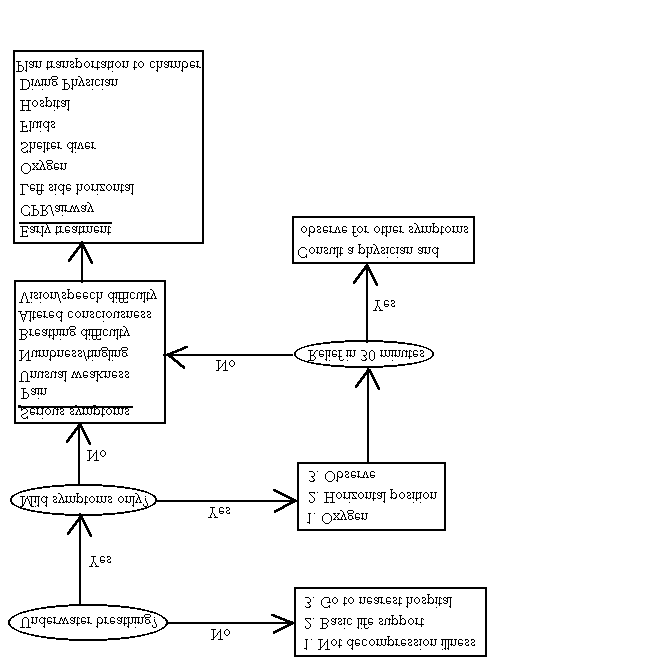
MCSDT GOG-15 PAGE 1 OF 2 FIRST AID FOR DECOMPRESSION ILLNESS: 15.00 Two life-threatening conditions may occur as a result of a diving accident: 15.01 Air embolism and Decompression sickness - grouped together as Decompression Illness. 15.02 Anyone who has breathed air underwater, regardless of depth, may have an air embolism. 15.03 Decompression sickness can occur in anyone who violates the decompression limits. 15.04 Before O2 therapy can begin, place the victim in the proper position. 15.05 If the diver has mild symptoms, is fully alert, not in distress, keep them in a horizontal position. 15.06 Do not obstruct blood flow by crossing legs or resting the head on an arm. This would restrict gas elimination. 15.07 If the diver has serious symptoms place them in the "recovery position". This is on their side (usually left) with head supported at a low angle and the upper leg bent at the knee to stabilize them on their side. 15.08 Anytime we suspect a diving accident we will administer oxygen at 15 LPM with a non-rebreather mask. 15.09 Do not remove the O2 even if the signs and symptoms appear to be alleviated. 15.10 Refer to the attached flow chart for basic care. This guideline shall take effect immediately and shall remain in effect until superseded. SIGNED:__________________________________ DATE:__________________ CHIEF DIVER
MCSDT GOG-16 POST DIVE ANALYSIS: 16.00 A post dive analysis should be conducted immediately after a dive. 16.01 If this is not possible, then one should be scheduled within one (1) week of the dive. 16.02 It will concentrate on positive reinforcement and learning from any mistakes. 160.3 A record of the post dive analysis shall be made and attached to the log sheet which shall be kept by the Chief diver. 16.04 It will be the responsibility of the Chief diver to notify members of the time, place and date of the post dive analysis. 16.05 Consideration should be given to notifying the Critical Incident Stress Debriefing team (737-6666). This guideline shall take effect immediately and shall remain in effect until superseded. SIGNED:________________________________ DATE:________________________ CHIEF DIVER MCSDT GOG-17 DIVE SAFETY OFFICER : The Safety Officers primary responsibility is to prevent injury. They must have a genuine concern for the safety of everyone at the scene. Safety must be the focus. They must have a thorough knowledge of the GOG’s. They are to have the duty and responsibility of halting unsafe acts and removing members from unsafe environments. They must be an effective communicator and active listener, able to convey messages in a clear, concise manner. Must set the example: Be the Role Model 17.00 Everyone on site is wearing pfd in the prescribed manner. (all straps secured) 17.01 Pre-Post Neurological assessments takes place 17.02 Shall ensure that both the diver(s) and support equipment is properly affixed, i.e. BCD, chest harness, safety lines, wet/dry suit, hood, mask, fins, cutting tools. 17.03 Shall ensure the diver(s) are properly weighted for dive 17.04 Shall ensure the Comm gear is in working order. 17.05 Will check with the diver a final time - does diver feel OK, can they make the dive? 17.06 Will monitor the diver air during dive. 17.07 Shall ensure the safety diver is in place and at the ready. 17.08 Relief diver (if available) is in place, i.e. suited up, equipment at the ready. 17.09 Monitor dive taking place and express concerns about potential safety issues 17.10 The Safety Officer must constantly evaluate the Risk Management Potential and ask themselves: Can we handle this? Do we need specialized technical assistance or mutual aid? Is the benefit worth the risk? This guideline shall take effect immediately and shall remain in effect until superseded. SIGNED:__________________________________ DATE:__________________ CHIEF DIVER |