Under-construction: The North Star Exhibit (seen in photo)
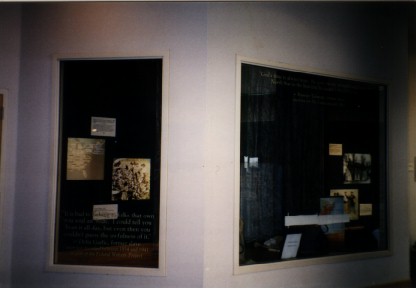 I have been assigned to assist in the planning and organization of an exhibit on the Underground Railroad. The exhibit, scheduled to be constructed in late September, will be coupled with the opening of a new program at Conner Prairie entitled “Follow the North Star.” To accurately portray the Underground Railroad and slavery, in general, in the exhibit, I have spent over two weeks researching the conditions of slavery, the true nature of the Underground Railroad, and the abolitionist movement.
I have pooled resources from the library at Conner Prairie and at Indiana University-Purdue University, Indianapolis. I also plan to visit the Indiana Historical Society and the Indiana State Library to read through a number of manuscripts that address the topics of slavery and abolition in the nineteenth century. In researching these topics, I have learned a great deal about the importance of historical accuracy as it relates to museum exhibits. In as much as I aim to educate the public on the TRUTHS relating to the Underground Railroad, I must avoid all exaggerations and unsubstantiated legends that have surfaced regarding the topic. I must balance secondary sources with primary accounts. I must strive to find sufficient documentation to support every bit of information I decide to include in my exhibit. In conducting my research, I have encountered a number of myths and romanticized stories that have contributed to a general misunderstanding of the true nature of the Underground Railroad. I hope to dispel these myths and stories by planning an exhibit that is as historically accurate as possible. I plan to highlight testimonies from whites and blacks, from men and women. In the end, if I succeed in my effort to accurately portray the Underground Railroad, the public will walk away with an enlightened awareness of slavery in nineteenth-century America. They will consider the brutality slaves endured daily. They will recognize the contributions of fugitive slaves in securing their own freedom. They will acknowledge the minimal role Whites, even Quakers, played in assisting fugitive slaves. Finally, they will appreciate the overall significance of slavery in American history.
I have been assigned to assist in the planning and organization of an exhibit on the Underground Railroad. The exhibit, scheduled to be constructed in late September, will be coupled with the opening of a new program at Conner Prairie entitled “Follow the North Star.” To accurately portray the Underground Railroad and slavery, in general, in the exhibit, I have spent over two weeks researching the conditions of slavery, the true nature of the Underground Railroad, and the abolitionist movement.
I have pooled resources from the library at Conner Prairie and at Indiana University-Purdue University, Indianapolis. I also plan to visit the Indiana Historical Society and the Indiana State Library to read through a number of manuscripts that address the topics of slavery and abolition in the nineteenth century. In researching these topics, I have learned a great deal about the importance of historical accuracy as it relates to museum exhibits. In as much as I aim to educate the public on the TRUTHS relating to the Underground Railroad, I must avoid all exaggerations and unsubstantiated legends that have surfaced regarding the topic. I must balance secondary sources with primary accounts. I must strive to find sufficient documentation to support every bit of information I decide to include in my exhibit. In conducting my research, I have encountered a number of myths and romanticized stories that have contributed to a general misunderstanding of the true nature of the Underground Railroad. I hope to dispel these myths and stories by planning an exhibit that is as historically accurate as possible. I plan to highlight testimonies from whites and blacks, from men and women. In the end, if I succeed in my effort to accurately portray the Underground Railroad, the public will walk away with an enlightened awareness of slavery in nineteenth-century America. They will consider the brutality slaves endured daily. They will recognize the contributions of fugitive slaves in securing their own freedom. They will acknowledge the minimal role Whites, even Quakers, played in assisting fugitive slaves. Finally, they will appreciate the overall significance of slavery in American history.
In planning the exhibit, I have spent a brunt of the time trying to locate relevant artifacts and images to help illustrate the topics of slavery, the Underground Railroad, and abolition. I have conducted a nationwide search for such artifacts and archives via the internet and have reviewed pictorial captions for locations of artifacts pictured. The final list I generate will be used to contact museums and private collections housing artifacts and archives that may be used in the final exhibit.
Myths of the Underground Railroad
The tale of the Underground Railroad is, for the most part, just that, a tale. In truth, the Underground Railroad, as portrayed in a majority of history textbooks, never existed. There was never a well-organized system of convenient stops for fugitive slaves in route to the North. The suggestion that such a system ever existed is completely inaccurate. The true nature of the co-called Underground Railroad was disjointed and disorganized. Fugitive slaves were primarily self-reliant, dependent upon their own ability to guide themselves through foreign wilderness. While fugitive slaves may encounter an occasional person sympathetic to their endeavor, they were more commonly greeted with great hostility from white folks. Indeed, white residents of the North were not necessarily friendly and welcoming to a fugitive slave simply because they lived in a free state. They were oftentimes just as racist as their white counterparts in the South. Therefore, fugitive slaves found little comfort in their venture North. With no organized system of stops and no promise of friendly faces, they drew upon their own ability to survive and succeed in their quest for freedom.
In history books, authors emphasize the white man’s participation in the Underground Railroad. They frequently exaggerate the lengths northern whites went to to ensure the safety of fugitive slaves. Testimonies and established fact, however, paint quite a different picture. Once again, we see that only a few white folks were willing to take the risks involved in assisting fugitive slaves in their journey North. Even the Quakers, the celebrated conductors of the Underground Railroad, played only a very minimal role in the system.
Authors also exaggerate the number of hidden doorways and secret rooms used along the Underground Railroad. In truth, slaves oftentimes took cover in a conductor’s barn, hiding under hay or in a wagon. However, on rare occasions, fugitive slaves may have been led into a secret room or passage where they waited until nightfall.
As I prepare my exhibit for the Follow the North Star program, I plan to address these myths and provide the public with an accurate portrayal of the Underground Railroad, a portrayal that emphasizes the true nature of the Railroad and the numerous challenges and dangers fugitive slaves faced as they ventured north.



