Mcdonnel Douglas- F/A-18
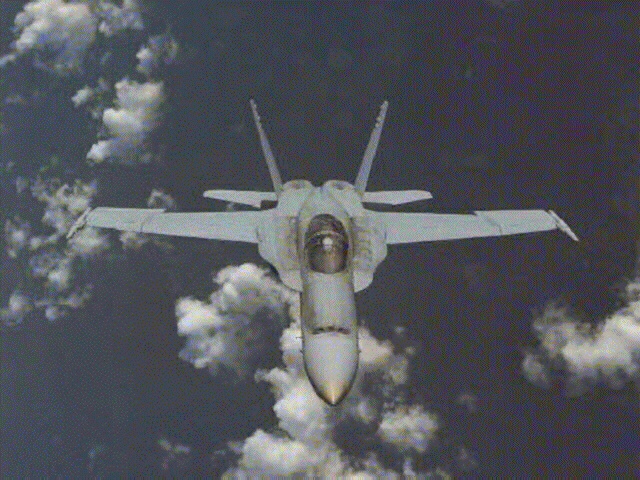
Quick Summary
- Mutirole strike, Carrier fighter, radar and antiship bomber.
- One M61A1 Vulcan 20mm cannon. Two AIM-9 Sidewinders, 4 AIM-7 Sparrow or AIM-120 AMRAAMs or 15,400 lbs of ordnance.
- Mach 1.8, Ceiling: 50,000ft. Range: 655mi
- Two 17,600 lb-Thrust afterburning General Electric F404-GE-402 EPE (enhanced performance engines)

This magnificent fighting jet from McDonnell Douglas has established a place as the backbone of US Navy and Marine Aviation; sailors and marines wanted the F/A-18 Hornet so badly they relinquished other aircraft to get it. Their faith is justified: the F/A-18 performed superbly in Libya and in Operation Desert Storm.
To keep the F/A-18 on top in the crucible of air combat, they are improving the Hornet constantly the newest version is the F/A-18E/F Super Hornet which will have better electronics, be 33ft. longer carry 3,000 lbs of more fuel and be capable of carrying the JSOW (Join Stand Off Weapon). Better flight instruments and avionics have been added to new aircraft along with the capability to use far far-reaching missiles including the air to air AMRAAM and the air to ground HARM. None of these changes detract from the maneuverability of the Hornet, an exceedingly agile adversary.
The Hornet is the aircraft of choice for the US. NAVY'S Flight Demonstration Squadron,
"The Blue Angels". The "Blues" fly one of the most precise aerial demonstrations in the world, maintaining a minimal 36-inch separation between individual aircraft. The Blue Angels first flew the Hornet in November of 1986, after transitioning from the A-4 Skyhawk. The Hornet has proven to be a very capable aircraft in the hands of the Blue Angel pilots. They have demonstrated the Hornet's ability for audiences all over the world.
Making the first flight in November 1978, the F/A-18 and its two-place derivative have undergone most of their development testing at the Naval Air Test Center, under the new single-site testing concept. While much attention, both internal and external, was focused on development problems, these have largely been typical of those in any new program with their resolution being part of the development process. For the most part, these have occurred in the basic aircraft hardware rather than in the digital electronic systems.
The initial production airplanes, the first training F/A-18s have been in service with VFA-125 since November 1980. The new capabilities introduced by the F/A-18 have met with an enthusiastic response among operating personnel.
Current F/A-18s in the inventory included F/A-18As, F/A-18Bs, F/A-18Cs and F/A-18Ds. The Hornet is a critical element in the plan to recapitalize the Navy and Marine Corps aviation capability. When the A-6 Intruders and F-14 Tomcats have left the inventory, the F/A-18 Hornet alone will represent the Navy's carrier-based strike fighter capability.
The F/A-18 is a multi-role fighter which basically means that it has many roles such as "mud moving" or attacking ground and sea targets. It also has the capability to attack air to air targets. Some people call the F/A-18 more of an attacker than a fighter because of its low radar range and it can only target track and target two close flying same altitude targets while the F-14 can take on up to 6 targets flying at different speeds, altitude and directions. But the F/A-18 is still a very agile and potent fighter. The Marine Corp use the F/A-18 as their principal fighter and attacker next to the AV-8B Harrier. Its dimensions are Span: 37ft. Length: 56ft. Height: 15ft. 3.in. Wing Area: 400 sq. ft.
The Hornet is also exported to many countrys including Canada, Spain and Australia.
Email: doom479@aol.com

