
Quick Summary
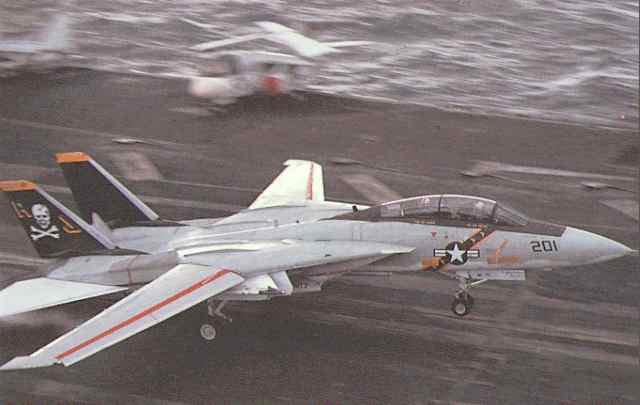
 The Grumman F-14, the world's premier air defense fighter, was designed to replace the F-4 Phantom II fighter (phased out in 1986). F-14s provided air cover for the joint strike on Libyan terrorist targets in 1986. The F-14A was introduced in the mid-1970s. The upgraded F-14A+ version, with new General Electric F-110 engines, now widespread throughout the fleet, is more than a match for enemy fighters in close-in, air combat.
In late 1995 the F-14 Tomcat took on a new combat mission as part of Operation Deliberate Force in Bosnia., Nicknammed "Bombcat's", they delivered laser-guided bombs while other aircraft painted the targets with lasers.
In 1994 the Navy planned to spend over $2.5 billion to add limited ground attack capability and other improvements to 210 F-14 Tomcat fighter aircraft (53 F-14Ds, 81 F-14Bs, and 76 F-14As). The ground attack capabilities were required to partially compensate for the loss in combat capabilities during the period starting in 1997, when all of its A-6E Intruder attack aircraft were retired, to the turn of the century when the F/A-18E/F, the next generation strike fighter, was scheduled to arrive. The F-14 is undergoing two upgrades.
Concerned about the Navy's capability to maintain carrier-based power projection without A-6Es and with only limited F-14 upgrades, the Joint Conference Committee on the fiscal year 1994 Defense Authorization Act directed the Navy to add an F-15E equivalent capability to its F-14D aircraft, including the capability to use modern air-to-ground stand-off weapons. But the Navy, in a report submitted on May 20, 1994 outlining its plans for the F-14, reiterated the intent to add only the A/B and Block I upgrades. The Navy estimated it would cost $1.8 billion to add F-15E-equivalent capability to 53 F-14Ds and another $9 billion to upgrade 198 F-14A/Bs. According to the Navy, an upgrade of that magnitude was not affordable. The 157 F-14A/B models' AWG-9 radar is one of the most powerful US military aircraft radars for detecting multiple air targets approaching at long range, but it does not provide a ground mapping capability that permits crews to locate and attack targets in adverse weather and poor visibility or to precisely update the aircraft's location relative to targets during the approach, a capability that improves bombing accuracy. Only the 53 F-14Ds, with their improved APG-71 synthetic aperture ground mapping radar, will have this capability.
Its dimensions:Span: 61ft. 10in. Length: 62ft. Height: 16ft. Wing area: 565 sq. ft.
The Grumman F-14, the world's premier air defense fighter, was designed to replace the F-4 Phantom II fighter (phased out in 1986). F-14s provided air cover for the joint strike on Libyan terrorist targets in 1986. The F-14A was introduced in the mid-1970s. The upgraded F-14A+ version, with new General Electric F-110 engines, now widespread throughout the fleet, is more than a match for enemy fighters in close-in, air combat.
In late 1995 the F-14 Tomcat took on a new combat mission as part of Operation Deliberate Force in Bosnia., Nicknammed "Bombcat's", they delivered laser-guided bombs while other aircraft painted the targets with lasers.
In 1994 the Navy planned to spend over $2.5 billion to add limited ground attack capability and other improvements to 210 F-14 Tomcat fighter aircraft (53 F-14Ds, 81 F-14Bs, and 76 F-14As). The ground attack capabilities were required to partially compensate for the loss in combat capabilities during the period starting in 1997, when all of its A-6E Intruder attack aircraft were retired, to the turn of the century when the F/A-18E/F, the next generation strike fighter, was scheduled to arrive. The F-14 is undergoing two upgrades.
Concerned about the Navy's capability to maintain carrier-based power projection without A-6Es and with only limited F-14 upgrades, the Joint Conference Committee on the fiscal year 1994 Defense Authorization Act directed the Navy to add an F-15E equivalent capability to its F-14D aircraft, including the capability to use modern air-to-ground stand-off weapons. But the Navy, in a report submitted on May 20, 1994 outlining its plans for the F-14, reiterated the intent to add only the A/B and Block I upgrades. The Navy estimated it would cost $1.8 billion to add F-15E-equivalent capability to 53 F-14Ds and another $9 billion to upgrade 198 F-14A/Bs. According to the Navy, an upgrade of that magnitude was not affordable. The 157 F-14A/B models' AWG-9 radar is one of the most powerful US military aircraft radars for detecting multiple air targets approaching at long range, but it does not provide a ground mapping capability that permits crews to locate and attack targets in adverse weather and poor visibility or to precisely update the aircraft's location relative to targets during the approach, a capability that improves bombing accuracy. Only the 53 F-14Ds, with their improved APG-71 synthetic aperture ground mapping radar, will have this capability.
Its dimensions:Span: 61ft. 10in. Length: 62ft. Height: 16ft. Wing area: 565 sq. ft.
