
There is a lot of confusion about this. Many claim that Peking man were savage killers who fed on the brains of their own kind.
Some people have claimed that the bones making up Peking man are actually gibbon bones, eaten by modern humans.
They think that humans were decapitating gibbons, and eating their brains.
They say that this is why no bodies of Peking man have been found, and they also use this to explain the presence of the fire pit.
You will see elsewhere that this so called "fire pit" is nothing more than the remains of a natural fire, not a controlled one.
|
Do people eat Monkey brains? As bad as this sounds, there are many people in foreign cultures who eat monkey brains. If this fire pit was made by a human, then that means that man was already around at the same time as "Peking man". If these 2 species lived at the same time then man could not have evolved from Peking man (Homo erectus). I discuss the coexistence of Homo erectus and Homo sapiens (humans) and whether or not 2 species can coexist and still be related elsewhere on my page. Click HERE for this article
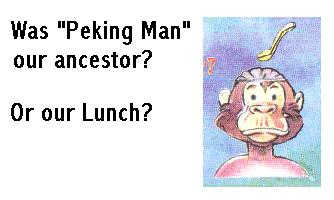
So far from being mans Evolutionary ancestor, Some people believe that many of the bones at the Peking man site actually belonged to mans lunch! However, the Peking man remains are not gibbon bones. (see my page on Java man) |
|---|
|
UPDATE (7/25/01): There does not seem to be any evidence that Peking man was a cannibal. The evidence suggests the bones were chewed on by hyenas. Read the article: "Scavenging of Peking man", Natural History March 2001, pg 46. Breuil was the first person to theorize that Peking man practiced cannibalism.("The Scavenging of Peking Man" by Noel T. Boaz and Russell L. Ciochon, Natural History magazine 3/01, pg 48) Breuil believed that the skulls found in the cave were trophies of headhunters. He also postulated that Peking man may have been hunted by humans (Homo sapiens). But most anthropologists rejected this idea. Yet oddly enough they accepted the cannibalism hypothesis.("The Scavenging of Peking Man" by Noel T. Boaz and Russell L. Ciochon, Natural History magazine 3/01, pg 48) Franz Weidenreich described the skulls in great detail in the late 1930's, noting many signs of trauma to the skulls. These included both scars, and fresh injuries.("The Scavenging of Peking Man" by Noel T. Boaz and Russell L. Ciochon, Natural History magazine 3/01, pg 48) Weidenreich noticed that the base of the skulls were missing in many of the Peking individuals. He thought this must be evidence that the skulls were broken open to extract the brains.("The Scavenging of Peking Man" by Noel T. Boaz and Russell L. Ciochon, Natural History magazine 3/01, pg 48) The longitudinal splits in the Peking thighbones showed that these bones were broken to extract the marrow. ("The Scavenging of Peking Man" by Noel T. Boaz and Russell L. Ciochon, Natural History magazine 3/01, pg 48) Pei Wenzhong disagreed with Breuil's cannibal theory, and believed the Homo erectus remains from Peking were chewed on by hyenas.("The Scavenging of Peking Man" by Noel T. Boaz and Russell L. Ciochon, Natural History magazine 3/01, pg 48)
|