The Thunderbolt
The month of May was torn off the wall calendar, and the two older Fraley children, Dan and Beth, began a countdown to the end of the school year and the start of their summer vacation. Kirby, the youngest, had yet to start school, but he was excited just the same. Not only did his siblings get two months off, but during the last week of July and the first one of August, the family would go on its annual outing to the beach. Last summer, the Fraleys traveled all the way from northern New Jersey to Cape Cod. The year before that, it had been Atlantic City.
The decision of where they would head this year, like all important decisions in the household, was left up to Ronald Fraley, the children's father. It was 1929, after all, a time when the man of the house was not only the breadwinner but also the king of his domestic domain. Thankfully, Ronald was a kind, good-natured man who ruled the roost with a gentle hand. The decisions he made often took into account his wife's and children's opinions. Thus, as the father looked at the new page on the calendar, he invited suggestions from his family.
"So, where does everyone want to go this year?"
"Cape May is nice," Jill, his wife, replied. "It's much quieter than Atlantic City."
"Asbury Park is closer," Dan, the oldest child, said.
"But we went there three years ago. Why don't we try someplace new?" Beth, the more adventurous middle child, suggested.
Kirby had no opinion. To a four-year-old, all seaside resort communities were pretty much the same.
"Where would you like to go?" Jill asked her husband.
"I was thinking we might go to Coney Island this year."
"Where's that?" Dan inquired.
"In New York," Beth told him, proving once again that despite being two years younger—and a girl—she was the smarter child.
"They have a nice beach, a boardwalk, a giant Ferris wheel called the Wonder Wheel, and not one but three roller coasters: the Thunderbolt, the Tornado and a brand new one called the Cyclone."
"Three roller coasters!" Beth exclaimed. "I want to go there!"
"Me, too," Dan added.
"And me," Kirby said, not exactly sure what he was agreeing to but wanting to pattern himself after his older siblings.
"I suppose we're going to Coney Island then," Ronald declared.
Not long after their father made that announcement, Dan and Beth took the calendar down from the wall and marked off the days until Saturday, July 27, the official starting date of their two-week vacation.
"Let's see," Beth said, doing a quick mental calculation, "We have thirty days in June and twenty-six days in July. That makes fifty-six to go."
"Fifty-six days!" her older brother exclaimed. "That's like a lifetime!"
For once, the little girl did not disagree with her older brother's hyperbole.
* * *
Early on the morning of Saturday, July 27, Ronald Fraley loaded his family and their luggage into his Ford Model A. Since the highways and bridges of the 1920s were no match for those we have today, the trip took much longer and was not nearly as comfortable. What made the drive worse—both then and now—was the eagerness of the children to arrive at their destination. There were frequent cries of "Are we almost there yet?" and "How much longer do we have to be in the car?"
Ronald was relieved when he could answer, "Only half an hour and we'll be there."
Dan replied with his oft-repeated complaint, "Half an hour! That's like a lifetime!"
When they finally arrived at the Half Moon Hotel, the parents were exhausted. Their children, however, were eager to take to the Riegelmann Boardwalk and explore the wonders of Steeplechase and Luna Parks.
"Now, now, children!" their mother said. "We'll be here for two weeks. You'll have plenty of time to see everything. But now we're going up to our rooms to unpack and freshen up. Then we're going to find someplace to eat dinner."
"If you behave, we might stroll along the boardwalk this evening," their father promised.
A man of his word, Ronald later led his family down Surf Avenue to Luna Park, where the two older children planned what rides and attractions they would enjoy the following day. Dan wanted to ride the Dragon's Gorge Scenic Railway and Dodgem cars, while Beth wanted to visit Trip to the Moon and ride the Chute the Chutes in the Lagoon. Little Kirby even joined in the conversation, insisting they ride the carousel, too.
"Don't forget," their father laughed, "there's also Steeplechase Park."
"Let's go see what rides they have," Dan cried.
"Not tonight," Jill said. "It's getting late. We're going to return to the hotel and get a good night's sleep because you're going to have a very busy day tomorrow."
Seeing the look of disappointment on his children's faces, Ronald suggested they take the long way back.
"You spoil those kids outrageously!" his wife said.
"Don't you remember what it was like to be their age?" he asked wistfully. "All the wonder and excitement! Let them enjoy it now because, before you know it, they'll leave childhood behind and take on all the responsibility of adulthood."
There was sadness in his voice despite his attempts to project a carefree attitude.
"Are you feeling all right?" Jill asked. "Is your back bothering you?"
"It's just a little stiff from all that driving. I'm sure it will be better tomorrow."
Unbeknownst to his wife, Ronald, who frequently complained of pain in his lower back, had gone to see a doctor in March. The prognosis was grim. The X-rays revealed an inoperable tumor on his spinal cord. For now, at least, the pain was somewhat manageable, but soon enough ....
I mustn't think about that now. I have to remain cheerful. I don't want to spoil everyone's vacation.
Eventually, he would have to break the news to Jill and help prepare her, as best he could, for the transition from wife to widow. But now was not the time.
The following morning, the twinge of pain in his lower back woke him. He quietly got out of bed and tiptoed across the room to get the prescribed analgesic out of his coat pocket.
"What's that you're taking?" his wife whispered, careful not to wake her children.
"Aspirin," her husband lied.
"How's your back today?"
"Sore."
This, at least, was the truth.
"Are you going to be able to go on the rides?"
"I don't think so. You'll have to take the kids on them."
"What will you do?"
"I'll stroll along the boardwalk, sit on a bench and watch the ocean. Don't worry about me. After working all year, this is my big chance to get some rest."
Five minutes later, Beth opened her eyes. Once she was awake and out of bed, her brothers followed suit.
"It's Sunday," Dan said. "Do we have to go to church?"
"No, not today."
Their father's answer elicited a loud roar of approval from the children. As Jill urged them to be quiet so as not to disturb any guests in the neighboring rooms, Ronald smiled at them benevolently.
What I wouldn't give to be a child again!
* * *
Ronald accompanied his family to Luna Park, but once they were in line for the Grand Canyon Railroad, he headed toward the beach. Although most of the benches were taken, he found a seat next to an old man who was staring out across the ocean.
"Mind if I sit here?" Ronald asked out of politeness.
"Go right ahead."
The young father from New Jersey closed his eyes and enjoyed the cool breeze from the Atlantic blowing on his face.
After several minutes of silence, the stranger turned in his direction and commented, "Nice weather today."
"Yes, it is," Ronald agreed, opening his eyes. "I'm glad. My three children would have been devastated had it rained and prevented them from going on the rides."
"You bring them here often?"
"No. Actually, this is our first time. We're from Jersey, so we usually go to the beaches there—although last year, we went up to Cape Cod."
"There's no place like Coney Island, though."
"You come here quite a bit?"
"I practically live here," the stranger laughed. "I was born and raised right here in Brooklyn. Of course, things were different when I was a boy. I remember when there was nothing much but the three hotels: the Oriental, the Manhattan Beach and the Brighton Beach. They catered to rich New Yorkers who wanted to get away from the city during the hot summer months. Then, back in 1876, a man named John McKane moved the three-hundred-foot observation tower from the Philadelphia Exposition to the island. It was the tallest structure in America at that time, and people would line up to ride the steam-powered elevator to the top. I was one of them, along with my wife and son."
"I guess some things haven't changed. There are still men wanting their families to have a good time."
"Yes. Unfortunately, my boy was already grown up by the time George Tilyou put up his Ferris wheel. Not long after, Captain Paul Boyton opened Sea Lion Park, and Tilyou—not to be outdone—built Steeplechase Park. From that point on, it seemed like there was no end to the growth of Coney Island. Frederic Thompson and Skip Dundy opened Luna Park on Surf Avenue, across the street from Steeplechase. Their success prompted New York politician William Reynolds to build Dreamland."
"And you got to see all this growth. How exciting!"
"Yes, it was."
The old man entertained Ronald for hours with his accounts of past attractions from the reenactment of the Boer War, the Galveston flood and the explosion of Mt. Vesuvius to the gondolas on the imitation Venetian canals. He was describing the miniature town of Lilliputia when Jill appeared and called to her husband.
"There you are!" she said. "We've been looking for you. The kids are hungry. They want to go over to Nathan's and get hot dogs."
He was about to introduce his wife to the person beside him, but he was now alone on the bench. The old man must have gotten up when Jill arrived and then vanished into the crowd.
Too bad, he thought. I would have liked to have gotten his name at least.
The Fraleys walked to the corner of Surf and Stillwell Avenues, where Nathan's hot dog restaurant was to become an American institution. Once they filled up on frankfurters, potato chips and root beer, the children clamored to go on more rides.
"Let your food digest first," Jill insisted. "You don't want to get sick and lose your lunch, do you?"
"Why don't we all go down to the beach and look for shells?" their father suggested. "Then, in about an hour or so, you can go back on the rides."
"An hour!" Dan cried. "That's like a lifetime!"
"Everything is always 'like a lifetime' to you," Beth criticized. "Why must you always exaggerate?"
"It's no exaggeration. An hour IS like a lifetime to me."
Once the hour passed, the parents and children returned to the boardwalk, emptied the sand out of their shoes and headed toward the Thunderbolt roller coaster.
"I don't think I should take Kirby on this ride," Jill said. "He's too small."
"I'll watch him while you take the other two on," her husband offered.
"Are you sure you wouldn't rather go on with them?"
"I would if my back wasn't bothering me so much. I think I might have slept on it the wrong way."
How long can I keep this up? he wondered. Eventually, Jill is going to suspect something is wrong.
As his wife and two older children headed toward the Thunderbolt, Ronald tried to cheer up the youngest, who was in tears at being excluded from the fun.
"Why don't you and I head over to the midway?"
"I want to go on the ride with Mommy," he sobbed.
"But think how envious your brother and sister will be when they learn that you visited the penny arcade!"
Although Kirby had no idea what an arcade was, the thought of one-upping his siblings placated him. The baby of the family, he was used to being the follower; here was his chance to be first at something. As he and his father strolled hand-in-hand along the midway, he was fascinated by the action around him. Men, women and children were playing games, and some were winning prizes. He was particularly fascinated by a teenager who tried to knock over a pyramid of metal cans with a baseball.
While his son was watching to see if the young man could win his girlfriend a stuffed bear, Ronald noticed an old mutoscope tucked between two concession stands. The coin-operated "moving picture" device, which used a roll of photographs printed on cards and worked on the same principle as a flipbook, was popular when he was a kid; but with the advent of Edison's movie houses, the old-fashioned machines fell out of favor. Feeling nostalgic, he reached into his pocket and took out a handful of change. He put a coin in the slot and leaned forward to peer into the viewer.
For close to a minute, he watched a car ascend the hill of the Thunderbolt roller coaster and then race down. But the Coney Island he saw inside the mutoscope was different from the one he was visiting. No vibrant colors were visible; the world had been reduced to a palette of blacks, whites and grays. There was also an absence of sound. Still, it was interesting to see how a rapidly displayed series of still images can give the appearance of movement.
"What are you looking at, Daddy?" Kirby asked.
"Pictures of Coney Island."
"Can I see?"
"Just a minute. When it's done, I'll start it over again for you."
Moments before the moving picture came to an end, a girl appeared in the viewer. There was something about her face that Ronald found fascinating. Her features became clearer as though a movie camera was zooming in for a close-up. He could see that her eyes, large and luminous, were looking directly at him.
It's as though she can see me!
It was an absurd idea, and he knew it. But even after the moving picture stopped, he was left with the disturbing feeling that while he was watching her, she was also watching him.
* * *
By early evening, Jill gathered her family together and, with the promise of dessert, was able to get them out of Steeplechase Park and corral them into Childs restaurant.
"It's been quite a day," Ronald observed as he waited for their dinner to be served.
"And it's not over yet!" Dan added. "The parks don't close for hours."
"That may be so," Jill said sternly, "but you're not staying until closing time.
"Ah, Ma!" he cried with disappointment.
"You have fourteen more days until we go home. You don't have to do everything in one day."
"Fourteen days. That's like ...."
"A lifetime?" Beth teased.
"I wish we had a lifetime to spend here."
"I think you'd get tired of riding the roller coaster if you did it every day," his father laughingly said. "Besides, there are so many wondrous things to see and do in the world."
"I'll bet none can beat the Thunderbolt."
As Dan and Beth argued over which roller coaster was superior, the Thunderbolt or the Cyclone, Ronald's mind turned to all the places his younger self had hoped to visit. He had wanted to travel the world, yet he never even made it to Florida or California. He spent his whole life in New Jersey and only occasionally ventured into other nearby states, namely Pennsylvania, New York, Connecticut and Massachusetts.
When the waiter placed the dishes of food on the table, Ronald's spirits rose. He looked at the happy expressions of his wife and children as they picked up their forks and, claiming they were famished, attacked their meals with gusto.
I can't complain, he thought as a smile spread across his face. I may never have traveled south of Cape May or north of Cape Cod, but I've been blessed with a loving wife and three extraordinary kids.
Once the family finished their dinners, Dan ordered pineapple upside-down cake, Beth asked for lemon meringue pie and Kirby wanted chocolate pudding. Even the parents decided to top their meal off with a sweet treat. Ronald ordered his favorite, apple pie, and his wife got raspberry sherbet. Afterward, they strolled along the boardwalk and visited the midway. Dan's envy over his sister's winning a stuffed dog when he failed to win anything dissipated when he saw the barker calling attention to the sideshow attractions.
"Can we go see Dr. Couney's babies?" he asked his mother.
"I don't know if that's an exhibit for children."
"Why not?" Ronald asked. "It's not like we're seeing a freak show. They're only babies. They don't have two heads or three arms. They're just very small."
Martin Couney, who claimed to be a doctor, came up with the idea of opening an "Infantorium" at Coney Island, which consisted of a collection of incubators containing prematurely born infants, and charging spectators a fee to view them. On the surface, the idea was a barbarically cruel form of exploitation. However, Couney's exhibit proved to be more altruistic than commercial. Not only was the cost of caring for the so-called "premies" exorbitantly high for lower-income families, but many hospitals lacked the facilities needed to maintain the babies' lives. Thus, children born too early more often than not did not survive. Thanks to the money raised at his Coney Island attraction, Couney was able to save thousands of these premature infants without charging a fee to the parents.
Ronald led the way into the Infantorium, followed by his children, with Jill bringing up the rear.
"It's so tiny!" Beth exclaimed as she stared wide-eyed at a one-pound newborn.
"It's about the size of Billy's dog's puppies," her older brother added.
"Thanks to Dr. Couney, these babies have a good chance of growing to full size and being sent home to their families," Ronald explained.
"I hate to admit it, but that was interesting," Jill announced when they exited the exhibit.
"I can't wait to have a baby!" Beth cried, taking her parents by surprise.
"I think you have a few more years before that happens," her mother laughed.
Ronald quickly turned his head away so that no one would see the tears in his eyes.
I'll never get the opportunity to walk my daughter down the aisle or get to hold my grandchildren. My life will be cut short by this damned tumor! If only I had a Dr. Couney to save me from premature death!
* * *
For the most part, Monday was a repeat of Sunday. After breakfast, the children were eager to return to Luna and Steeplechase Parks. Ronald, claiming his back was still sore, let his wife take charge of them.
"You really ought to see the doctor when we get back home," Jill suggested. "There might be something he can do for you."
"Maybe I just need some rest."
"Well, you go sit down on one of those benches, and I'll take the kids on the rides."
Surprisingly, as he walked toward the ocean, Ronald saw the same old man sitting on the same bench.
"Good morning," he called cheerfully.
"Morning," the stranger replied. "Have a seat."
"Do you come here every day?"
"Just about—weather permitting. Is your family having a good time?"
"The children are. I'm not so sure about my wife. They're running her ragged, I'm afraid."
"Ah, you're only young once!"
Eventually, the conversation turned into another history lesson about Coney Island, with the old man slipping into the role of teacher.
"I remember the day Steeplechase Park burned to the ground," he said. "It was July 28, 1907. We watched for hours as the firemen battled the flames, but there was not much left. George Tilyou swore he would rebuild, and he kept his word. Nine months later, the park reopened with new rides and attractions. Unfortunately, the same could not be said for Dreamland."
"That burned, too?" Ronald asked.
"Yup. Memorial Day weekend, May 1911. Workers were getting the park ready to open up for the season. Hell Gate, a water ride featuring a boat that traveled through dimly lit caverns and rapids into a giant whirlpool, had sprung a leak. Workers caulked it with tubs of hot tar. When the ride was started up again to test it, several light bulbs exploded—perhaps the result of a short circuit. The sparks ignited the hot tar, and that was that! Hell Gate went up in flames. The fire spread quickly, destroying everything in its path. Despite the best efforts of the firefighters, Dreamland was destroyed by the inferno."
"Such a tragedy!"
"This place has seen its share of those," the old man agreed. "First, the Steeplechase Park fire and then Dreamland, not to mention how many lives were lost on our roller coasters."
"Have there been many?" Ronald asked, suddenly worried for his family's safety.
"Too many, if you ask me. But most were the result of people not following the rules. Why would anybody stand up on such a wild ride? It's downright suicidal!"
A sudden stab of pain in his lower back made the man from New Jersey wince.
"You okay?"
For some unknown reason, he did not lie or try to make light of the situation. Instead, he admitted the truth to the old man. It was the first time he actually uttered those three words aloud: "I have cancer." They were words he had yet to say to his wife, but he told them to a stranger.
"That's a tough break. It's always a shame when a young man like yourself has to face an early end. Does your wife know?"
Ronald shook his head. Then he reached into his pocket for the bottle of painkillers.
"They help any?"
"A little. Sitting on this hard bench doesn't, though."
He rose to his feet and stretched, bending from side to side, hoping to loosen his stiff muscles, but his back did not feel any better.
"Maybe if I walk around ...."
He stopped. The bench was empty. Once again, the old man had silently slipped away into the crowd.
"And I still don't know his name."
His search for his family took him past the midway. In the shadowy recess between two concession stands stood the mutoscope. Although he had already seen the moving picture that the wheel of cards revealed, he was inexplicably drawn to it. Compelled by a force he did not understand, he reached into his pocket for change and dropped a coin in the slot.
This time, the girl appeared within moments of the start of the presentation. Only a quick glimpse of the Thunderbolt preceded her arrival. As he watched, fascinated, her large, luminous eyes gazed at him from her grayscale world. Then she raised her arm, her hand extended toward him, palm up in a form of invitation. Her lips moved. Although no sound actually came from them, her words echoed in his brain: Come with me.
* * *
"Daddy!" Kirby called.
"We found him," Beth told her mother.
"We've been looking all over for you," Dan said.
Jill saw her husband's ashen complexion, which stood out in a crowd of sunburned faces, and was immediately concerned.
"Are you feeling okay? You're as white as a sheet!"
"It's n-nothing."
"Your back is bothering you again, isn't it?"
"Only a little."
This was no lie meant to quell his wife's worries. It was not the pain in his spine that caused his deathly pallor. Rather, it was the strange girl he had viewed in the mutoscope.
"When we get back to Jersey, I'm calling the doctor and making an appointment for you!" Jill insisted.
"All right. Whatever you think is best."
While the Fraleys were eating dinner, there was a sudden change in the weather. The sky turned dark, and the wind kicked up.
"It looks like it's going to rain any second now," Jill observed as she came out of the restaurant.
"It can't rain!" Dan complained. "They'll close the rides if it does."
A distant rumble of thunder confirmed his mother's observation.
"Let's go back to the hotel before we get caught in a downpour," she urged.
The children looked to their father to take their side.
"Can't we stay, Dad?" his oldest child pleaded. "The storm might blow over."
"You heard what your mother said. Let's head back to the hotel."
Mere moments after they stepped into the lobby, it started to rain. It was no light sprinkle or even a steady rain. It was a drenching downpour, accompanied by hail, flashes of lightning and deafening thunder.
"We got out of that just in time!" Beth exclaimed.
"But now we have to wait until tomorrow to go on the rides again," her older brother groaned.
Ronald remained strangely silent throughout what his children saw as a major crisis. What was a rainstorm, no matter how severe, compared to what he was going through? And it was not only the pain in his back and his fear of impending death that bothered him.
I think I'm losing my mind.
He had gazed into dozens of mutoscopes over the years. The moving pictures they showed were always the same. They only changed when the cards were replaced. What he viewed on the second day should have been identical to what he saw on the first, yet it was different.
Perhaps it was the old man's mention of the deaths caused by the roller coasters that preyed on his mind since both times the moving picture began with images of the Thunderbolt. Maybe the girl was nothing more than a figment of Ronald's imagination. It suddenly occurred to him that the painkillers he was taking might contain a powerful narcotic that made his mind play tricks on him.
That's what it must be! he thought with relief. Maybe it's even a combination of the painkillers, the old man's stories and the emotional turmoil of dying.
In a situation fraught with perhapses, maybes and mights, one thing was certain. If he wanted to confirm or disprove his theory, he would have to look into the mutoscope's viewfinder again.
* * *
The family woke on Tuesday morning to clear blue skies. It had stopped raining during the early morning hours, leaving behind puddles that would disappear in the summer sun. The children were eager to go on the rides, but their mother insisted they have breakfast first.
"Besides, I doubt the parks are open yet. I'm sure there's a lot of debris to clean up after the storm."
Once the children were dressed and ready to go to breakfast, Jill turned her attention to her husband.
"How are you feeling today?"
"Much better," he replied; although his back still bothered him, his frame of mind was vastly improved.
"You're looking better. You've got some color back in your cheeks."
"Maybe you can go on the rides with us today," Dan cried.
"I'd rather not push myself too much."
As the children headed for Luna Park, Ronald strolled along the boardwalk, trying to find the courage to visit the midway and look into the mutoscope. Unlike the previous two days, there was no sign of the old man, so he sat alone on the bench for nearly an hour.
This is ridiculous! he berated himself. What have I got to be afraid of? It's just an old mutoscope. It's the tumor on my spine that I ought to worry about. That, and telling my wife the bad news.
Finally, he stood up, wincing from the pain in his lower back, and headed toward the midway. He walked slowly. No need to rush. When he saw the mutoscope in the shadowy recess—as though it were hiding in wait—his pulse quickened. Was it excitement? No. More like dread. Saying a silent prayer, he put money in the coin slot and leaned forward.
Again, the moving picture he viewed had changed. There was no sign of the roller coaster this time, only the girl. Her arm was raised, and her hand was extended as though expecting him to clasp it. Her lips moved, speaking a silent language that he could hear in his brain: Come with me, Ronald.
"No!" he screamed, quickly stepping away from the mutoscope as though the girl's hand might reach through the viewfinder and pull him down into her silent, black-and-white world.
"You okay, fella?" a passing teenager asked him.
He did not take the time to reply. Wanting to put as much distance between himself and the mutoscope as quickly as possible, he ran down the midway and back to the boardwalk. He was so frightened, he might have run across the beach, jumped into the Atlantic and swum halfway to England, had he not seen the familiar face of the old man who was once again sitting at his post on the bench.
"What's the rush?" the stranger asked.
"I ... I just saw something."
"What?"
It was a simple enough question, but there was no easy answer.
"Just something that upset me."
"Why don't you have a seat and catch your breath?"
The old man's voice had a calming effect on him.
"I suppose a man your age has seen quite a lot of unusual things," Fraley said. "Things that, on the surface, seem inexplicable but must surely have a rational explanation."
"When I was a boy," the old man reminisced, "I saw a jackalope. You know what that is?"
"No. Can't say that I do."
"It's a jackrabbit with the horns of an antelope. Since the animal I saw was stuffed, I was convinced it was some kind of joke. Some taxidermist with a sick sense of humor stuck a pair of antlers on a dead rabbit. But when I was older, damn me, if I didn't learn that such creatures exist. They're practically extinct, but a few have been spotted in Washington state."
"What I saw was no creature, alive or dead."
"Instead of telling me what you didn't see, why don't you tell me what you did see?"
"That's just it. I'm not sure if I really saw it or only imagined it."
"Son, I'm no head doctor, but as you said, a man my age has seen a lot. And I know talking about your problems goes a long way in making them disappear."
"I saw a girl."
A simple sentence of four words, it could never convey the horror Ronald felt. The old man patiently waited for details. Slowly, he got them.
"You say she called you by your name?"
"She didn't actually speak. You see, she exists in the silent world of a mutoscope. Her lips moved, and the words came into my mind."
"Have you had much experience with lip-reading?"
"No, none at all."
"Then you don't know if that's what she was actually saying. You saw her lips move, and you imagined what the words were. But you could be wrong. Hell, for all you know, the girl could have been saying, 'Welcome to Coney Island.' And, as I understand it, mutoscopes consist of a series of still photographs that flip rapidly to convey a sense of movement. But there's always a fraction of a second between the time one photo is taken and the one after it. So, even if you could lip-read, you wouldn't be seeing the words exactly as she spoke them."
"You're right. I never thought about that. From the first time I looked into the mutoscope, I thought her eyes were looking at me, so naturally, I assumed she was speaking to me, as well. But why is it that I see a different moving picture every time I look into the viewer? The cards are the same, so the moving picture should be, too."
"There's only one possible explanation," the old man declared after giving the matter some thought. "The machine isn't working right. It showed you only a portion of the cards each time you looked."
"I bet you're right. And because of the malfunction, it doesn't go all the way back to the first card."
"See? I told you talking about your problem would help."
"Yes, it did."
Too bad, the old man's wise words could do nothing for the pain in his lower back.
* * *
On Wednesday, Ronald varied his routine. Rather than head for the boardwalk or the midway, he chose to join his wife and children as they made their way through the parks.
"I want to ride the steeplechase horses next," Dan cried after getting off the Parachute Jump.
"Me, too," his sister agreed. "Why don't you come with us, Daddy?"
For a brief moment, he saw not his daughter, Beth, but the black-and-white girl from the mutoscope.
Come with me, Ronald, her soundless voice urged.
"I don't think your father feels well," Jill said, noticing the color drain from his face.
"Are you going to be sick for our whole vacation?" his older son asked with disappointment.
When I'm gone, all they'll have left of me are memories. I want my children to look back at the good times and not remember me as a sick, dying man.
"I think I can handle the Steeplechase Race," he announced, despite the severe discomfort in his back.
"Are you sure you're up to it?" his wife asked.
"We're on vacation, remember. We should all try to have a good time."
"That was fun! Wasn't it, Dad?" Dan asked when they got off the ride.
"Yes," Ronald lied through clenched teeth.
The pain in his back was excruciating, and he looked for the nearest restroom where he could take his painkillers without his wife's seeing him.
"Why don't we go on a Trip to the Moon next?" the boy asked.
"In a minute, son. Let me stop at the men's room first."
After four more rides, Ronald could not take any more, despite his doubling the number of painkillers prescribed.
"I'm sorry," he apologized to his children. "I really am. Daddy's sick."
It was as close to the truth as he would come.
"Are you going to throw up?" Kirby asked.
"No. I'm in a lot of pain, though. But I don't want to spoil your day. So, you go ahead and ride as many of the rides as you want."
"Are you going to go sit on the bench again?" Jill asked.
"I think I'm going to go back to the hotel and lie down."
Tears filled his wife's eyes, and it occurred to him that she might suspect the truth.
"Do you want me to bring you back something to eat?"
"Maybe one of Nathan's hot dogs and a root beer."
As Ronald walked away, he heard Dan cry, "Let's go ride the bumper cars."
"You and Beth can go on them," his wife said, furtively wiping the tears from her eyes. "Kirby and I will watch from the sidelines."
The quickest route to the hotel was through the midway. As he neared the shadowy recess where the mutoscope was located, his pace slowed.
Is the old man correct? he wondered. Is it a simple mechanical malfunction that caused the moving picture to change each time I viewed it?
There was one way to find out. He slipped a coin into the slot and peered through the viewfinder. There was the girl with her outstretched hand. The lips moved, and her words sounded clearly in his brain.
Come with me, Ronald. Let's ride the Thunderbolt.
He trembled with fear but could not look away.
You don't want to needlessly suffer.
"Suffer? What do you mean?"
"You talkin' to me, buddy?" the man standing beside him asked.
Suddenly, Ronald found himself no longer on the midway but at the entrance of Steeplechase Park.
"How did I get here?" he cried.
"I think you may have had one too many, pal," the man said and walked away in disgust.
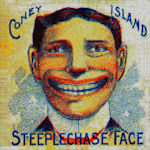
Ronald looked up at the "Steeplechase Face," the clown-like logo that was to become the iconic symbol for Coney Island in the years to come. That wide, toothy smile seemed to mock him. Although its lips remained fixed in an ear-to-ear smile, the face spoke to him.
Why don't you take a ride on the Thunderbolt?
The terrified man began to run, but the pain in his back eventually slowed his pace. He was barely able to walk by the time he reached the Half Moon Hotel.
* * *
Thursday was the first of August, and it was a hot, humid, sticky day. Jill was able to get the children into their bathing suits and out onto the beach with minimal difficulty. Ronald remained in the hotel room.
"Maybe a day or two of bed rest will help," he said.
"Or maybe you should ride the Thunderbolt instead."
"What did you say?" he asked, raising his voice in panic.
"I said that I'll bring you back some hot dogs later," Jill answered.
Once his family left the hotel, heading for the beach, Ronald closed his eyes and tried to sleep. But visions of the girl from the mutoscope haunted him and kept him awake.
Maybe if I had something to read, it would take my mind off all these bizarre experiences.
There were no newspapers or magazines in the room, however. But there was a Gideon Bible inside the drawer of the nightstand. Considering what lay ahead of him, reading the Bible might be a good idea. As people often did when seeking divine guidance, he opened a page at random, closed his eyes and blindly pointed to a spot in the text. He opened his eyes and read the words beneath his finger. They were from James 5:15.
"And the prayer of faith shall save the sick, and the Lord shall raise him up; thou shalt receive life everlasting when you ride the Thunderbolt."
Ronald dropped the Bible as though it had burned his hands.
"I must be losing my mind!" he sobbed.
His eyes went to the mirror above the hotel dresser. The leering smile of the Steeplechase Face looked back at him.
Why don't you take a ride on the Thunderbolt? it seemed to ask.
Anxious to escape from the waking nightmare, he ran from the hotel room, down the stairs and out onto the street. He saw the old man walking from the direction of the boardwalk.
"There you are," he said. "I missed seeing you this morning."
"I ... I ... s-stayed in b-bed," Ronald stammered.
"The pain getting to you?"
He nodded his head, and his hand went to his lower back.
"I'm in agony."
"You know it's not going to get any better."
"Yeah, I do. In fact, I imagine it will only get worse."
"And your family is going to have to watch you go through it all."
Ronald could not imagine what prompted the old man to say such a cruel thing.
"Naturally, I don't want them to see me die, but it's not as though I have any choice in the matter."
"You know what they say about those Band-Aids sold by Johnson & Johnson?"
"No, I don't. What do they say?"
"It hurts a lot less if you yank them off quickly rather than try to slowly remove them."
"What's that supposed to mean?"
"You're a smart guy. I'm sure you'll figure it out." As the old man walked away, he stopped, turned around and said, "Why don't you ride the Thunderbolt? And as you ascend the first hill, remember what I said about the Band-Aids."
A wrenching pain temporarily took Ronald's breath away. He squeezed his eyes shut and clenched his teeth.
I don't know how much more of this I can stand.
When he felt someone take his hand, his eyes immediately opened. There in the brightly colored world of Coney Island was the black-and-white girl from the mutoscope.
"Come with me," she said.
When the grayscale girl led him to the Thunderbolt, he put up no resistance. With little urging from her, he sat in the front seat of the roller coaster. And as the car made its climb up the first steep hill, his thoughts went to his wife and children. He remembered seeing the tears in Jill's eyes. She knew something was wrong; he was certain of it. Perhaps it was female intuition, or maybe his doctor had confided in her.
I don't want to put my wife and children through the hell that awaits me.
A sign above the apex of the hill read PLEASE REMAIN SEATED.
"Remember the Band-Aid," the girl with the gray complexion said. "It's best to yank it off."
"I suppose it would be better for my family," he said.
"It'll be over before you know it. It was for me. I didn't even feel anything when I hit the ground."
As the Thunderbolt's car reached the crest of the hill, Ronald stood up. The last thing he saw before falling out of his seat and pitching head first to the ground below was the wide, toothy smile of the Steeplechase Face.
* * *
"Someone must have gotten hurt," Jill announced when she saw the ambulance heading toward the Thunderbolt roller coaster.
"Let's go see," Dan said.
"I wouldn't do that," a voice said from directly in front of them.
Jill saw an old man blocking their way.
"It's best if you stay away," he whispered to Ronald Fraley's widow. "He wouldn't want the children to see him like that."
"Is it ...?"
She could not bring herself to say her husband's name.
"It was over quickly."
"But the children ...."
"Why don't you take them home to New Jersey? The sooner they get back to their normal routines, the sooner they'll adapt to their loss."
"Y-yes. I suppose you're right," she said, looking down at her now fatherless sons and daughter.
When she raised her eyes again, the old man was gone.
As Jill and her children headed back to the Half Moon Hotel, none of them saw the black-and-white man who followed closely behind. He was trying to speak to them, but like the girl in the mutoscope, although his lips moved, no sound came out.
I'll see you all again someday, he wanted to tell them.
But like young Dan was so fond of saying, it would be a lifetime until that day came.
I got to visit Luna Park at Coney Island this year (2021), but it is not the same park as it was in 1929. The Cyclone roller coaster still exists though. It is now a designated landmark on the National Register of Historic Places. As a fan of the smoother steel coasters, I found the wooden Cyclone a bit rough. (I felt I needed a chiropractor when I got off!)

What's Salem's favorite attraction at Coney Island? You guessed it! Nathan's hot dogs.


