Out of Order
As Jerome Hollandbeck and his lovely wife, Vivian, celebrated the turn of the century on the night of December 31, 1899, the wealthy industrialist silently congratulated himself on his ascension from the coal mines of Pennsylvania to a Fifth Avenue mansion in New York. He had shaken off the black dust of Scranton for the shimmering gold dust of Manhattan during the time of the Gilded Age.
When the final countdown to midnight began, Jerome took his wife in his arms in anticipation of a New Year's kiss. Although Vivian, a close relation of the illustrious Astor family, came to the marriage with a considerable net worth equal to his own, their union was one of love, not financial gain. Unlike many of the men in his social circle who felt trapped in a marriage of convenience and sought comfort in the arms of young, attractive mistresses, Jerome adored his wife. All he needed to achieve a life of perfect bliss was one or more children to complete their family. He sincerely hoped the new century would see the birth of a little Hollandbeck.
In March 1900, Vivian believed she was pregnant. While she did not want to make her suspicions public until the doctor confirmed them, she could not help sharing her excitement with her husband. As she had hoped, Jerome was overjoyed at the welcome news. The eager anticipation the young couple felt at the prospect of parenthood made the doctor's findings all the more difficult to bear. Not only was Vivian not carrying a child, but she was terminally ill as well. Her death in September 1900, at the tender age of twenty-four, left her husband inconsolable.
Notwithstanding his devastating loss, the stalwart former coal miner managed to go on. In all honesty, he would have preferred death to living alone; however, as a man raised on Christian principles, he feared that suicide would forever banish him from heaven and keep him from the woman he loved for all eternity.
With his wife gone, Jerome's life fell into a monotonous routine. Believing the only way he could survive was to stick to an inflexible schedule, he took life each day at a time, never looking forward to a brighter spot on the horizon. In due course, the days became weeks, the weeks became months and the months became years.
As the fifth anniversary of Vivian's death drew near, Jerome received a letter from his sister, Hetty, an unmarried young woman who still lived in Northeast Pennsylvania.
"It's been so long since I've seen you," she wrote. "I probably wouldn't recognize you if you passed me on the street. Can't you find the time in your busy schedule to visit?"
Jerome had always supported his family financially, ensuring that they led a life of comfort and wanted for nothing. Nevertheless, he felt a deep sense of guilt that he had not kept in touch with them except for the occasional letter and gift sent through the mail. Both his father and mother were gone now, and Hetty was all the family he had left. Still, he dreaded returning to Scranton even temporarily.
I have a better idea, he thought as he placed a bouquet of red roses on his wife's grave. I'll arrange for my sister to come to New York instead.
Despite not having seen one another for more than a decade, Jerome had no difficulty recognizing his sister when he met her train at Grand Central Terminal. She may have been a fully grown woman, but she was the same freckle-faced girl he remembered from his youth. Seeing her infectious smile, his sense of guilt and familial obligation vanished, and he felt the first taste of joy since Vivian had died.
* * *
The following week went by in a whirlwind of activity as Jerome gave Hetty a personally guided tour of New York. The siblings attended the symphony at Carnegie Hall and the Ringling Brothers Circus at Madison Square Garden. They picnicked in Central Park, rode over the Brooklyn Bridge and visited the Statue of Liberty and the recently constructed Fuller Building, the iconic triangular-shaped skyscraper that would later be known as the Flatiron Building.
"I'm having so much fun!" Hetty exclaimed as she and her brother dined at Delmonico's. "I almost hate to go home."
"Why don't you stay here in New York then?" Jerome suggested.
Although tempted by her brother's offer, Hetty declined.
"I can't."
"Why not? I've got plenty of room. And with our parents gone, there's no reason for you to remain in Pennsylvania."
"But my friends are there. Then there's my church and my job ...."
"What job? Why didn't you tell me you were working? I'll send you more money."
"It's not a paying job. I do volunteer work."
"There are plenty of opportunities to volunteer here in the city."
"Thank you, but no. Scranton is my home."
Jerome frowned. Surprisingly, he had enjoyed playing tour guide to his sister and dreaded the resumption of his lonely, monotonous existence. Seeing her brother's downcast countenance, Hetty attempted to cheer him up.
"What are we going to do tomorrow?"
"I thought we'd have dinner and then go to the theater. There's a production at the Olympia that my business associates tell me is quite enjoyable."
"Oh? What is it?"
"It's a musical called Little Johnny Jones written by a former vaudeville performer named George M. Cohan."
"It sounds like fun, but what about during the daytime?"
"Maybe I'll take you shopping."
Hetty seemed less than enthused at the idea.
"Is there something else you'd rather do?"
"Oh, yes!" she replied excitedly. "I'd like to go to one of Mr. Edison's phonograph parlors."
"Why would you want to hear music out of a phonograph when we've just visited the symphony?"
"It's the novelty of the experience. There's nothing like it in Scranton."
"I'm not surprised," her brother said derisively.
"Mr. Edison is a genius for inventing a way of recording music on a machine that anyone can replay and enjoy anytime!" Hetty added, her enthusiasm not dampened by her brother's sarcasm.
Jerome had no desire to travel downtown to listen to prerecorded music, but he did not want to deny his sister's request. Thus, early the following afternoon, he and Hetty entered the crowded parlor where people were queued up to listen to one of a dozen phonographs lining the walls of the room.
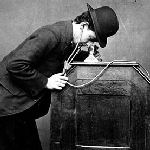
After patiently waiting ten minutes, it was finally Hetty's turn. She inserted the rubber listening tubes into her ears and put a coin in the slot. Her eyes widened with wonder when she heard "Ode to Joy" from Beethoven's Ninth Symphony.
"This is fantastic! You must try it, Jerry!" she insisted, pointing to an open phonograph near the rear window.
Jerome yielded to his sister's urging. After putting a coin in the slot, he closed his eyes and listened, but there was no music.
I don't hear a thing! Perhaps Tom Edison isn't quite the genius everyone thinks he is.
He was about to remove the rubber tubes from his ears when he heard a woman speak to him from the phonograph.
"Jerome?" the faint voice called to him.
With furrowed brow, he increased his concentration, trying to hear above the surrounding sounds.
"Jerome. It's me, darling: Vivian."
"What the devil!" he cried, feeling thunderstruck.
"Is something wrong, sir?" Elmer Brinley, the manager of the parlor, inquired in response to the customer's outburst.
"What's the meaning of this?" Jerome demanded to know.
"Oh, I'm sorry, sir. That particular phonograph is out of order. The sign must have fallen off."
"Listen to it and then tell me it's out of order."
Elmer put the tubes in his ears and inserted a coin. As he had explained, the phonograph was broken.
"Did you hear her?"
"Hear who? There's no sound at all."
Jerome grabbed the tubes and put them back in his own ears. He listened intently but heard nothing.
* * *
Hetty remained in New York for three more days. During that time, her brother was uncharacteristically subdued.
"Are you feeling all right?" she asked on the evening before she was due to depart on a train to Scranton.
"Yes," Jerome lied. "I feel fine."
True, there was nothing physically wrong with him; his mental state was another matter. Since hearing what he believed was his late wife's voice on one of Edison's phonographs, he could not get the eerie experience out of his mind. A pragmatist, he did not believe in spiritualism. In his world, people did not communicate with the dead. That meant only one thing: he was losing his mind.
The following day, Jerome accompanied his sister to Grand Central Terminal, where they said their goodbyes.
"I can't thank you enough!" Hetty exclaimed, hugging him tightly. "I had such a wonderful time!"
"Me, too," he admitted. "You'll have to come back again—soon."
"I'm looking forward to it."
She stared at his handsome face for several minutes as if trying to commit his features to memory.
I'm being silly, she thought, finally turning away and boarding the passenger car. It's not as though I'll never see him again.
After the westbound train pulled out of the station, Jerome returned to his carriage. Before entering, he ordered his driver to take him to Edison's phonograph parlor.
"Yes, sir," the man replied, showing no surprise at his employer's rather bizarre request.
Because it was still early in the morning, few people were waiting to hear the recorded music. Jerome walked to the first phonograph, put in the ear tubes and deposited his coin in the slot. Moments later, he heard Mozart's overture to "The Marriage of Figaro." On one hand, he was relieved that his imagination was not running rampant again; on the other, he was disappointed in not hearing Vivian's voice.
Without waiting for the music to end, he removed the tubes from his ears and turned to leave. As he headed toward the door, he saw the phonograph near the rear window, the one he had played on his previous visit. An OUT OF ORDER sign lay on the floor in front of it.
Don't be an ass! he told himself. You won't hear her voice out of that one either.
The fierce denial aside, he walked toward the malfunctioning phonograph. Reacting to a compulsion he was helpless to ignore, he reached into his pocket for another coin. There was no Mozart this time.
"Oh, Jerome! You're not going mad. It really is me."
He shouted for the manager.
"Listen and tell me what you hear," he ordered.
Elmer Brinley put the tubes in his ears and listened.
"Nothing. This unit is out of order. The sign must have fallen off. Here, let me refund your money."
"I don't want the damned money!" Jerome barked. "I just want ...."
Suddenly, he fell silent—not from embarrassment but from the simple fact that for the first time since early childhood, he did not know what he wanted.
* * *
A month went by. The people who saw Jerome Hollandbeck on a regular basis noticed a change not only in his demeanor but in his outward appearance as well. He lost weight, and his eyes looked as though he had not had a good night's sleep in weeks.
"You really ought to see a doctor," Calvin Sandburg, his attorney and close personal friend, advised after the quarterly board of directors meeting.
"There's no need. I'm feeling fine."
The well-meaning lawyer was not about to let the matter go so easily.
"My wife's sister is in town from Rochester. Why don't you come to our place for dinner tomorrow night and meet her?"
"No, thank you. I'm sure your sister-in-law is a lovely woman, but I'm not interested in meeting anyone at this time."
"Forgive me for speaking so bluntly, but I've only your welfare in mind. Your wife has been gone for five years now, and you're not getting any younger. She wouldn't want you to spend the rest of your life alone, mourning your loss."
"How do you know what Vivian would want? Maybe she's trying to find a way to speak to me, to tell me she's still here and that she's still very much in love with me."
"That's nonsense!" Calvin argued, his heart filled with compassion for the grieving widower. "Your wife is dead, but you have to go on living. Don't shut yourself off from the world."
Jerome had had enough of his friend's advice, however well-intentioned it was. He stormed out of the boardroom, slamming the door behind him. His secretary called to him, but he kept on walking.
"I'm going out," he announced over his shoulder as he entered the elevator.
Having no clear destination in mind, he absentmindedly walked the streets of New York. His mind had taken refuge in the past, reliving happy moments with Vivian. Two hours later, he slowed his pace and looked at his surroundings.
Where am I? he wondered.
With no recognizable landmarks to indicate his location, he walked to the nearest intersection to read the road sign. It was a street he had been on only twice before, once with his sister and once by himself. After making sure he had change in his pocket, he headed toward the Edison phonograph parlor, which was five blocks away. There was no hesitation in his step as he entered the front door and crossed the room to the phonograph near the rear window, now apparently in good working order. He remembered the routine: tubes in ears, coin in slot.
"I knew you'd come back."
A smile appeared on Jerome's face. He did not call for the manager this time. He had made up his mind to keep filling the phonograph with coins until his change ran out.
"I've missed you so much! Five long years—it seems like an eternity."
His tears building up, he closed his eyes and imagined Vivian standing beside him, speaking the words he was hearing. He had no idea what was happening or how any of it was possible, but he did not give a damn!
When Jerome eventually ran out of coins, he went to the bank across the street and got change for a twenty-dollar bill. Hour after hour, he listened to his wife's voice assuring him that she had not forgotten him, that she loved him with all her heart and that they would soon be together again.
As nine o'clock neared, Elmer Brinley approached the parlor's only remaining customer.
"We close at nine, sir," the manager informed him.
Jerome reluctantly removed the tubes from his ears.
"I want to buy this phonograph," he said, reaching into his pocket for his wallet.
"I'm sorry, sir, but it's not for sale."
"Money is no object; just name your price."
"I'm afraid I can't do that. Mr. Edison has a strict policy regarding the sale of the equipment."
"What Mr. Edison doesn't know won't hurt him."
The industrialist began thumbing through bills of large denomination. It amounted to more money than Elmer would make in a lifetime. To the manager's credit, he could not be bribed.
"I'd be risking my job."
Hollandbeck was not to be deterred.
"Sell me this phonograph, and I'll give you a job myself. I'll even double your salary, triple it."
"I'm sorry, sir, but no."
"Very well. I bid you good evening then."
Although he admired Brinley's scruples, Jerome was desperate to gain possession of the phonograph. If necessary, he would resort to more drastic means.
* * *
Four days later, assured of a dark, moonless night, Jerome made his move. Dressed in black from head to toe, he quietly tiptoed down a back alley until he found the rear entrance of Edison's phonograph parlor. Using a chisel and hammer, he managed to pry open the locked door. Only after he was safely inside did he turn on his battery-operated flashlight. He knew the exact phonograph he wanted: the one near the rear window. To his horror, the spot was empty.
What happened to it? he wondered, feeling the panic rise inside him.
As he shone the beam of the flashlight around the room, looking for the missing machine, a policeman walking his beat saw the erratic light and decided to investigate. He sneaked around to the back door and went inside. Seeing an intruder, he went for his .32 Colt police revolver.
"Hands up!" he bellowed, aiming the gun at the burglar.
Jerome, who counted the mayor one of his personal friends, had no fear of being arrested, knowing full well that all charges would be dropped. He immediately lifted his hands up in the air and put up no resistance. As he was being taken away, he spied a phonograph in front of the door to the loading dock. The OUT OF ORDER SIGN was lying on the shipper's desk beside it.
There it is! The manager must be planning on shipping it back to Edison's factory to be repaired.
If such were the case, he might never hear Vivian's voice again! Forgetting about the police officer, he ran to the phonograph, put the rubber tubes in his ears and reached into his pocket.
"Oh, no, you don't!" the lawman declared, trying to put a pair of handcuffs on his suspect.
Somehow, Jerome managed to get the coin in the slot before the cuffs locked into place.
"Darling! We can be together again—for all eternity," Vivian promised. "But you must act quickly because we haven't much time."
"What do you want me to do?" Jerome asked aloud.
The police officer, believing the culprit was talking to him, replied, "I want you to just remain calm and come along with me to the station."
"You have to get away. Go back to our house. I'll be waiting there for you. Hurry, Jerry!"
Jerome did not think; he merely reacted to his wife's demands. He pushed the policeman aside with his shoulder and ran. He made it as far as the rear exit before a .32-caliber bullet took him down.
* * *
Elmer Brinley was woken up by the police in the middle of the night.
"Where are you going?" his wife asked, half-asleep.
"I have to go downtown. Apparently, there's been a break-in at the phonograph parlor."
"Do you keep any money there?"
"There's a supply of change, but it doesn't amount to much. My guess is that a bunch of hooligans broke in to vandalize the equipmemt. The police want me to go down there and see if anything is missing."
"Be careful," his wife cautioned as he left the house.
Once Elmer Brinley identified himself as the manager of the establishment, the police let him inside. Thankfully, Jerome's body had already been taken away. After a close examination, he concluded that, other than the broken lock on the rear door, nothing had been disturbed. Even the money in the till was where he had left it when he closed up shop the previous evening.
"Everything appears to be in order," he informed the police officer in charge of the crime scene. "So I'm going to go home now."
As he was walking toward the rear door, he saw a pair of rubber tubes lying on the floor beside the recently repaired phonograph. When he picked them up, he heard a faint sound coming from them. He placed them in his ears.
That's strange, he thought. I could swear I heard a man and a woman talking.
Since there was no music coming from the primitive earphones, he assumed the unit had not been repaired after all. He would have to return it to the factory rather than put it back on the floor. Before he left for home, he nonchalantly placed the OUT OF ORDER sign on the phonograph, unaware that Mr. Edison's extraordinary machine had recently reunited Jerome Hollandbeck with his beloved Vivian.
I bought Salem an Edison phonograph for Christmas. He spent hours on the internet trying to learn how to upload his playlist onto it.


