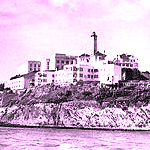
Ghost of Alcatraz
The prisoner shivered in the cold, damp cell and tried to pass the time by reciting the names and positions of his favorite major league baseball players. He didn't know how long it had been since they had put him in there. Locked in solitary with no sounds, no light and no distractions to occupy his mind or ease his loneliness, he lost all sense of time. It was as though he had been buried alive. He wondered how long it would be before being confined to this dark, silent tomb finally broke his spirit, before he was driven to the brink of insanity, before he went over the edge ...
Sean Kelly woke with a start, his heart pounding rapidly in his chest and beads of perspiration dampening his body. He looked around the room, eager to reassure himself that he was safe in his own bed. Out the bay window, he could see his own backyard and beyond that the blue Atlantic.
It was only a dream, a nightmare, he realized with relief.
He ought to be used to nightmares by now, having suffered from them for as long as he could remember. Sean supposed that he should be thankful for his bad dreams since, in a way, nightmares were his business. Although not in the same league—and tax bracket—as Stephen King, Sean Kelly was a modestly successful writer of horror stories. So far, he had written more than a dozen thrillers, the last four of which made it to The New York Times bestseller list. In fact, his most recent one made it all the way to the number three position, topped only by Tom Clancy and John Grisham.
"But," he said with a sigh as he rose from his bed, "if I ever want to write a fifth bestseller, I'd better come up with a good idea."
The subject of his next book, or rather the lack of one, had plagued Sean for weeks. No doubt that was why he was having so many nightmares. Early in his career, he discovered that the problem with writing horror fiction was trying to come up with an original idea or a new slant on an old one. Tales of vampires, witches, werewolves, zombies and mad scientists had been told so often that it was hard to think of a fresh approach.
That was one of the reasons Sean greatly admired Stephen King. He had the uncanny ability to come up with unique material: a child-eating monster who assumes the guise of a killer clown, a 1958 Plymouth Fury that not only eliminates its owner's enemies but repairs itself as well, a telekinetic prom girl who gets doused with a bucket of pig's blood and an isolated hotel that can transform a loving father into a homicidal maniac. Yet the great master of the macabre could also write a story about something as ordinary and simple as a mother and son being trapped in a car by a rabid dog.
If only I had King's imagination!
Throughout the morning, Sean tried to concentrate on potential plots for his next book but found that he couldn't get the dream out of his head. He had felt terrified inside that cell, but he didn't know exactly why.
"That's it!" he exclaimed with a combination of triumph and relief. "I'll use my dream as inspiration and write a story about a prisoner being held in solitary confinement. But I don't want the setting to be an imaginary prison. I want to use a famous one, a prison my readers will identify with, one whose name itself will kindle fear in their hearts and minds."
The choice was an easy one. There was one prison that had left an indelible mark on the American psyche: Alcatraz.
Sean spent the afternoon on the Internet doing research on San Francisco's legendary and infamous federal penitentiary. He learned that the twenty-two-acre island situated in San Francisco Bay was made entirely of rock covered by a thin layer of dirt. Since there was no fresh water supply, the island was uninhabitable except for its bird life. In fact, the Spanish who first sighted the island in 1769 called it La Isla de los Alcatraces, which meant "Island of the Pelicans."
In 1854 a lighthouse was constructed on the island, and in 1858 the United States Army built a fortress and military prison there. Then in 1933, the island was turned over to the Department of Justice. The existing buildings were demolished, and a new state-of-the-art prison was constructed. The "Rock," as it came to be known, was said to be escape-proof and once housed such infamous criminals as Al Capone, Machine Gun George Kelly, "Creepy" Alvin Karpis, James "Whitey" Bulger and the Birdman of Alcatraz, Robert Stroud.
"Now that I have a setting and a main character for my novel," Sean wearily said with a sigh as he prepared for bed that night, "all I have to do is decide what to do with them."
* * *
The prisoner bit into the chunk of stale bread, one of two daily meals he received in the hole. The faint pineapple taste of mold made him gag, but he tried his best to keep the bread down. It would be hours before he would get anything else to eat. Besides, if he got sick, perhaps the guards would transfer him to the hospital ward. It was doubtful, he knew, but still possible. As he forced down another bite of hard, moldy bread, he heard the unseen rats scurrying around the cell. Sometimes he was thankful for the darkness ...
Sean had the dream again that night. He had found himself in the same dark, damp cell. It was not a replay of the previous night's events but rather a continuation of them. This dream seemed to have picked up where the previous one had left off, like a serialized television program.
The yawning writer made his way down to the kitchen, and while drinking his morning cup of coffee, he started outlining his plot. He had decided to go with the old standby: a ghost story.
"And why not?" he reasoned.
People have loved ghostly tales for centuries. Some of the greatest writers in literature wrote them. If ghost stories were good enough for Charles Dickens, William Shakespeare, Robert Louis Stevenson, Oscar Wilde, Henry James and, of course, Edgar Allan Poe, they ought to be good enough for Sean Kelly. And Sean's plot was original: he had decided to write about a man locked in solitary confinement with only a ghost to keep him company. To his knowledge, no one had ever tackled that storyline before.
Chewing on the end of his pencil, Sean considered the ghost.
Who could it be? Perhaps the spirit of a murder victim comes back to haunt his killer. Nah, most readers would figure that one out by the end of the second chapter.
He wanted to write a story with an ending that would take everyone by surprise.
Maybe the ghost could be that of a former guard, one so dedicated to his job that he continues his duties even after death. Yeah, right! I'm writing a horror novel, not a fairy tale. What about a former prisoner then?
Sean liked that idea.
Now, the next question: why would the ghost of a former prisoner haunt the place where he'd been incarcerated? Had he been executed at the Rock and his soul condemned to remain there after death? Sean quickly rejected that idea. It was a bit too much like Jacob Marley having to wander the world wearing the chains he forged in life. Besides, during his online research, Sean read that no executions had ever taken place at Alcatraz.
Perhaps the prisoner was killed while attempting to escape. That seemed plausible, especially since prison officials often boasted—in fact, they fervently insisted—that Alcatraz was an escape-proof prison. There had been fourteen escape attempts, most of which ended in death. Yet five men who managed to get out of the prison were never seen or heard from again, and despite the absence of bodies, the escapees were presumed to have died. Sean tended to agree with this conclusion. After all, the Rock was situated on an island surrounded by the icy cold, shark-infested San Francisco Bay. It was doubtful that someone escaping into the water could make it to shore alive.
A foiled escape it is!
Once he had the general idea for his plot, Sean began the actual writing process. Over the next several months, he carefully developed that idea, adding characters, dialogue, subplots and all the little supporting details and plot twists that go into a good story. With his keen imagination and creative writing talent, Sean Kelly wove his tale of a man who died in the icy Pacific while attempting to escape, and although the prisoner's body was never found, the man's ghost returns to the Rock and befriends a forlorn prisoner locked away in cell thirteen of block D, one of Alcatraz's four solitary confinement cells. In turn, the unfortunate inmate, who had been stripped, beaten, imprisoned in the darkness of the hole and forced to exist on a diet of bread and water, was grateful for any companionship he could get, even that of a dead man.
* * *
The prisoner had worked his way through not only his favorite ballplayers but also the rosters of every major league team several times, reciting the names over and over again. Now his mind concentrated on the works of two of his favorite authors: Jules Verne and H.G. Wells. He had always loved their tales of space exploration and time travel ...
As work progressed on the new book, Sean decided that the events in his story would take place in the mid-1930s, during the time of the Great Depression as well as the time when the infamous Al Capone was incarcerated in Alcatraz. Maybe he would even find a clever way to work the notorious gangster into the storyline.
Meanwhile, the dream, or rather the series of dreams, continued to plague his slumber. It was as though every night when Sean fell asleep, the phantom inmate woke up. Surprisingly, the prison in his dreams turned out to be Alcatraz. Or, maybe it wasn't so surprising after all. His preoccupation with the penitentiary during the day must be spilling out of his subconscious at night.
The setting of these nightmares was always the same: the dark, cold, lonely cell. Only the prisoner's feelings and memories distinguished one installment from another.
As the dream sequence evolved, Sean learned more about the prisoner of whom he dreamt. While still in school, the young man had longed to become a writer like F. Scott Fitzgerald. But then came the stock market crash and the resulting catastrophic economic depression. He was forced to quit school and go to work. Unfortunately, with so many businesses closing, legitimate jobs were hard to come by, and the young man eventually became involved with a group of small-time hoodlums.
Sean decided to incorporate the images he saw in his dreams into the background description of the prisoner in his book (the living one, that is, not his ghostly companion). Each night he slept with a pen and pad by the side of his bed in order to get every detail of his dreams on paper. Upon waking up each morning, the author immediately wrote down the new developments from the previous night before he could forget them.
As the first draft of his book was nearing completion, Sean could sense that his serialized dreams were reaching a conclusion, too. He had lately seen images of the prisoner being involved in a shootout that resulted in three dead police officers. The young man had then been arrested, tried and convicted. After several attempts to escape from state prison, he was sent to Alcatraz.
By the first day of November, just six months after he wrote the opening sentence of his novel, Sean was within pages of finishing it. He sat at the computer, his eyes burning as he read the words on the screen. He had been writing since five in the morning, and it was now after midnight.
I'm so close to completing the first draft, he thought, fighting his exhaustion.
Finally, he turned off the computer; he had to get some sleep. The book would have to wait until tomorrow.
* * *
The hole. Hell was a more apt description of such a place. All it lacked were the flames and the scent of brimstone. Men had gone crazy down there, driven mad by the feeling of isolation. But it wasn't the solitude and loneliness that really got to this particular prisoner; it was the boredom. Sitting there hour after hour, day after day, he had nothing to do but daydream. He just had to get out, to escape somehow, anyhow ...
Sean woke from the nightmare, not knowing it would be his last. He rubbed his eyes, stretched and hurried downstairs for a quick cup of coffee, after which he would shower and begin work. Barring any unforeseen circumstances, he was sure to finish the book that day. Then maybe he would take a week off and do some sailing before he began the long, tedious editing process. He'd put in too many long nights working on this one, and it was beginning to take its toll on him.
Sipping a strong, freshly brewed cup of coffee, he sat at his desk, staring out his bay window at the blue Atlantic. A deep feeling of peace and contentment came over him, knowing that he was safe and secure in his home on the Island of Nantucket, three thousand miles away from that infamous island just off the coast of San Francisco.
The writer turned on his computer and clicked open a file. He wrote throughout the morning and into the afternoon. At precisely 3:05 p.m., he typed the final two words: THE END. Then he leaned back in his chair and closed his eyes.
A sudden pain shot through his head, followed by a wave of dizziness and nausea. When he opened his eyes again, Sean feared that his vision was failing. The words on his computer screen seemed to be fading.
I really need some rest, he thought. I hope I'm not coming down with the flu.
With a growing sense of panic, he watched the words on the screen disappear, followed shortly by his computer monitor, his keyboard, his desk, his den, his house ...
* * *
The prison guard opened the door of cell thirteen of block D. He called out to the prisoner, but there was no response. The guard then shined his flashlight into the darkness of the cell. He found the prisoner slumped in a corner against the wall, dead. When the guard returned to the guard station, he filled out the entry in his logbook: "November 1, 1933, 3:05 p.m., Prisoner Number 12098 found dead in his cell."
Prisoner Number 12098, known to the world outside those prison walls as Sean Patrick Kelly, would have done anything to escape from the dreaded hole. He discovered, while locked away in that dark, cold cell, that there was only one way out, and that was through his own imagination. Unfortunately for Sean Kelly, he had forgotten that Alcatraz was an escape-proof prison and that those who made the attempt died in the process.

No, Salem, you're not the Birdman of Alcatraz.


