
Crayon Drawings
Little Jeremy Hawkes loved to color. For hours on end, the five-year-old child would sit at his Fisher-Price Sesame Street table with his latest coloring book and his sixty-four-count box of Crayola crayons, happily oblivious to the world around him.
Jeremy was systematic in his coloring: he would start on the first page and color each subsequent sheet of paper in sequence, gradually working his way through the book to the last page, coloring nearly every square inch of the book's surface.
Sonya Hawkes, Jeremy's doting mother, would usually sit nearby, reading or watching television while keeping careful watch over her only child. With the boy's father dead for more than two years, Sonya had built her world around her son. This was to be expected since the boy was all the family she had left after her husband had been killed while serving in Iraq.
Had Jeremy been like other children his age, this predominantly sedentary existence would no doubt have worried the boy's mother. Her son, however, had been born deaf, and, despite the best efforts of a number of dedicated teachers, he had not yet learned to speak, sign or read lips. Living in a soundless, voiceless, wordless world, the boy's only form of expression was through his crayons and coloring books.
Jeremy took the first step toward more meaningful communication one day after he finished coloring the last page of a Thomas the Tank and Friends coloring book. He placed Thomas the Tank on top of a pile of completed books in his bedroom closet and went to his bookshelf to get a new one, but to his disappointment, there were no more there. His mother had obviously forgotten to buy one when she did her grocery shopping the previous day.
Without a book to color, the child had nothing to do with his spare time. He wasn't able to read yet, and television bored him since he usually didn't understand what was happening on the screen. Instead, he retrieved an old book from the pile in his closet and walked to the kitchen where his mother was making dinner. He reached up and tugged on the hem of her blouse.
"What is it, honey?" Sonya asked, even though she knew he couldn't hear her.
Jeremy handed his mother the completed Muppet Babies coloring book.
"Oh, no!" she exclaimed, putting her hands on her forehead. "I forgot to get you another book yesterday, didn't I?"
Her son stared up at her with a vacant expression on his face, not comprehending a single word she said. But when she lovingly smiled down at him, Jeremy knew the new coloring book would soon be forthcoming.
Sonya decided that after dinner she would drive to the nearby Walmart and buy the boy an assortment of coloring books, but until then she would have to improvise a way to keep him occupied. She went to the family room, took a thin stack of white paper out of her computer printer and then sat at the dining room table beside her son. Picking up a pencil, she demonstrated how to draw a train on the blank sheet of paper.
Jeremy was a bright child, and in spite of his inability to hear her words, he understood his mother's actions. He took the paper back to his bedroom, selected a blue crayon out of his box of Crayolas and started to draw.
Initially, the little boy's crayon drawings were similar to those one would expect of any five-year-old child: stick-figure men and women, umbrella-like Christmas trees, simple four-petal flowers, square and triangle houses with picket fences and crude renderings of different types of animals. As he got more practice at drawing, however, his pictures became more detailed and showed signs of a potentially promising artistic talent.
Once Jeremy experienced this new, far more creative form of self-expression, he was no longer content to merely color the illustrations he found in his mass-produced books. In fact, he soon lost all interest in coloring Sesame Street, Nickelodeon or Disney characters. He much preferred drawing scenes from his own vivid imagination.
Like nearly all young children, Jeremy took great pride in his artwork and enjoyed the praise he received from his parent. Whenever he finished a new crayon drawing, he would present it to his mother, who would then proudly display it in the place of honor on the refrigerator door. The drawing would hang there until the completion of the next masterpiece, which was usually the following day.
Over the next several months, the freezer door of Sonya's Frigidaire displayed an impressive collection of tail-wagging dogs, galloping horses, tree-climbing calico cats, floating boats with billowing sails, speeding race cars and chugging, smoking train locomotives, as well as the everyday things Jeremy saw in school or while he was riding in the car with his mother.
As her son's artistic skills steadily improved, Sonya wondered if somewhere there might be a school or an individual who offered art classes to the hearing impaired.
I'll have to check into that, she thought, as she hung up a drawing of New Jersey's Barnegat lighthouse. Who knows? Jeremy might be the next Thomas Kinkade.
* * *
Unfortunately, what began as an innocent childhood pastime eventually changed into something much more sinister. Shortly before dinner one evening, Jeremy handed his mother his latest artistic creation. At first, Sonya didn't understand what her young son had tried to draw.
The mother smiled and nodded her head to show the boy her gratitude. He was happy that he had pleased his mother and took his place at the kitchen table.
She carefully studied the crayon picture from every angle before she finally realized with horror that it was a sketch of an airplane, not one soaring through the air but one that had crashed and was lying broken into two sections on the ground. Vivid orange, red and yellow flames seemed to consume the wreckage.
Sonya desperately wanted to ask Jeremy why he had drawn such a dreadful scene, but she had no idea how to pose the question in such a way that Jeremy would understand. Finally, she reluctantly hung the picture on the refrigerator door, and for the rest of the night tried to put the disturbing image out of her mind, with little success.
The following morning, as Sonya was brewing a cup of coffee for herself, she went outside to retrieve The Oak Valley Courier that her paperboy had thrown on the steps of the front porch. With newspaper in hand, she went back inside the house, fixed Jeremy a bowl of Honey Nut Cheerios, poured him a glass of apple juice, sat down at the kitchen table and opened the Courier.
The headline seemed to jump off the page: AMERICAN AIRLINES FLIGHT CRASHES. She quickly scanned the article beneath: an American Airlines Boeing 767 had gone down in a central Pennsylvania cornfield and burst into flames, killing all 187 passengers and crewmembers onboard. When Sonya flipped the paper over to read the continuation of the article at the bottom of the page, she caught her breath in shock. The UPI photograph of the flaming wreckage was uncannily similar to Jeremy's crayon drawing.
* * *
During the following weeks, Jeremy's drawings once again reflected the innocent, childlike creations of a highly imaginative little boy. He drew an ocean full of brightly colored fish and shells, a rolling green hill dotted with purple and yellow wildflowers, a frowning Halloween Jack-o-lantern and a three-tiered frosty snowman complete with a red scarf, two coal nugget eyes, a corncob pipe, a black top hat and a carrot nose.
Sonya had all but forgotten about the disturbing crayon drawing of the plane crash in Pennsylvania when in early September Jeremy presented his mother with another rather gruesome picture.
British punk rocker Vanity Fair was one of the most popular rock stars of the day. Her trademarks were her purple and red streaked spiked hairdo, her tattoos, her body piercings, her outrageous wardrobe and her gothic makeup.
Jeremy's crayon drawing depicted a young woman with purple and red hair lying on her back across a bed. The chalk-white face, blood-red lipstick and heavy Night-of-the-Living-Dead eye makeup were undoubtedly those of Vanity Fair as were the distinctive nose and eyebrow rings. But what disturbed the boy's mother most about the drawing were the woman's lifeless, staring eyes and the hypodermic needle sticking out of the singer's arm. To Sonya's knowledge, Jeremy had never seen a photograph of Vanity Fair, and he certainly was too young to understand about intravenous drug use. So why had Jeremy drawn such a picture?
Early the following morning Sonya paced the living room floor, anxiously waiting for the paperboy to deliver The Oak Valley Courier. When the newspaper finally arrived, she quickly opened it, anxiously looking for any reference to the punk rock star. To her relief, the singer's name did not appear in either the headlines or the obituaries. In fact, the worried mother could not find Vanity Fair's name anywhere in the paper.
Breathing a sigh of relief, she made breakfast, got dressed and, after dropping Jeremy off at school, headed toward her office.
As she drove down the highway, Sonya listened to two early morning deejays on WKMH joke about the Rolling Stones' Mick Jagger and Keith Richards being older than VCRs, cable television, cell phones, personal computers and microwave ovens. In the midst of their humorous exchange, the station's news announcer broke in with a special bulletin: Grammy-award-winning rock singer Vanity Fair had been found dead in her fashionable London apartment earlier that morning.
"The twenty-seven-year-old punk rock star," the newswoman concluded, "had been the apparent victim of a lethal heroin overdose."
Sonya started trembling so violently that she couldn't drive. She was forced to pull the car onto the shoulder of the road and wait until she regained her composure before continuing to work.
What is going on? she wondered. Jeremy drew his picture of Vanity Fair yesterday afternoon, yet the singer was still alive then.
It did not take Sonya long to grasp the implications of the situation. There was only one conclusion she could draw: her young son, her baby, was psychic. Cut off from all sounds since birth, Jeremy had apparently been given another sense to compensate for the absence of hearing: a sight into the future.
Sonya knew all too well the dangerous drawbacks that accompanied this "gift." Psychics were often ridiculed, condemned as fakes or lunatics, harassed by people inquiring about their lost loved ones or sought out by law enforcement agencies seeking their help in finding solutions to unsolved crimes. The protective mother vowed she would never subject Jeremy to such an existence. There was only one way to deal with his psychic abilities: she must keep them a secret at all costs.
Perhaps, she thought optimistically, he might even outgrow them in time.
In the months that followed, however, Jeremy rendered three more of his psychic visions in crayon. The first was of a beloved former professional football star who had hanged himself in his ex-girlfriend's basement after she ended their eighteen-year-long relationship. The second depicted a pickup truck carrying eight teenagers who had been hit by a commuter train at a railroad crossing. The third was a drawing of the execution of a condemned serial killer in Texas. All three of these visions, like Jeremy's previous ones, came true.
Although Sonya had little choice but to accept Jeremy's strange new talents, she also came to dread them.
* * *
The second Saturday in November proved to be a fateful day in the lives of little Jeremy and Sonya Hawkes. For the first time in over two years, the child failed to give his mother the crayon drawing he had completed. The medieval castle with its moat, turrets and drawbridge that he had drawn and colored the previous day was still given the place of honor on the refrigerator door.
Sonya knew her son had been busy drawing at his Sesame Street table all morning, yet he hadn't shown her the finished picture. Curious yet somewhat apprehensive, the mother went into the boy's bedroom where she saw his familiar, well-worn sixty-four-count box of Crayola crayons and his thick drawing pad lying on his desk.
Where's the drawing he was working on? she wondered.
She rifled through the pages of the pad, but the sheets were all blank. Then she opened the desk drawer and looked inside; there were no pictures there either. Her eyes scanned the room. Jeremy had not hung his drawing on the wall or left it lying on either his dresser or his bed. Perhaps he had it with him, intending to complete it when he came in from playing outside.
Sonya shrugged and abandoned her search. She was sure Jeremy would give her the drawing in his own good time. Meanwhile, she had a house to clean and clothes to wash.
As she turned to leave her son's bedroom, Sonya caught a glimpse of white paper in his Toy Story wastebasket. A sheet of drawing paper had apparently been crumbled into a ball and thrown away. She leaned over and picked up the discarded artwork. When she opened it and saw the picture that Jeremy had drawn, she screamed, clutched her chest and collapsed onto the carpeted bedroom floor.
* * *
Clark Vanson of the Oak Valley Police Department, the responding officer, shook his head in response to the question asked by the Hawkes' next-door neighbor, Mrs. Henderson, who had phoned 911 when she heard a woman's scream coming from inside the house. Mrs. Henderson understood the gesture: her young neighbor was dead. The old woman turned away to hide her tears from the police officer.
"That poor boy," she said, looking out the window at Jeremy playing on his swing set in the backyard, blissfully ignorant of his mother's death. "First he lost his father, and now ...."
She couldn't continue.
"What's this?" she heard Clark ask.
Mrs. Henderson turned and saw the police officer kneeling beside Sonya's body and holding a crumpled sheet of paper.
"Oh, that's probably one of Jeremy's crayon drawings. He does them all the time. He's quite an artistic little boy."
Mrs. Henderson glanced over Officer Vanson's shoulder at the picture he held in his hand. She gasped in horror at what she saw, for Jeremy's most recent crayon drawing was a perfect rendering of Sonya Hawkes lying dead on her son's bedroom floor.
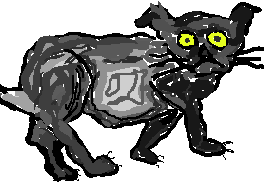
No, Salem, I don't think Crayola will give you a refund even though you only used four colors from the 64-count box.


