
Barbie's Dream House
Monica Schaefer grew up in the late Fifties and early Sixties when the world had yet to hear of Bill Gates and Steve Jobs, a time before American households became inundated with technology and youngsters turned to video games, prerecorded movies, cable television, cell phones, personal computers and iPods for entertainment. Children of her generation played with simpler toys: scooters, hula hoops, jump ropes, paper dolls, marbles, jacks and Colorforms.
When Monica was a little girl, she loved to play with dolls, and in the years before the advent of hi-tech toys, there were a large number of them from which to choose: dolls made of porcelain, vinyl and cloth. There were dolls that could walk, talk, cry, wet and drink from a bottle.
Among Monica's favorite dolls were Raggedy Ann, Patty Play Pal, Tressy, Tammy, Thumbelina, Betsy Wetsy, Pebbles Flintstone and Chatty Cathy. More than any other doll, however, she loved Barbie, Mattel's iconic eleven-inch-tall fashion doll. While her older sister, Anne Marie, was the proud owner of the 1961 version with the ponytail and curly bangs, Monica owned the newer model, the one with a stiff, short bouffant hairstyle often referred to as the "bubble cut."
Little Monica never tired of playing with her Barbie. For hours on end, she would dress the doll in a variety of outfits, including a blue corduroy jumper, an apple print sheath, a red cheerleader outfit, and a pink satin evening gown, all accessorized with miniature plastic high-heeled shoes, hats, gloves, purses and jewelry. Using her imagination, she created all sorts of scenarios for her Barbie doll: working, shopping, sunbathing, going out on a date and many other activities little girls associated with being a grown-up woman.
These make-believe situations were easier to enact when Monica added Barbie's best friend, Midge, a freckle-faced doll with her hair worn in a tightly curled flip, to her collection. Midge was soon followed by Barbie's little sister, Skipper, and, more importantly, Barbie's boyfriend, Ken.
Along with the new dolls, Mattel offered more outfits and accessories for the existing ones. Soon Ken, dressed like a football player, and Barbie, decked out like a Japanese geisha, were riding across the Schaefer kitchen floor in their own orange plastic Austin-Healey convertible.
As Monica got older, however, she outgrew the desire to play with dolls. Quite naturally, she preferred to spend her allowance on clothes and shoes for herself rather than for Barbie. Her teenage years brought with them a greater interest in school, girlfriends, rock and roll music and boys.
One boy, in particular, dark-haired, blue-eyed Justin Haggard, attracted her attention. At first, Justin took little notice of the thirteen-year-old Monica, but once he entered puberty and Monica's baby fat was redistributed to form provocative curves, his interest in her blossomed.
* * *
Inevitably, the Sixties came to an end and the Seventies began. Monica and Justin graduated from high school in June of 1973. She immediately started working as a typist for a life insurance company in Wayne, New Jersey, while he went on to attend a local college. Four years passed, and then, just three days after her twenty-second birthday, Monica and Justin were married.
For the young newlywed wife, marriage meant overwhelming responsibilities. The Donna Reed days of the Fifties and early Sixties, where men were the breadwinners and women stayed home cleaning the house and baking cookies, were as much a part of the past as the bubble-cut Barbie. It was now the age of the liberated woman, and Monica, after putting in an eight-hour day at the office, still had to come home each night and cook dinner, clean the house and do the laundry.
"You know," she complained to her husband one evening when she was ironing his shirts at ten o'clock at night, "it wouldn't hurt you to help out a little around the house."
"What do you mean? I do plenty of work around here," Justin argued. "I mowed the lawn all summer long. I raked the leaves in October and now I shovel the driveway every time it snows."
"I'm talking about housework, not yard work. I don't want to sound like a nagging housewife, but I work just as many hours at my job as you do, and yet I have to make the bed and prepare breakfast every morning. When I come home each night, I have to cook dinner, wash and dry the dishes, dust the furniture, vacuum the carpets and then wash, dry and iron the clothes. I would appreciate a little help. Maybe while I'm cooking dinner, you could vacuum the rug."
Justin, a confirmed male chauvinist from a long line of similarly-minded men, rolled his eyes with annoyance.
"That's women's work," he said, parroting what he'd heard his father say many times.
"Women's work? Jesus, Justin! You do know it's the twentieth century, don't you? Because you sound positively medieval."
"Don't start with all that women's lib crap. My father never did dishes or laundry, and I'm not about to start."
"Your mother didn't work outside the home either. She was what everyone is now calling a stay-at-home mom."
Sadly, Monica's arguments fell on deaf ears. Justin was not about to change his mind. From that point on, she stoically bore the uneven workload without any further complaints. Once she and Justin became parents, she reasoned, she would stop working, and the balance of work would be restored, or at least shifted more in her favor.
Fate, however, saw fit to make motherhood an unattainable goal. Although fertility doctors had given them both clean bills of health, the Haggards were never blessed with children.
Men, in general, adapt to childlessness better than women do. This was certainly true in Justin's case. What energies he might have spent being a father, he poured into his job.
The upside of this situation was that the Haggards joined the upwardly mobile yuppies of the Eighties. Not only were they able to purchase a house in the upscale Smoke Rise section of Kinnelon, but they also had money left over to spend and invest for the future. The downside was that their marriage gradually deteriorated and what little happiness they had disintegrated.
With Justin bringing home six figures a year, there was no longer a financial need for Monica to work. Yet although she quit her stressful job at the insurance company, she found part-time employment at a toy and gift shop. Since her husband worked sixty to seventy hours a week, she was home alone most of the time. Working at the toy store gave her some much-needed contact with other people.
It was while working at this shop that she developed a renewed interest in dolls. Monica was surprised to see that the most recent generation of Barbies bore little resemblance to Mattel's original fashion doll. Gone were the heavily blue- and black-lined eyelids, the eyes that always glanced mysteriously to the side, the rosebud-shaped lips and the tight, Brillo pad-like Saran hair that always held its shape. Where the early Sixties doll possessed an air of sophistication, her Eighties counterpart looked more like a "dumb" blonde, with a massive Farrah Fawcett-style head of hair that lost its shape not long after the doll was removed from the package, leaving the world's most famous toy icon with a perpetual bad hair day.
Like his famous girlfriend, Ken had also undergone several transformations over the years. The first version of Mattel's male doll had always reminded Monica of Jerry Mahoney, Paul Winchell's ventriloquist dummy. The original Ken had flocked, "peach fuzz" hair that gradually wore away, leaving him as bald as actor Yul Brynner. (Alas, the first Ken had been designed before the advent of Rogaine.)
The later versions of Barbie's perennial "significant other" were a big improvement—hair-wise, anyway. The peach fuzz was gone for good; his crew cut was subsequently painted on. In some models, he had rooted hair similar to Barbie's, only much shorter. The Mod Hair Ken even boasted a detachable beard and mustache, which when worn gave him a strong resemblance to Charles Manson. Fortunately, the majority of Kens looked more like athletes, rock singers and movie stars and less like crazed cult leaders.
Seeing the large selection of dolls Mattel now had to offer—a plethora of Barbies and Kens as well as friends, cousins, brothers and sisters in a politically correct mixture of ethnicities—Monica decided to become one of a growing number of serious adult collectors.
Although she was a latecomer to the Barbie craze, in a relatively short time, her collection grew to an impressive number. Thanks to doll shows, flea markets and eBay, she was able to purchase a large number of limited editions, annual holiday dolls, department store exclusives, porcelain reproductions of the classic Barbies and dolls wearing lavish costumes designed by Bob Mackie. These treasured collectibles—some so high in price that they were payable in monthly installments—were kept in their original packages and safely stored on a shelf on top of the guest bedroom closet.
"Not another damned doll," Justin complained one evening when his wife came home from the toy shop with a new acquisition. "Honestly, you're a grown woman. Can't you think of a more sensible way to spend your money? If you must collect something, why not stamps or books?"
"Doll collecting is a popular hobby among people of all ages," Monica explained patiently. "They're not just for children anymore."
Justin shook his head with disgust and went to the den to immerse himself in the paperwork he had brought home from the office. He had no patience for what he saw as his wife's foolishness.
As her husband sat sulking in the den, Monica ate her dinner alone, and after cleaning up the kitchen she went to the family room where she had the less valuable dolls on display. She rearranged several boxes on one of the shelves to make room for the Peppermint Princess Barbie she had just purchased. Then she stood back and perused her collection. The simple act of looking at her dolls brought back pleasant memories of Monica's happy childhood. Too bad her grown-up life as she had imagined it then bore little resemblance to the reality in which she eventually found herself.
With each passing year, she and Justin grew further apart, and their arguments became more frequent and bitter. Monica would have preferred a divorce to such a volatile relationship, but her husband wouldn't hear of it. As far as he was concerned, separation was not an option. The unhappy wife had often considered simply walking out, but then she would remember what her husband had threatened on more than one occasion.
"If you ever leave me," Justin claimed, "I swear I won't rest until I find you. And when I do, I'll kill you."
Monica had little doubt that was one promise he would keep.
* * *
Time marches on, as the old saying goes. Everyone spoke apprehensively of Y2K and the possible dangers it posed. Thankfully, the new millennium began without any disasters, and the twentieth century was quietly consigned to the pages of the history books.
Not long into the twenty-first century, Monica and Justin Haggard celebrated their silver wedding anniversary. There was little cause for merriment at reaching the twenty-five-year mark, however. In a quarter of a century, the once happy marriage had eroded into an endless series of lonely nights for Monica. Even on those rare occasions when Justin was home, their evenings usually were marked with either menacing silence or raging arguments.
Once more, Monica brought up the subject of divorce.
"As I told you before," her husband warned. "If you leave me, I'll find you. And when I do, I'll kill you."
Monica couldn't fathom why Justin insisted on remaining in a loveless marriage. Why satisfaction did it give him? It certainly brought neither of them any pleasure.
It must be his damned caveman attitude on life, Monica thought bitterly. He's like a dog with a bone, wanting to fight to keep it even if he doesn't want to eat it. Or maybe it's a simple case of his not wanting to admit to failing at something.
Regardless of his reasons, Justin Haggard was not about to agree to the dissolution of their marriage.
* * *
Eventually, however, all things must come to an end, even the Haggards' unhappy marriage. Despite Justin's stubborn insistence on holding it together, forces were working against him that were beyond his control.
The end began one evening while Monica was shopping at Willowbrook Mall for a birthday gift for her young grandniece. As usual, she walked down the doll aisle first. There she found a newly released Barbie that was a replica of the one she had when she was a little girl. It had the same eyes glancing off to the side, beneath thick eyeliner and the same platinum blond bubble-cut hairstyle. Mattel had dressed this special edition collector's doll in reproductions of two vintage outfits: Silken Flame (a white silk evening dress with a strapless red velvet bodice) and Red Flare (a full, red velvet coat with a matching pillbox hat).
Although that particular doll was not one of Mattel's more sought-after collectible items, Monica wanted to own it purely for sentimental reasons. Just looking at the doll made her feel like an eight-year-old again.
Oh, to be able to go back and relive my childhood, she thought wistfully. I would do everything differently.
Even though life did not allow for "do-overs," seeing the bubble-cut Barbie in the red velvet coat made Monica feel more hopeful for her future. During her drive home from the mall, she considered the possibility of going back to school and earning a college degree. There was no reason why she shouldn't since she had both the time and the money to do so.
While buying the doll put Monica in a good mood, seeing Justin's Lexus in the driveway when she got pulled up in front of the house quickly disheartened her.
"You're home early," she noted, careful not to let her displeasure show in her voice.
"What have you bought now?" her husband asked when he saw the shopping bag his wife held in her hand.
"I bought a gift for Emma. It's her birthday next week."
"Is that all?"
"No. I bought a doll for myself, too."
"Christ!" he spat. "Another doll? Really? Are you going through menopause or something?"
"No. And what difference does it make to you what I buy?" she asked defensively.
"It doesn't. I just think it's pathetic for someone your age to be playing with dolls."
"I don't play with them, but even if I did, I don't see where it's any of your business. I use my own money to buy them, not yours."
The argument continued through dinner. When Justin finally went upstairs to bed, angrily slamming the door behind him, Monica picked up the bag containing the new Barbie and took it to the family room.
Getting the doll out of the box was no easy task. She had to first remove all the twist ties, plastic strips, cardboard tabs, elastic bands and strings that were holding the doll in place. Having finally set Barbie free from her packaging bondage, Monica closely examined the doll itself.
"I've got to hand it to you," she said. "You've certainly aged better than I have. There's not a gray hair in that platinum blond bubble cut, not a wrinkle on that vinyl face, not an ounce of fat on that perfect hourglass figure, and, despite all the wedding dresses you've worn during the past forty years, you were smart enough never to get married. How I envy you!"
As she spoke, Monica lovingly touched the doll's outfit, delighting in the softness of the red velvet coat. Finally, she sighed and put the doll in the living room of the three-story Dream House, which stood on a coffee table in the center of the room.
When Monica leaned forward to peek inside the top floor of the Dream House, a sudden sharp, stabbing pain gripped her chest, causing her to clench her teeth, catch her breath and close her eyes. When the pain finally subsided, she exhaled and slowly opened her eyes. A moment later, she opened them wider in amazement.
She was no longer standing in the middle of her family room. Impossible though it seemed, Monica was inside the doll's house! She glanced down. On her hands were long, white gloves; on her feet were red, plastic high heels; and over the Silken Flame evening dress that clung to her curvaceous figure, she was wearing the Red Flare velvet coat.
I must be dreaming! she thought as she reached her hand up to her head and felt a velvet pillbox hat placed atop a stiff bouffant hairdo.
On trembling legs, Monica walked to the full-length mirror in the Dream House's bedroom and peered at her reflection. She gaped in awe at what she saw: Barbie's unbelievably long, shapely legs; unnaturally tiny waist; full, silicone-free breasts; long, graceful neck; and high cheekbones. It was a perfect body and a perfect face, crowned by a no-maintenance, platinum blond, bubble-cut hairstyle. Through some wondrous, inexplicable miracle, she had become Barbie!
"I must be dead," Monica surmised after contemplating the situation for several minutes. "That sharp pain I felt in my chest was probably a heart attack."
Death neither worried nor frightened her. On the contrary, she had a smile of peaceful contentment on her pink rosebud lips as she walked across the miniature bedroom and, like a child unwrapping presents on Christmas morning, threw open the wardrobe doors with cheerful anticipation. Inside the closet were some of the most exquisite outfits ever designed for a doll.
"I am going to spend eternity in satin, lace, velvet and silk. I'll wear evening gowns morning, noon and night. Best of all, I'll never grow old, and I'll never get fat!"
Monica laughed with delight as she realized she would never have to cook another dinner or iron another shirt for her ungrateful husband. She no longer had to endure another domestic argument or suffer through another miserable day of an unhappy marriage.
"I must have died and gone to heaven!" she exclaimed, feeling happier than she'd ever felt in her life. "I can live here in Barbie's beautiful Dream House without a care in the world."
Her joy was cut short, however, when the plastic bedroom door was forcefully thrown open. Monica Haggard's heaven instantly turned to hell when into the scaled-down domain of Barbie's Dream House walked the flocked-hair Ken, smiling malevolently as he walked toward her with murderous intent.
In her husband Justin's voice, he asked, "Did you think you could escape me so easily? Didn't I tell you I'd find you if you ever tried to leave me?"
Barbie® is a registered trademark of Mattel, Inc.
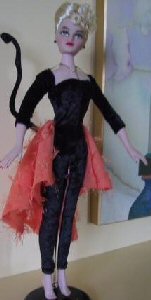
Salem tried to turn himself into a Barbie doll, but the spell didn't work too well.


