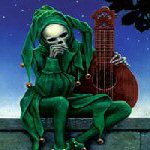
The Jester
Lord Dudley Percy, who had fought bravely against the Scots beside King Edward III at the Battle of Dupplin Moor and the Battle of Halidon Hill, was riding beside his noble wife, Lady Josephina, on their way home from an extended visit to court. They were both delighted to see Gatesbridge Manor appear on the horizon. Their journey from Windsor had been a long and difficult one. Lady Josephina, who was five months pregnant with the couple's first child, was cold and weary, and her husband, who had had too much to drink the night before, was exhausted and suffering from a raging headache.
In spite of his discomfort, Lord Percy felt his heart swell with pride when he neared his ancestral home. The estate, one of the finest in all of England, was a large and profitable one and had been in the Percy family since the time of the Norman Conquest in the eleventh century.
As the lord and his lady made their way across the rich, fertile lands of their estate, they observed the hardworking serfs bringing in the harvest. There was also a great deal of activity inside the manor house itself, which was only to be expected since there was to be a great celebration commencing the following day.
"At least none of our guests have arrived yet," Lord Percy sighed with a feeling of gratitude as he climbed down from his horse. "We can both get some much-needed sleep tonight, my dear."
"Yes, but we must wake up early tomorrow. With the banquet to be held in the evening, I imagine everyone will begin arriving in the morning," his wife surmised.
"I still see no need for all this fuss and bother," the nobleman grumbled. "There is really no need for us to celebrate on such a large scale."
Despite his protest, Lord Percy was looking forward to the festivities. He was, after all, a proud man from a noble family and enjoyed entertaining on a grand scale and playing the lord and liege to his peasants.
"Not celebrate!" the lady of Gatesbridge Manor exclaimed. "Surely, you cannot be serious! You have been made a Knight Companion in the Most Noble Order of the Garter. King Edward has bestowed a great honor on you, and it is only natural that your friends and vassals would want to celebrate the great occasion."
"Yes, the king has chosen to honor me-no doubt because he hopes I will help finance his war with France."
"You be sure you continue to do so," his wife urged. "England is on the verge of great prosperity. I can feel it."
"You and your feelings," the lord chuckled. "Sometimes I wonder if, beneath your fine clothes and jewels, you are not a soothsayer."
"Go ahead and laugh at me if it gives you pleasure, but English ships rule the sea, and there are great fortunes to be made in trade with foreign lands. If you remain a good friend of King Edward and Queen Philippa, you may someday become second in power only to the monarch himself."
"Be careful not to give voice to your predictions in front of any of the members of the clergy this week, dear wife. One of them might accuse you of being a witch."
Lady Josephina laughed.
"There is enough of that witchcraft foolishness elsewhere in Europe. We do not need it here in England."
"Very well, my dearest one, let us retire to our bedchamber. The revels scheduled for the next fortnight are sure to tire us both, and in your condition, you must get your rest."
* * *
As Lady Josephina had predicted, many of Lord Percy's guests began arriving early in the morning. Over the next several hours, neighboring noblemen, knights, their ladies and attending squires, as well as bishops and abbots from near and far, descended upon Gatesbridge Manor. When the sun went down and the manor's servants lit the candles in the darkening evening, the doors to the great banquet hall were opened wide.
The hall of Gatesbridge rivaled those in the finest castles and palaces in England and on the continent. Exquisite tapestries hung on the walls, and heraldic banners proudly displayed the Percy coat of arms from the rafters. Fine linens covered not only the high table but also the trestle tables. Hundreds of beeswax candles-tallow would never do for such a magnificent gathering-illuminated the room. No expense, it seemed, had been spared in the hall's décor.
The first night's feast was a memorable one, indeed, befitting King Edward himself. Lord and Lady Percy, dressed in their finest attire and bedecked in priceless jewels, were seated at the place of honor at the high table. Two swans, a great epicurean delicacy in the fourteenth century, were laid out on silver platters before them. Throughout the evening, a small army of serving boys brought in roasted meats, fried fish, freshly baked bread, tarts, pastries and drinks of all kinds.
While the celebrants satisfied their appetites and quenched their thirsts, minstrels provided musical entertainment with trumpets, drums and fifes; jongleurs sang bawdy ballads and boisterous songs of heroism and combat; and bards delighted the lord's guests with poems and stories. Finally, when everyone had eaten their fill, the tables were cleared. Some of the diners retired, but most chose to dance, share the latest talk of war with France, gossip about the latest scandals at court, play chess or otherwise socialize with their fellow guests.
The first day of the celebration has been a great success, Lady Josephina thought with relief as she watched the couples dancing.
She hoped the remaining days would be as merry as this one.
* * *
The following morning, the celebrants gathered for an early meal in the great hall. Afterward, they ventured outdoors where the estate had taken on the appearance of a village faire. The minstrels, jongleurs and bards that had performed for the guests at dinner the previous evening were now joined by acrobats, tumblers, jugglers and conjurers. The younger, more athletic knights enthusiastically participated in a joust. The many and varied revelries continued until the mouth-watering aroma of roasting boar and venison eventually turned everyone's thoughts to the evening meal.
As was the case on the previous night, once the sun went down and the candles were lit, the heavy doors to the great banquet hall were opened, and the assembled guests feasted as the minstrels played. But this banquet was shorter than the one held the evening before. Not only were the attendees not nearly as hungry as they had been after their long journeys, but they were also eager to view the night's special entertainment.
"My friends and honored guests," Lord Percy announced in a booming baritone voice, "a troupe of actors, who traveled here all the way from London, is going to perform for our enjoyment."
The play, an original tragedy written by one of the lead actors, was well-received by the audience, but it was over too soon. The guests were not yet ready to retire for the night; they wanted additional entertainment.
"Let there be no more music this evening," a mildly inebriated Lord Percy bellowed. "I've had enough for one day. Send for my jester instead. I'm in the mood for some merriment."
The guests readily agreed with their host. Engelbert, Lord Percy's personal jester, was known throughout England for his wit and his ability to make noblemen, clergymen and peasants alike roar with laughter.
"Where is Engelbert?" wondered Lady Josephina. "I have not seen him all day."
Into the great hall walked a dwarf wearing a brightly colored tunic. On his head, he wore a matching hood with bells on its points, so that he jingled whenever he moved. And on his face, he wore a mask.
"Engelbert, tonight you appear to us in disguise, yet this is no masquerade party," Lord Percy observed, believing that the white mask that covered the dwarf's face was meant as a prank.
"Yes, m'lord."
The jester's voice sounded strange, possibly because it was muffled by the mask.
When no joke followed, Lord Percy commanded, "Won't you entertain us with your humor, good Engelbert?"
The jester spoke at length, but very few people in the audience were amused, for he spoke of the injustice of the feudal system, the greed of the English nobility and the hypocrisy of the clergymen who served the Catholic Church. Such talk naturally made the guests feel embarrassed and uneasy. Lord Percy was furious.
"You call that humor? You forget your place, little man. I ought to have you flogged for daring to ridicule your betters."
The jester showed no fear.
"I have a riddle for you, my lords and ladies. What is it that does not take notice of either the richness of the king's garments or the shabby rags of the poorest beggar?"
"That's easy," Lady Josephina responded in good humor. "The answer is a blind man."
"Wrong, m'lady. It is Death. He knows not wealth or power, and the only authority he recognizes is that of the grave."
"Enough!" Lord Percy shouted. "We are not amused by your words."
The minstrels and actors, fearful that the nobleman's displeasure might cause him to be less generous to them, hurried forward to silence the jester. The actors grabbed the dwarf under his arms and attempted to carry him away as the minstrels began playing a lively tune.
"What's wrong with you?" one of the angry thespians asked the fool. "This is supposed to be a celebration. Why do you deliberately invite his lordship's wrath upon us?"
"It matters not whether he is displeased by what I say," the jester explained. "No man has dominion over me."
"I think our little friend here has taken leave of his senses," the actor who had written the evening's drama opined.
"Or perhaps he's had too much mead to drink," another laughed.
Intending to smell the jester's breath to see if it reeked of alcohol, the first actor yanked the white mask off Engelbert's face. The performer screamed with horror at what he saw. Curious, the guests turned toward the sound, and they too were terrified by the sight of the dwarf's face. Several of the women, including Lady Josephina, fainted upon seeing his hideous visage.
Rotted flesh hung down from the jester's hairless skull. His empty eye sockets looked like two black holes, as bottomless as the pit of hell itself. Accusations of "leper" could be heard throughout the room, and many of the guests tried to flee from the great banquet hall in fear of catching the dreaded disease.
"You cannot escape," the jester proclaimed. "By this time next year, more than half of you will be worm's meat."
Anger again rose in Lord Percy's breast, but his fear of the leprous jester stilled his tongue.
"A plague has traveled to the shores of your island, a plague brought from the continent on merchant ships."
"This cannot be true," a bishop argued. "God's mercy would not allow such a scourge to be visited upon England."
The jester's harsh laughter sent chills down the bishop's spine.
"Prince, priest and pauper alike will be struck down, for the Black Death is no respecter of power or privilege."
"There is no need for anyone to fear, my good people," the bishop insisted loudly. "This poor man is quite mad, no doubt driven insane by his hideous affliction."
The jester giggled maniacally, and taking the hands of a young noblewoman sitting nearby, he began to dance with her in a circle.
"Ring around the rosie, a pocket full of posies. Ashes, ashes, you'll all fall down."
The jester then let go of the woman's hands, and she swooned.
"Are you all right?" one of the knights inquired as he helped the lady to her feet.
"Yes, I'm just a bit dizzy."
She put her hand to her head, which had begun to ache.
"I'm suddenly not feeling ...."
A wave of nausea swept over her, and she vomited on the floor.
"You're burning with fever," the knight said as he carried her to a chair.
The guests were so worried over the health of the noblewoman that they failed to notice Engelbert the jester had disappeared.
* * *
The following day, the noblewoman was near death. Red spots, which had appeared on her neck the night before, turned black and grew to the size of goose eggs. The other guests, fearful of the jester's dire predictions, made immediate preparations to leave Gatesbridge Manor. Before the end of the week, however, many of them suffered from fever, achy joints, nausea and headache. Buboes soon appeared on their necks, armpits and groin areas.
More than half of Lord Percy's guests would fall victim to the dreaded pandemic. Lord Percy himself, one of the richest landowners in England, a friend of King Edward III, member of the Order of the Garter, lay in his great bed, sweating profusely from the fever that was burning his body. In his agony, he called out for his wife, unaware that she and their unborn child had preceded him to the grave.
It was, instead, the hideous little jester who answered his summons.
"You! Why are you here? I call for my wife, and you come to mock me."
This time, there were no jokes, no riddles, no inappropriate comments about the social structure of medieval England. The jester drew near, and Lord Percy could see a red glow in the hollow of his black eye sockets. In that glow, the nobleman saw the devastating effect that the plague would ultimately have on his homeland. He saw bodies being taken out of homes and burned in the streets; mass unmarked graves; men, women and children of all classes—one-third of the population of Europe—mowed down by the merciless juggernaut of the Black Death.
"Show me no more, I pray!" the nobleman sobbed and turned his head away in bitter defeat. "I've seen enough."
"Come, m'lord. It is your time. You must hurry; I have many, many more souls to collect before this day is over."
Thus, Death—the greatest conqueror in history, a respecter of neither age nor beauty, neither intelligence nor talent, neither innocence nor godliness—claimed the life of the brave Lord Percy of Gatesbridge Manor.
As he and the nobleman made their journey to the hereafter, the jester began to sing.
"Ring around the rosie, a pocket full of posies. Ashes, ashes, you'll all fall down."
Then Death disappeared, off to claim his next soul. Moments after the Grim Reaper faded from view, the spirit of Lord Percy heard the melancholy jingling of the bells on his jester's hood.
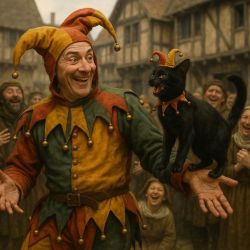
Can you guess who is the real fool?


