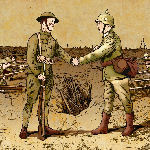
The Truce
Lemuel Gosford shivered from the cold and hunkered down against the packed earthen wall of the trench. There had been a steady drizzle and fog throughout the day, and when the sun went down, the temperatures dropped even more. Along the stretch of Belgian soil referred to as "no man's land"—barren except for crump-holes and a scattering of fallen soldiers—the water droplets had turned to ice, making it appear as though the ground was covered with a thin coating of snow. Somewhere off in the distance, he could hear the sound of rifles firing and shells exploding as enemy troops occasionally shot at each other's trench line.
As he tried to keep warm, his mind returned to Baron's Woods and to Gwyneth.
Has it really been less than six months since I last saw her? he wondered. It seems so long ago.
Only a year before, he was a bachelor, a novice schoolteacher fresh out of university. In the past twelve months, so much in his life had changed. In April, he married his sweetheart and moved into his own home. But after only a few short months, their idyllic married life came to an abrupt end when the vicissitudes of fate caused England and Germany to go to war. As part of the British Expeditionary Force, he was now in Ypres, burrowing in the ground like an animal with his fellow Tommies, following a strict philosophy of shoot or be shot.
In the midst of a battle zone, it was not always easy to remember what day of the week it was. The passing of one month and the start of another often went unnoticed as well. That particular day was an exception, however. Every man in the trench knew what day it was: December 24, Christmas Eve.
This would have been our first Christmas together as man and wife, Lemuel thought, with an even greater longing for home than he usually felt.
He reached into the pocket of his uniform where he kept his two most precious possessions: a well-worn photograph of Gwyneth and a lock of her hair. He removed the swatch of fabric that held the auburn curl and unwrapped it. The cold, tired, lonely soldier lifted the silky tress to his face and gently rubbed it along his jawline. It reminded him of the nights his wife had slept peacefully in his arms with her head against his cheek. He closed his eyes and tried to recall the floral scent of her shampoo. After several minutes of tender reminiscences, he returned the lock of hair to the safety of his uniform pocket.
Maybe we'll be together next Christmas, he thought optimistically. And hopefully for many Christmases thereafter.
Lemuel's thoughts went from memories of the past to dreams and aspirations for the future. Someday, he prayed, there would be a Christmas when he, his wife and their as-yet-unborn children would gather around the table for a holiday dinner with his and Gwyneth's parents in attendance.
As the soldier dreamt of his Christmases yet to come, he was aware of the other men around him, also hunkered down to keep warm. They came from all parts of Great Britain and served in several different regiments including the Royal Dublin Fusiliers, the Rifle Brigade, the Royal Field Artillery, the Argyll and Sutherland Highlanders, the Cheshire Regiment and the Royal Welsh Fusiliers.
What are they all thinking? he wondered. Are they missing their own wives, children, parents, friends, brothers or sisters? Are they husbands and fathers? Are they single men, hoping to marry their sweethearts once the war is over? Perhaps they are confirmed bachelors with no desire for a wife. If so, what treasured mementos do they keep as anodynes to the pain and suffering of this war?
"What I wouldn't give to wake up tomorrow morning in my own bed in Canterbury," the soldier to his immediate left said.
"Is that where you're from?" Lemuel asked.
"It sure is, mate. Born and bred a stone's throw from the cathedral. What about you?"
"I'm from a little village called Baron's Woods. I doubt you've ever heard of it."
"You got that right. Sounds like one of those places where if you sneeze, you'll miss it."
"That pretty much sums it up," Lemuel laughed. "Baron's Woods is a far cry from London; that's for sure."
"Not that I'd know. I've never been to London," the boy—he was far too young to be called a man—admitted. "I rarely left Canterbury, and when I did, I didn't go very far. Funny, I always wanted to travel, and now here I am in Belgium."
"And now you wish you were back in Canterbury. I know the feeling."
"What is it you miss most about home?"
"My wife. And you?"
"My dog. Don't get me wrong. I miss my parents, too. I miss them a lot, but I get letters from home on a regular basis. But Oliver—that's my dog—he's nine years old, and I don't know if he'll still be alive when the war is over."
Lemuel heard the sorrow in the lad's voice and sympathized with him.
"I had a dog that lived to be sixteen. Perhaps Oliver will live to a ripe old age, too."
"You think so? My name's Noel, by the way," the teenager said.
"Lemuel."
Although soldiers were routinely addressed by their surnames, in the intimacy of that moment, their given names seemed more appropriate.
"You got any children?" Noel inquired.
"No. Not yet. My wife and I want them, though. But we were only married for a short time before war was declared."
"I'd like to get married someday and have a family. There's a girl back in Canterbury. Her name is Clara. I always fancied her."
"Does she know that?"
"I think so. She wrote me a letter—two of them actually. I haven't written back to her yet though."
"Why not? If you like her, don't let her get away."
"I don't know what to say to her. Do you think, maybe, when you have some extra time on your hands, you can help me?"
"I'd be glad to."
Not long after asking for the older man's assistance in wooing Clara, the boy closed his eyes and drifted off to sleep. Still awake, Lemuel lifted his face to the sky and noticed that the moon and stars were clearly visible. The clouds that had ushered in the dreary gray mist and drizzle were gone. Although cold, it was relatively good weather for late December.
Then he noticed something else was missing besides the clouds and dampness. An eerie silence had descended upon Ypres. He listened carefully for several minutes. The rifles and artillery were quiet. The only thing he could hear was Noel's soft snoring beside him.
Lemuel was about to fall asleep himself when a lone voice traveled across no man's land to the British trenches.
"Stille Nacht, Heilige Nacht."
Although not proficient in the German language, he recognized the melody of the song. In English, it was known as "Silent Night." Other voices from the enemy's trench joined the first. By the time the chorus of soldiers moved on to the second verse, a sprinkling of Tommies began singing the song in English. More and more voices joined in on both sides.
"Blimey! Would you look at that!" one of the fusiliers suddenly called out.
Several British privates cautiously raised their heads and peeked across no man's land.
"Where in hell did they get Christmas trees?" a young man cried out in a thick Scottish accent.
"Kaiser Wilhelm sent tannenbäume to the troops at the front to help bolster morale," a young Irish officer explained.
"And why in bloody hell didn't King George send us something?" a soldier from London laughed. "We could all use a little Christmas spirit, right?"
"Look what they're doing now!" a voice called out.
"What's that they've got?" another asked.
"Lanterns. What are they going to do with them? Go Christmas caroling?"
Still singing, a number of German soldiers—some carrying tannenbäume, others lanterns—emerged from their trenches and slowly walked across no man's land toward the British line.
"They're coming in this direction!" the Irish officer cried. "Hurry. Get your guns. They might be carrying explosive devices."
Although the Tommies were quickly prepared for battle, not one of them wanted to fire. Not that night, not on Christmas Eve, not at men singing "Stille Nacht" and carrying tannenbäume. Roughly ten feet from the enemy's trench, the German soldiers stopped their advance. Their British counterparts watched with trepidation, fearing for their lives.
"Merry Christmas, English!" one of the Germans called to them in a heavily accented voice.
There was a moment of stunned silence in the British trench. Then an answering greeting was called out in the King's tongue.
"Merry Christmas to you, too."
* * *
All along the British line, men were climbing out of the trenches, helped by the hands of men who they had been trained to kill. On that cold December night, however, the words "Fröhliche Weihnachten" and "Merry Christmas" replaced the sounds of rifle and artillery fire.
During the hours of pleasant camaraderie that followed, Lemuel Gosford shared a box of shortbread cookies (a gift from his parents) with a young German soldier named Franz. An educator like Lemuel himself, he spoke fluent English, albeit with an accent. In the light of his lantern, Franz showed the Englishman a photograph of his wife.
"That's my Gretchen," he said, smiling with pride at the attractive blond woman in the picture. "She's pregnant with our first child."
"Congratulations!"
"Danke. She's due next month. I only wish I could be there with her to welcome our baby into the world."
Lemuel reached into his uniform pocket and took out the photo of Gwyneth.
"That's my wife."
"She's beautiful."
"I think so."
"Do you have any children?"
"Not yet. But we hope to have two or three of them someday."
Around Lemuel and Franz, other groups of men spoke to each other. Some joined together to sing Christmas carols, in both German and English. When daylight came on Christmas morning, several of the soldiers took it upon themselves to gather the corpses from the field and give them a proper burial. This unpleasant task was followed by a much more joyful pastime: a spontaneous game of football.
One would never know there was a war going on, Lemuel thought as he listened to his companion relate an amusing anecdote about teaching school in Cologne. Take Franz and I, for instance. We have so much in common. Under different circumstances, we might have become good friends. And these other men. They don't hate each other.
He heard a familiar voice nearby. It was Noel, the lad from Canterbury. He was deep in conversation with a German boy of approximately the same age. He was telling him about his dog, Oliver, and Clara, the girl he fancied.
"Wouldn't it be nice if this was how the war came to an end?" Franz asked. "If the soldiers could all just climb out of their trenches and greet the enemy with a handshake and a friendly word?"
"It certainly would," Lemuel agreed. "Then we could all go home to our families and live in peace."
"Unfortunately, our Kaiser and your Prime Minister have other plans for us."
"How long do you think this war will last?"
It was a surreal moment, indeed, discussing the war with the enemy.
"Too long, I'm afraid," Franz replied.
There was an awkward moment of silence. Lemuel wanted to break it, but he was at a loss for something to say.
"All I ever wanted to do was to teach," Franz announced, his eyes misting with tears. "That and marry my Gretchen, of course. I never dreamed someone would put a gun in my hand and send me to Belgium to kill men I have no quarrel with. What is the world coming to?"
"When you study history, you see that the world has always been like that. There have been wars down through the centuries."
"That's why I prefer mathematics," the German schoolteacher laughed. "Numbers are logical; men aren't."
"I majored in literature at university myself. When I was a child, I read every book I could get my hands on. Shakespeare. Dickens. Chaucer. Tennyson. These authors were my heroes."
Lemuel yawned; he was sleepy after having stayed up all night. However, the exhaustion was a small price to pay for the extraordinary experience he was having. Christians often spoke of peace on earth and goodwill toward men, especially at Christmas time. This was a concrete example of such an idealistic concept.
Lemuel wondered if there had been similar instances in past wars. Had the Roundheads enjoyed a temporary truce with the Cavaliers during the English Civil Wars? Did the English and French pause their fighting in the Hundred Years War long enough to celebrate the holiday? And what of the Yorkists and the Lancastrians? Was there a cessation of fighting during the Wars of the Roses?
The day wore on, and not a single man showed any eagerness to crawl back into the trench and resume hostilities. Even the officers, although leery to trust the enemy at first, were enjoying the welcome respite from battle.
"I have to hand it to you and your men," Lemuel said as he and Franz shared rations with Noel and several other soldiers in an impromptu, makeshift holiday dinner. "You showed great courage. You all took a chance coming across no man's land carrying only lanterns and tannenbäume with you. Weren't you afraid we would shoot you?"
"Yes, but it was Christmas Eve. We made the gesture in the name of peace, and we hoped you would see that."
"Whose idea was it?"
"It was a joint decision. We all discussed it before we took any action."
"Well, thank you."
"Yeah," Noel agreed. "Thanks. I haven't had such a good time since I left Canterbury."
"You're welcome," Franz said and added with a laugh, "and thank you for not shooting us! I have a feeling, though, that when word of our truce reaches the upper echelon of the German command, they won't be too happy."
"Neither will the British government, I'm afraid," Lemuel said.
"I'm sure they'd feel differently if it was them out here in the trenches getting shot at instead of us," Noel opined.
* * *
The sun set early in the evening on that memorable Christmas day. In the gathering darkness, exhausted soldiers who longed for sleep were hesitant to leave no man's land. They wanted to remain in the warmth of brotherly love for as long as possible. Finally, the officers yielded to the call of duty and ordered the men back into the trenches. The British and the Germans parted with handshakes and best wishes.
"Goodbye."
"Auf Wiedersehen."
"Goodnight."
"Gute Nacht."
When he was back in his hole in the ground, hunkered down against the packed earthen wall, Lemuel once again found himself next to Noel.
"I don't think I've ever been so tired in my life," the lad from Canterbury cried as he curled up his body in an attempt to stay warm. "But it was well worth it! This is something I'm going to tell my grandchildren about when I'm an old man."
Although Lemuel basically agreed with him, there were questions that troubled him. What would happen the following morning? How could men who had behaved like friends one day see each other as enemies the next? How could you raise a gun to a man you had shared your dinner with the night before?
Maybe it will all be different tomorrow. When the sun comes up in Ypres, perhaps the war—for us, at least—will be over.
When his thoughts went to Gwyneth and he began mentally composing the letter he would send her, describing his Christmas experience, sleep, at last, calmed his brain. His dreams that night were those of a contented young man, looking forward to a happy future. They were the dreams of a husband, a son and a teacher, not a soldier.
The sun rose the next morning on what the British referred to as Boxing Day. As the men ate their morning rations, they spoke of the strange turn of events of the twenty-fourth and -fifth.
"Blimey! That was weird, wasn't it?" one private from Manchester laughed. "Us celebrating the holiday with the Hun!"
"It'll be one for the history books; that's for sure!" a young man from Edinburgh agreed.
Once the men were fortified, an officer called out an order.
"We're going over the top today, men."
"Going over the top" meant leaving the safety of the trenches, charging across no man's land and attacking the enemy's position.
"Is he serious?" one of the Dubliners asked. "He expects us to resume killing as though yesterday never happened?"
"I don't like it any more than you do," a man from Cornwall said. "But we're soldiers. It's our duty to fight for king and country."
"I say let George fight it out with his cousin himself and leave us out of it," Noel whispered to Lemuel.
"I'm afraid the world doesn't work ...."
He stopped midsentence and stared down the length of the trench.
"What is it?" Noel asked noticing his comrade's pallor.
"I thought I saw .... Never mind."
"You're seeing things, too?"
"What do you mean?" Lemuel asked.
"This morning when I woke up, I watched the sun rise in the east. The light must have played a trick on my eyes because I thought I saw Clara standing on the top of the trench, looking down at me."
Suddenly, the officer appeared. He walked along the trench, ordering men to prepare for action.
"On my signal," he called out, "we go over the top."
The British soldiers adjusted their helmets and grabbed their weapons.
This is war, Lemuel reminded himself. We're here to fight, not fraternize with our country's enemies.
The men stood poised for action, waiting for the order to be given.
"Attack!"
Like a distorted echo, the word was repeated across no man's land in the enemy's trench in German: "Attacke!"
Men on both sides clamored up over the tops of the trenches, and crawled on their stomachs, staying low to the ground so as not to be shot. As he and Noel looked for cover in the same spot they had enjoyed their Christmas dinner only hours before, Lemuel saw the enemy with rifles in hand, ready for battle.
How can this be happening? he wondered, even as he placed his finger on the trigger of his army-issued Lee-Enfield repeating rifle.
When he looked through the sight, he was stunned to see Franz's face. He closed his eyes momentarily, saying a silent prayer.
Dear God, I can't shoot him! Not Franz. Not the man who only wanted to teach mathematics and have a family with his wife, Gretchen.
Again, two orders were shouted, in two different languages, at approximately the same time.
"Fertig. Zielen. Feuer."
"Ready. Aim. Fire."
Lemuel opened his eyes and quickly gazed through his sight as he pulled the trigger. But it was not the German mathematics teacher he saw in his line of fire. Rather, it was his beloved Gwyneth. He did not see Franz's head explode as his bullet hit its mark. Nor did he feel Franz's bullet enter his own body. As he lay there dying on the blood-stained ground of no man's land, he watched what he believed was his wife approach.
"It is time, Lemuel," the Valkyrie said, as she stretched out her hand to claim the soul of the worthy soldier.
As his spirit departed his body, his gaze wandered around the battlefield. There were other women there, assisting other fallen warriors. A blonde who resembled the photograph of Gretchen was taking Franz by the hand. A young girl, presumably Clara, was comforting a terrified Noel.
"You have all died bravely in battle," the Valkyrie with Gwyneth's face and voice announced, as more and more women and fallen soldiers joined them. "We have come to take you to Valhalla."
* * *
Shakespeare wrote in his tale of star-crossed lovers, Romeo and Juliet, "What's in a name? That which we call a rose by any other name would smell as sweet."
Whether you call it Valhalla, Elysium, paradise or heaven, it is a place where the souls of deserving men and women go after death. And whether you refer to their escorts as angels or Valkyries, these beings take the dead to the hereafter where they will dwell in peace and happiness for all eternity. It was only a matter of time before the real Gwyneth, Clara and Gretchen would join them, along with Oliver, Noel's dog. And time was something they now had plenty of.
Until the day came when they were reunited with their loved ones, the three men would enjoy time together as they had on that quiet battlefield in Ypres, Belgium, on Christmas Day of 1914.
This story was inspired by an actual impromptu truce between British and German soldiers on Christmas 1914 in Ypres, Belgium.

Salem and the dog next-door declared a truce one Christmas, and they've been good friends ever since (as long as the dog doesn't try to help himself to Salem's chocolate supply).


