
Harvest of Memories
Three names invariably come to mind when someone thinks of the advent of the computer age: Bill Gates, Steve Jobs and Logan Moorehead. Founding Microsoft, Apple and Mikel, respectively, these men became giants in the electronics industry. Eventually, however, these young geniuses grew older. Despite the god-like reverence Apple users held him in, Steve Jobs proved to be a mere mortal and passed away in 2011. Two years later, Bill Gates stepped down from his position on Microsoft's board to devote his life and part of his considerable fortune to philanthropy.
That left Logan Moorehead, the youngest of the three, to pass the torch to future generations; yet as his sixty-fifth birthday neared, Mikel's CEO showed no sign of retiring. The mega electronics company he founded continued to come up with innovative technology and new products to entertain, educate and make life easier for consumers around the globe.
"Sixty-five years old," he mused as he and Rochelle, his third wife, sat down to dinner at a fashionable restaurant not far from the couple's home in San Francisco's Nob Hill neighborhood. "I can't help wondering where all those years have gone."
"They went into making your company one of the largest in the world," Rochelle said.
Only twenty-six, she could not comprehend her husband's bewilderment at the fact that he was getting old.
"I saw Jeff Bezos at a charity luncheon the other day, and he asked me if I was going to retire!"
"I don't see why you won't. You've got more money than you will ever be able to spend."
"This isn't about money. I feel I've still got so much more to contribute."
"Then become a philanthropist like Bill."
Logan, however, was a "hands-on" guy who liked to roll up his sleeves and sit at a keyboard for hours on end, writing code or troubleshooting programming errors. He could not see himself sitting behind a desk writing checks.
When he opened his menu, the number sixty-five seemed to jump off the page and mock him. It was sixty-five dollars for the lobster dinner. There were sixty-five calories in one tablespoon of the lite house salad dressing. There were sixty-five varieties of craft-brewed beer available.
What am I doing? he asked himself.
Naturally, it was a rhetorical question. He had not expected an answer from his brain. Besides, he knew all too well why his age was bothering him. His father had been sixty-five when he showed the first symptoms of Alzheimer's.
It can run in families, he thought, as he folded his menu and laid it on the table.
For at least a decade, Logan had lived in fear of following in his father's footsteps. Although recent medical breakthroughs had found a way of eliminating the physical deterioration associated with the disease, there was still no way to prevent the progressive memory loss. It was to a large extent this fear of mental decline that drove Moorehead to maintain his heavy involvement in the company. He often heard it said that people needed to exercise their brains like they did their muscles. "Use it or lose it" became his motto. So far, it seemed to be working for him.
Two days later, employees at Mikel's home office celebrated the founder's birthday with a cake ordered from TV celebrity baker Duff Goldman. The CEO was deeply touched by the gesture and made a mental note to increase the annual Christmas bonuses.
"And now," his administrative assistant announced as he finished his second slice of cake. "We have a surprise for you."
One of the programmers turned off the overhead lamp, and another started a slideshow presentation featuring more than a hundred photographs of Logan Moorehead.
"Where did you get those pictures?" he asked when he saw himself as a baby and a young child.
"I told your sister about our little surprise, and she sent us copies of them from the family photo album."
Logan watched the presentation in silence as he mentally relived the moments captured on film: birthdays, holidays, first day of school, summer camp, senior prom, high school and college graduations, the opening of Mikel and all three of his weddings.
"Talk about seeing your life flash before your eyes," he joked. "I'd like to have a copy of that presentation. You never know if I might someday need to refresh my memory."
It was a statement made in jest, in keeping with the gaiety of the moment. However, as Logan drove from the office to his home, he let his mind wander.
Wouldn't it be nice if we had the ability to store all our memories on the cloud so that a person could access them in the future should he fall victim to Alzheimer's?
On the surface, the idea was ludicrous, nothing more than the ramblings of an aging man who had too much champagne at his birthday celebration. That would definitely be the case with the majority of people, but this was Logan Moorehead, one of the Big Three who gave us laptops, smartphones, tablets, MP3 players and many other electronic gadgets we've all grown to love. If anyone was capable of developing such a product, it was the former boy genius from Mikel.
* * *
Early the next morning Logan called an emergency meeting of the best minds in his research and development department. This was not an uncommon occurrence. The boss often gathered people together at a moment's notice when a creative idea struck him.
"I assume most of you were at my birthday party in the cafeteria yesterday," the CEO announced. "Although there were a few of you who couldn't make it because you were out of the office. But I'm sure you heard about the 'this is your life' photo presentation. Well, it gave me an idea. It's no secret that people today are living longer than they did a century ago. Unfortunately, old age is not always a blessing. It's estimated that nearly twenty percent of people over the age of eighty have some form of dementia."
The engineers and computer programmers sitting around the conference table looked at each other uneasily, wondering if their employer was about to announce his retirement.
"Seeing all those photos reminded me of people and places I hadn't thought about in decades," Logan continued. "On my way home last night, it occurred to me that if it were possible to store a person's memories, he or she would have access to them later in life. That's why I wanted to meet with you all today. I want us to develop a program that will enable us to digitize, store and access a person's memories."
"With all due respect, sir, that's impossible!" Waylon Shriver, the senior vice president of research and development, exclaimed. "Besides, if someone wants to relive his past, why not just pick up a photo album or watch a home movie?"
"If I've completely forgotten who my wife is, would seeing a photo of her help any? No. The memory is gone. I want to create a device that will basically download saved memories into a person's brain. And I'm not talking about just the major milestones. I want an entire lifetime of memories stored."
"How?"
"That's where your department comes in. You need to discover a way of extracting or harvesting memories, storing them and making them available to a user at a later date."
"I still say you're asking the impossible!"
"I'm sure before Joseph Nicéphore Niépce took his first photograph, the idea of capturing images was believed to be impossible, too. Throughout history, mankind has done the impossible. Hell, we landed a man on the moon. If that's not making the impossible possible, I don't know what is!"
Although the majority of the people who worked in the research and development department believed the CEO's newest goal was unattainable, they nevertheless took the assignment seriously and devoted the next four years to the project. Working closely with experts in neuroscience and neurobiology, they were at last able to "record" memories from a human brain, digitize them and save them onto a computer hard drive.
"That was the easy part," Waylon said, putting a damper on the celebration his staff held when they made their breakthrough and successfully harvested the first human memories. "Now, we have to find a way of downloading them into a dementia patient's brain."
Logan smiled, shook his head and replied, "I never knew you were such a pessimist. You didn't used to be. You were once a dreamer like me."
"I still have dreams," the vice president admitted defensively, "but none of them involve electronics working in conjunction with human body parts."
"No? It's been going on for decades. Artificial limbs, lungs, hearts, kidneys."
"But the brain is different. That's where a person's identity is. If you take away the brain's ability to function normally, what are you left with?"
"Have you ever known anyone suffering from advanced Alzheimer's?"
"No, I haven't had the misfortune."
"Well, I have. My father had it. My mother and I took turns keeping watch over him. Let me tell you, it wasn't pleasant. And it's quite possible the same fate is waiting for me—or you, for that matter."
"Medicine has come a long way since your father's time. There are medications now ...."
"They only work on the physical aspects of the disease. What good is a strong, healthy body if the mind is gone? If I should come down with it like my father did, I don't want to be walking around like a zombie, not aware of who I am or what I've done in my life."
Realizing that Logan had a personal stake in the success of the project, Waylon was determined to succeed.
"I'll find a way to make it work," he promised.
"I agree with you that it will be difficult. That's why I've enlisted some additional assistance, but we need to go out of house for it."
"Oh? Are we going to work with MIT? The Mayo Clinic? That doctor who won the Nobel Prize in Medicine last year?"
"None of the above. Back in 2016, Elon Musk began a company called Neuralink."
"I never heard of it."
"That's because it never got the media attention Tesla or SpaceX received. I suppose space travel is far more exciting than exploring the workings of the human brain. Anyway, Neuralink has been working on developing a computer chip that can be implanted directly into the skull to enable electrode threads to interface with certain areas of the brain. The chip is intended to be used to restore eyesight to the blind, hearing to the deaf and movement to injured limbs. It's also hoped it can cure certain illnesses of the brain."
"And you've spoken to the people of Neuralink about our project?"
"As a matter of fact, I had dinner with Elon last night. He's as excited about a joint venture as I am."
"That's great."
"I want you to set up a meeting with his people at Neuralink as soon as possible. Thankfully, the company is located right here in San Francisco."
Although Waylon Shriver was not used to working with outside firms, in this instance, he was grateful for all the help he could get.
"Meanwhile," Logan continued. "I want to begin uploading my own memories."
"Are you sure that's wise? The procedure is still new. We've only done preliminary testing."
"My seventieth birthday is approaching. I don't want to wait any longer."
"All right. I'll have everything set up to begin next week."
"Make sure you tell the technicians to use a hard drive with lots of storage space. After all, I've got a lifetime of memories for it to hold."
* * *
Logan reclined on the sofa in his den and closed his eyes. Kirk Allenby, Mikel's latest computer Whiz Kid, attached electrodes to his temples, which were then connected to a specially designed computer that would record his memories and store them for future use. Although an eminent neurologist had tried to explain the process involved in the creation of memories in a human brain, the CEO was not interested in what went on in the hippocampus, the neocortex and the amygdala. He did not know the difference between a neuron and a synapse and, frankly, did not care. His business was computers and artificial intelligence; he had complete faith in his company's memory-harvesting program.
Once his employer was "wired up to the hardware," Allenby sat at the console of the computer, and the third man in the room took a seat next to the couch.
"Okay, let's begin," the hypnotist said in a soft, relaxing voice. "You're in a long hallway. At the end of the hallway is a door. You walk toward that door. One step. Two. Three."
By the time he was instructed to open the door, Logan was deep in a trance. The hypnotist made a suggestion to begin the session.
"Let's pretend today is your birthday. You just turned seventy-eight. What I want you to do is relax and try to recall everything that has happened to you during the last year."
Over the past twenty-two months, these sessions had become routine. The only thing that changed was the suggested age of the subject. Year by year, he recalled the events of his life while under hypnosis. Although the early sessions, those dealing with his first few years of life, were relatively short, they grew progressively lengthier as he recalled long-forgotten memories from his teenage years, early adulthood and middle age.
While the subject was lying peacefully on the sofa, reliving his recent past, the hypnotist poured himself a cup of coffee and joined Kirk at the computer console.
"After close to two years of this, I'm glad this is our last session," he said. "Although I'd be lying if I said I wouldn't miss the money. What about you?"
"I've worked for Mikel since I graduated college, so I'll probably be assigned to work with R&D on the next phase of the project."
"I've heard the subject shows no sign of dementia. Not that I wish it upon him, but it seems a waste of close to two years of his life to sit here every day, making a recording of his memories that he'll never need. Not to mention the prohibitive cost involved."
"Don't worry about that. He can afford it."
"Still, I can't help wondering how economically feasible this memory-harvesting business will be," the hypnotist said as he reached for a cinnamon roll from the tray of pastries the butler brought in. "I would assume only the wealthiest people would be interested in it."
"As far as I know," Kirk explained, choosing a cheese Danish, "other than the volunteer test cases, Logan Moorehead is the only one to harvest his memories—so far."
For the next five hours, the two men stayed in the CEO's den, leaving the room only to go to the bathroom down the hall. As they had for nearly two years, they kept a close eye on the monitor, watching the fluctuations of the line that indicated the subject's brain activity. While the harvesting was in progress, the line peaked and dipped. Once the memories stopped, the line would go flat. It was a tedious job, but it paid well.
Shortly before noon, the butler reappeared and asked what the two men wanted for lunch.
"I should have a salad," the hypnotist replied. "Especially after eating that cinnamon roll. But this is our last day, so what the hell! Order me a veal parm sandwich and a bottle of Dasani."
"And you?" the servant asked the technician.
"The usual: cheeseburger, fries and a Coke."
The meal sustained them through the afternoon and into the evening when the line on the monitor finally flattened out.
"That's it!" Kirk announced, turning off the recorder. "You can bring him out of his trance now."
* * *
Logan Moorehead was seventy-eight years, three months and seventeen days old when he walked through his front door late one evening and stared at the woman coming down the staircase toward him.
"Who are you?" he asked.
The young woman stared back at him, as perplexed as he was.
"Who am I? I'm your wife."
"No, you're not. Where's Christa?"
"I haven't any idea. You and she were divorced more than forty years ago."
"Who are you?" he repeated, the color draining from his face.
"I'm Kirsten, wife number four."
"It's finally happened," he said, fearing the worst. "Alzheimer's, like my father."
"You're just tired. That's all. It's no wonder the way you've been pushing yourself to finish this project of yours. Why don't you go up to bed? You'll feel better in the morning."
Although he remembered all four of his wives upon waking, he still felt the terror of the night before. After a morning cup of coffee, he contacted his doctor, calling him on his private line rather than the office number.
"I need to see you," he announced when the physician answered.
"What seems to be the problem?"
"When I came home last night, I couldn't remember who Kirsten was. I thought I was still married to Christa."
"I'll fit you in this morning. Can you make it here to my office by ten?"
"I'll be there."
After three days of testing, the diagnosis was confirmed. Logan Moorehead had Alzheimer's.
"I estimate you're at stage three, which means you will experience mild cognitive impairment," the doctor explained.
"Mild? You call not knowing who I'm married to mild?"
"At this stage, these episodes can be brief and infrequent," the doctor said, ignoring his patient's sarcasm.
"But they'll get worse."
It was a statement, not a question.
"A surprisingly substantial number of stage three patients show no further sign of decline. They live out the remainder of their lives with only mild impairment."
"But the others?"
"They'll eventually move on to the next stage."
"Stage four of seven," Logan said. "I read a good deal about the disease after my father got it."
"Since then, we've made tremendous progress in the treatment of AD."
"I know. Just tell me one thing. When will my memory loss reach a critical point?"
"You mean when should you bring out your latest device and use it?"
"Yes."
"If you move on from stage three—and that's a big if—it could be five years before you become moderately impaired and another three to five before you're severely impaired. And with medication, we can slow the progression down even further. So, don't go plugging yourself into your hard drive of memories just yet."
Despite the doctor's optimistic prognosis, by his eighty-first birthday, Logan was experiencing severe memory loss. In one of his increasingly rare moments of mental clarity, the retired CEO called Waylon Shriver and asked his old friend to come to his house.
"Did you want me to bring anything with me?" the current president of Mikel asked.
"Yes."
The single question and its one-word answer were all the conversation that was needed. Both men knew full well what was about to take place and why.
"I'll bring a technician along."
"Good idea. Why not the one who harvested my memories? I've forgotten his name."
"Kirk Allenby. He's now head of R&D, but I'm sure he's been keeping up to speed with the project."
As he waited for the men to arrive, Logan went into his den and reclined on the couch. By the time the butler showed the guests into the room, his memory began to fail again.
"What are you doing here?" he asked Waylon. "And where's what's his name, the hypnotist? We can't start the harvesting session without him."
"We're not here to harvest your memories. They've all been digitized and stored already. Kirk and are I here to initiate the final phase."
Logan's eyes went to the computer, the latest, top-of-the-line version of Mikel's popular laptop.
"Are you sure nothing will go wrong?" the octogenarian nervously asked.
"Relax. All our tests have been successful. You've nothing to worry about."
Kirk attached electrodes to the old man's temples. He was grateful that Waylon had brought him along. He had spent years harvesting the subject's memories and was eager to see the result of his efforts.
"Will it hurt?" Logan asked, sounding more like a child than a grown man.
"You won't feel a thing," Kirk promised.
Allenby then touched an icon on the screen to execute the final phase of the harvesting program. Immediately, the subject's eyes opened wide as though he were staring at something neither of the other two men could see.
"He reminds me of Malcolm McDowell in that movie ... What was it called?" Waylon asked. "You know the one where he sings 'Singin' in the Rain' as he's vandalizing a house."
"A Clockwork Orange."
"That's it. This reminds me of the scene where the scientists restrain him and make him watch scenes of violence in hopes of rehabilitating his delinquent character."
As the subject's memories downloaded, the two men talked about other movies they enjoyed. Their conversation then switched to sports and politics. It was nearly midnight when the image on the computer screen changed. A green icon appeared, signifying that the download had been successful.
"Logan? Can you hear me?" Waylon called as Kirk removed the electrodes from the subject's temples. "Do you recognize us?"
"Of course, I do. You're Waylon Shriver, and he's Kirk Allenby."
"And do you know why we're here?"
"Yes. You've come to restore my memories, and you've succeeded!"
Despite his advanced years, the former CEO rose from a reclining position to a sitting one with the ease of a much younger man. His face was radiant.
"It's amazing! Absolutely incredible! There are no words to describe how I feel at this moment," Logan said, his excitement mounting as the seconds on the clock ticked by. "I can remember everything! My dog, Herbie. The bicycle I got for Christmas when I was five. My third-grade teacher, Mrs. Tippit. I haven't thought about her in years. She was the first person to tell me I had potential."
Waylon and Kirk shook hands, congratulating themselves on the success of the project.
"It's like I'm a boy again. I remember my childhood like it was only yesterday. My dad took me to a Red Sox game at Fenway. I spent a week at Cape Cod with my parents and my baby sister. I can relive the best times of my life!"
"It's getting late," Waylon announced. "Maybe we ought to ...."
"Nonsense!" Logan shouted with uncontained exuberance. "Let's have a drink to celebrate!"
"I don't know about you, but I've been up since five this morning, and I have a meeting scheduled at nine tomorrow."
"Cancel it. I may be retired, but I'm still the major stockholder in the company. As such, I can tell you what to do."
"All right," Waylon conceded. "But let me phone my wife and tell her not to wait up for me."
Logan rang a bell and called for his butler.
"Bring us a couple of bottles of champagne, the most expensive vintage in my wine cellar. And four glasses. I think you deserve to be included in our celebration."
"Yes, sir."
As they waited for the butler to return, Logan continued to share his thoughts and emotions with his two guests. Long after the toasts were made and the three champagne bottles were emptied, he was still racing down memory lane at a dangerous speed, taking his two exhausted passengers along with him.
"This is better than traveling. Who needs to experience new places and cultures when you can become reacquainted with your own past? I can't believe I forgot all those heart-to-heart talks I had with my father while I was growing up. It's a damn shame that for so long all I could remember about him was how he was once he was sick."
"It's after four," Waylon interrupted Logan's sentimental recollections. "I can't keep my eyes open, and poor Kirk fell asleep twenty minutes ago."
"Oh, very well! I'll tell you what. Spend the night here. I've got a couple of guest rooms upstairs. I'll have my cook prepare us a breakfast buffet in the morning."
Although he wanted to return to his own home, the company president did not want to drive in his current state and risk falling asleep at the wheel.
* * *
It was nearly nine o'clock when Waylon Shriver woke up in a strange bed. It took him several moments before he realized where he was.
Maybe I need a little memory boost myself, he thought as he put on the same pants and shirt he wore the preceding day. But what I need more than that is a shower and a cup of coffee.
As he headed toward the staircase at the end of the hall, he met Kirk Allenby coming out of the second guest room.
"Going down to breakfast?" he asked.
"Yeah," the head of R&D replied. "I hope there's a bottle of aspirin around here. I've got a hell of a hangover from that champagne last night."
"I'm sure the butler can find you some."
When they entered the dining room, the food was spread out on the table, but there was no sign of Logan Moorehead.
"He must have finally fallen asleep. Thank God!" Waylon exclaimed. "I'm going to grab something quick to eat and head home before he wakes up."
No sooner did the two men fill their plates and sit down at the table than the computer genius burst into the room. His guests were shocked by his haggard appearance.
"Are you all right?" Waylon inquired.
"I want you to take it out!" the old man cried, grabbing Allenby by the collar of his shirt.
"Take what out?" Kirk asked, afraid that Logan might be suffering from paranoia.
"That computer chip. I want it out—now!"
"I can't do that. It was surgically implanted. You need a doctor to remove it."
"Why do you want it taken out?" Waylon asked. "Last night you thought it was the answer to your prayers. Has it stopped working? Are you starting to lose your memory again?"
"I wish to God I were!"
The two Mikel executives looked at one another with uncertainty. Neither one had expected such a reaction, and both were unsure what to do.
"Perhaps we ought to call his doctor," Kirk suggested.
"Yes," the old man answered him. "And have him bring a scalpel to cut this damned chip out! No. That's not possible. I'll have to go to his office. He can't perform the surgery here."
"I'll call him and let him know we're coming."
Suddenly, Logan screamed, grabbed his head with both hands and collapsed to the floor.
"Make it stop!" he whimpered.
"None of the other subjects experienced any discomfort, much less this kind of intense pain," Kirk said.
"I'm not in any pain," the old man said. "Not physical pain anyway."
"Then what the hell is going on?" Waylon demanded to know. "What's bothering you?"
"My memories. I remember everything—good and bad. Even things I've deliberately tried to forget. Things I've said and done that hurt people. The women in my life. I never treated them with the respect they deserved. And my wives. I always put work ahead of them."
"No one is perfect. You're probably no worse than any other man."
"You can't know how unbearable it is to relive certain moments in your life. Having lived through my father's illness once was bad enough, but to do it again? My sister was married by that time and had young children to care for. It was up to my mother and me to look after him. I could have put him in a home—God knows I had the money to do it. But I knew he was dying, and I wanted to spend as much time with him as possible before he did."
Tears rolled down his cheeks, and his face was a mask of agony.
"Try to remember your father before the Alzheimer's," Kirk said sympathetically. "Think about the time he took you to Fenway."
"I can't. I have no control over ...."
The old man squeezed his temples, shuddered and then fell silent.
"Logan? ... Logan? ... Look at me!" Waylon cried and then turned to speak to Allenby. "He's not breathing!"
Kirk, who had taken a first aid course in college, tried to revive him as the two men waited for the ambulance to arrive. But no amount of CPR could help; the founder of Mikel was dead.
In eighty-one years, Logan Moorehead had acquired literally millions of memories, which were now made available to him via the chip in his brain. Unfortunately, he could not pick and choose which ones to relive, nor could he delete those he would prefer to forget. Faced with the most painful of them all, he preferred death to living with the guilt of having murdered his own father as the man lay in bed, oblivious of his surroundings, in the final stages of Alzheimer's. It had been a mercy killing, to be sure, but a clear case of patricide nonetheless.
This story is fictional; however, Elon Musk did start a company called Neuralink to develop a computer chip that could be implanted into a human skull, thus enabling electrode threads to interface with the brain.
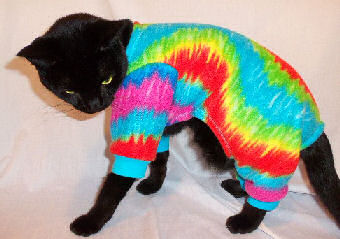
One memory Salem would like to delete is the tie-dye jumpsuit he wore in the '60s.


