Live Broadcast
I can't believe it's only two months until Christmas, Artie Tyrell thought as he woke on a chilly October morning. It seems the older I get, the faster time goes by.
He stepped into his slippers, put on his robe, made a pit stop in the bathroom and then went into his kitchen for a cup of hot coffee. Breakfast that morning consisted of two chocolate-frosted Entenmann's donuts, which he dunked in his cup of instant Maxwell House. (He had given up eating healthy meals at the same time he stopped jogging.)
Why bother? he figured. I have no wife. No kids. No pets. Not even a goddam goldfish!
What he did have was a career, and it was a great one. He was the most popular, highest-paid deejay on the city's number-one rock 'n' roll radio station. There was a time, not too long ago, when that accomplishment brought him a sense of pride, joy and fulfillment. Now, he saw it as nothing more than a job. It was not only the breakup of his marriage that caused this change of attitude. It was the continuing evolution of rock music itself that contributed to his melancholy. He grew up hearing his parents' records from the Sixties and Seventies, spent his formative years listening to the hair bands of the Eighties and cut his teeth in radio broadcasting with hits of the Nineties. Now, he barely listened to the songs he played on his shows.
I used to love being on the air, he thought, licking a dab of melted chocolate off the rim of his cup. Now, it's just like working a boring nine-to-five job, only my hours are eight to midnight. I am what I always dreaded becoming: a clock-watcher.
If there was still one bright star in his dull universe, it was his annual Halloween broadcast. Not only was it always done at a remote location, but it was the one day of the year he got to choose the songs he played. For those four precious hours, there was no Taylor Swift or Adele, no Justin Bieber or Drake, no hip hop artists, cute blonde female singers or boy bands. If he chose to do so, the station execs would let their celebrity deejay play his favorite bands and solo artists. They would have no objections to WMIW becoming an "oldies" station one night a year. However, the deejay always played Halloween songs—the creepier the better.
Once his sweet tooth was satisfied, Artie put his cup into the dishwasher and returned to his bedroom to get dressed. He was taking a pair of jeans out of his closet when his cell phone rang.
"You got a minute?" Martina Durgin, his show's producer, asked.
"Sure."
"I found a great spot for this year's Halloween broadcast."
"Good. I was beginning to think we'd have to start repeating ourselves. After all, there's a finite number of spooky places for us to use."
In keeping with the dark nature of the holiday, all his remote broadcasts were done from eerie locations. In the past, he had spent his Halloween nights at such diverse places as a graveyard, a former mental asylum, a defunct prison, an abandoned resort hotel, a morgue, a funeral parlor and a house where an entire family of five was annihilated.
"I had a tough time convincing the head of the city's public works department," Martina explained, "but I finally got his approval."
"Come on! Don't keep me in suspense. Where will it be?"
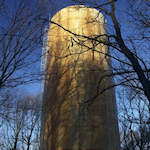
"You remember that old water tower near the river?"
"Yeah. When I was a kid, we had a name for it: Suicide Tower. Didn't they demolish that thing years ago?"
"No. It's still standing. It's perfect for our needs!" the producer exclaimed. "It's abandoned. It's in an out-of-the-way location. And, most importantly, it has a horrific history."
Artie recalled the stories he had heard as a youngster.
"That's where that kid, Lonnie Kirkwood, killed himself, wasn't it?"
"Yes."
"I was just an infant at the time of the suicide. I later learned of it from my friends when I went to school. By then, the tale had become an urban legend. Now, quite frankly, I can't distinguish the facts from the fiction. Was he a Satanist? A drug dealer? A neo-Nazi? A victim of sexual abuse? I've heard all kinds of stories about him."
"No need to worry. I did the research. I'm sending a PDF to your email. It contains all the pertinent facts you need to know about what happened. I'd suggest that between songs, you entertain your listeners with a real-life horror story."
* * *
On the evening of October 31, Artie Tyrell treated himself to a lobster dinner at his favorite restaurant. Although he indulged in a slice of rich cheesecake for dessert, he steered clear of alcohol and had only one beverage during the meal: a cup of coffee with his cheesecake. Martina had forewarned him about his working conditions that evening. There was no heat, running water or toilet in the small enclosure at the center of the observation deck.
When he stepped out of the warm, well-lit restaurant into the cold, dark night, he shivered and zippered his jacket. Not for the first time, he considered moving south. Maybe he could find a job playing classic rock for the aging baby boomers down in Florida.
It was a thirty-minute drive to the water tower. Upon starting his BMW, he turned the heat on and the radio off, enjoying a brief spate of peace and quiet before spending four hours playing music for his listeners. As he neared his destination, he turned on his high beams. There were no businesses, houses or streetlights in the vicinity—just bare trees and fallen leaves.
Martina picked a good location for my broadcast. This place is right out of a horror movie!
A late-model Subaru BRZ, a beat-up Mustang and the WMIW van were parked in the clearing beside the tower. The electric blue BRZ belonged to his producer, who was drinking a Starbucks pumpkin latte to stay warm.
"The equipment is up there and ready for you to go," Orrin Rader, the engineer, announced.
"Your playlist is on the laptop," Martina added.
Orrin turned toward the station's unpaid intern and called, "Light it up."
Two huge searchlights—the kind often seen at Hollywood premieres or store grand openings—were shined on the water tower.
"Holy shit!" Artie exclaimed. "The stairs are on the outside! Please tell me there's an elevator."
"Sorry," Martina apologized. "You're going to have to walk up."
"A hundred and fifty feet? I could have a heart attack by the time I make it to the top—if I make it to the top!"
"You've got thirty-five minutes until you go live. Just take your time."
The cup of coffee he drank in the restaurant had made its way to his bladder, so he stepped into the woods to relieve himself before starting to climb. The stairs encircled the circumference of the structure, and he felt slightly queasy as though he were on an amusement park ride. He stopped, closed his eyes and took several deep breaths. The nausea passed but was soon replaced by an ache in both his calves.
Why couldn't they just lower me from a helicopter? It would have been a lot easier on my legs!
He finally made it to the top, where the wind was much stronger. He hurried inside the enclosure. Orrin—bless his heart—had thoughtfully placed a space heater and a camper's porta potty inside for his comfort. The deejay took off his parka. His heavy sweatshirt would keep him warm, and he could work unencumbered by the bulky jacket.
Taking his seat, he put on his earphones to communicate with the people on the ground.
"I made it," he announced.
"Good," Martina said. "We go live in five."
As he waited, Artie double-checked the audio files on his computer, making sure all the songs on his playlist were there. Everything seemed okay on his end. Provided all the equipment functioned properly, there would be no dead air during his broadcast. In his mind, there was nothing worse than his listeners losing their signal during his show.
"We're ready when you are," Martina announced five minutes later.
"Happy Halloween, you children of the night!" the deejay declared in his best Bela Lugosi imitation. "Welcome to my annual Halloween broadcast. I'm here with you tonight at Suicide Tower. I'm sure most of you have heard of it, but who knows the truth of the bloody deed and the tragedy that inspired that name? Well, stay tuned to WMIW, and in between the songs I picked especially for this show, I'll tell you all about it. Let's kick things off this evening with one of the best-loved Halloween songs of all time. Here's Bobby Boris Pickett with 'Monster Mash.'"
"Monster Mash" was followed by The Classics IV's "Spooky." While Dennis Yost sang the 1967 hit, Artie removed his notes from his pocket and reviewed them. When it came to an end, he turned his microphone back on and began to read.
"Lonnie Kirkwood was an honor student who could best be described as an overachiever. Not only was he president of the sophomore class, editor of the school newspaper and clarinet player in the band, he was also a gifted athlete. He played right field on the baseball team, was first-string wide receiver on the football team and point guard on the basketball team. But dark demons haunted the fifteen-year-old. I'll have more on that later, but now, here's Godsmack."
He clicked the icon for the MP2 audio file—the format used in broadcast radio—and began playing "Voodoo."
"Had I known about the porta potty, I would have brought a bottle of water or a can of soda with me," he told Martina.
"If you want, I can have Stu bring something up to you," the producer offered.
"That would be nice. My mouth is bound to get dry soon."
"What do you want? Starbucks is half an hour away, but here's a convenience store not too far from here."
What he wanted more than anything was a cold beer, but he never drank alcohol while on the air.
"How about a couple of cans or bottles of Coke?"
"I'll send Stu out for a six-pack. Do you want anything to eat?"
"No. I'm still full from my lobster dinner and cheesecake."
He turned his mic back on and announced, "That song always reminds me of MTV's Fear. That was one of my favorite reality shows, although I don't know how real it actually was. Anyway, let's get back to the events of 1975. As I said, Lonnie Kirkwood was a model teenager. He was the child every parent dreams of having. Yet one afternoon, the young man came home from school, went directly to his bedroom, sat at his desk and, rather than write a report on JFK's role in the Civil Rights movement, penned a suicide note.
"Speaking of notes—music ones, that is—here's 'Witchy Woman' by The Eagles."
A minute and ten seconds into the song, Artie heard footsteps mixed with Don Henley's vocals.
That was quick, he thought, assuming it was Stu Van Blarcum, the station's unpaid intern, with his six-pack of Coca-Cola.
The footsteps grew louder. Soon, he could hear them on the landing outside the door. Artie waited, but the young college student did not enter.
"Come on in," he called. "It's open."
The door remained shut.
"Damned unpaid interns," he mumbled to himself. "They're useless."
He got up from his chair and opened the door. No one was outside.
* * *
"That was 'Strange Brew' by Cream," Artie announced, adjusting his mic and headphones.
"Getting back to our tale of tragedy, Lonnie Kirkwood didn't want his parents to grieve for him after he was gone. He didn't want them to suffer the loss of their son. So, he decided to kill them before he killed himself. But before we delve into the bloody events of 1975, here's another Halloween favorite: 'Thriller' by Michael Jackson."
Once Jackson's megahit began to play, he contacted Martina down on the ground.
"Hey, where did that kid go with my soda?" he demanded to know.
"Give him a chance to get back here. He just left a few minutes ago."
"But I heard him outside during the last song."
"That's impossible. His Mustang is gone," the producer insisted.
"Well, someone walked up those stairs. I heard the footsteps clear as day."
"You must have heard a bird or an animal because no one has gone near the tower. Orrin and I have been here the entire time."
Artie was convinced someone had been on those stairs, but he saw no point in arguing.
What does it matter who was out there? He or she is gone now.
"Thriller" was followed by prerecorded advertisements from the show's sponsors, Carmichael's West End Ford dealership and Gomez Tacos. Immediately after the restaurant's jingle came to an end, he played another song, "The Devil Went Down to Georgia" by The Charlie Daniels Band.
"While we're on the subject of the devil," Artie said when the foot-stomping, fiddle-playing country classic came to an end, "let's go to Elvis Presley. Here's '(You're the) Devil in Disguise.'—Oh, yes, you are."
As his radio audience was being entertained by the King of Rock 'n' Roll, the deejay looked at his watch and frowned.
The kid should be back with my soda by now. Where the hell is he?
Moments later, as though in answer to his question, he heard the footsteps on the metal stairs. He did not have to get up from his makeshift work area this time. Stu opened the door and came inside.
"Here's your Coke," he said, breathless from the exhausting climb.
"Thanks, kid."
"No need to thank me. That's what I'm not getting paid to do," he laughed and then headed back toward the stairs.
The deejay listened as the sound of the retreating footsteps faded.
"Let's follow that one up with a song that has a similar theme. Here's 'Devil or Angel' by Bobby Vee."
Artie popped the top on the can of Coke and took several sips before turning on his mic again.
"Stanley Kirkwood was sitting at the dinner table after a hard day at the office. His wife was upstairs in the bedroom. She had spilled something on her blouse while cooking and wanted to change it. Neither parent was aware of their son's decision. He was a well-behaved, obedient boy, after all, and they had no reason to suspect that something was wrong."
Hoping to build suspense, the deejay temporarily stopped speaking, creating an unnerving silence and dead air. When he spoke again, it was in a low voice, barely louder than a whisper.
"Now, here's 'Season of the Witch' by Donovan."
After another commercial break, he played "Black Magic Woman" by Santana. Halfway through the song, he heard a voice in his earphones.
"Artie."
"What do you want, Martina?" he replied.
"What was that?" the producer asked.
He repeated his question.
"I don't want anything. You called me," she said.
"No, I didn't. I was up here listening to Santana, and I heard you say my name."
"I don't know who you heard, but it wasn't me. I was texting my boyfriend."
"I must be hearing things!" he laughed uneasily. "First, footsteps on the staircase and now voices through my earphones."
"Maybe Suicide Tower is getting to you. God knows it gives me the creeps!"
"That's because you're a marshmallow. I've had broadcasts in much scarier places than this one."
With Santana coming to an end, he cut his conversation short.
"Let's return to the Kirkwood household now. When we left off, Stanley was in the kitchen, and Lorna Mae was upstairs in the couple's bedroom. And where was Lonnie? Outside in his father's toolshed, sharpening an ax on a whetstone."
More suspense. More silence. More dead air.
And then the sound of footsteps again.
"Here's one of my favorite bands of all time, Creedence Clearwater Revival."
As he sang along with the toe-tapping "Bad Moon Rising," Artie idly wondered why anyone would climb up all those stairs unless it was absolutely necessary. He listened as the sound grew louder. The footsteps came right up to the door and stopped.
"Who's there?" he yelled.
As before, there was no answer.
* * *
"That was 'Werewolves of London' by Warren Zevon. I'm sure if any Yankee fans are listening, they'll recognize the song before that one as Metallica's 'Enter Sandman.' For those who aren't familiar with baseball, that song would play whenever Hall of Fame relief pitcher Mariano Rivera entered a game."
Artie kept his eyes on the door. Was it an animal on those stairs? Could it have been a raccoon?
"'Tis some visitor ... tapping at my chamber door—only this and nothing more," he muttered, unaware that his microphone was still turned on.
Martina immediately spoke to him.
"What was that all about?" she asked.
Realizing his error, he quickly clicked on the MP2 file to begin playing the song.
"Sorry," he told his producer. "I was temporarily distracted."
"Well, don't let it happen again," she teased. "Your listeners want to hear about Lonnie Kirkwood and Suicide Tower, not quotes from Poe's 'The Raven.'"
"Nevermore."
"Funny."
Artie looked at his watch. He still had two hours before the broadcast was scheduled to end, at which time the late-night deejay, Jezebel Trueheart—not her real name—would take over for him.
Jez is lucky. She'll be in the studio, not a hundred and fifty feet up in the air on top of a water tower!
"Leaving Poe to contemplate the visitor who was perched on the placid bust of Pallas and the rare and radiant maiden whom the angels named Lenore," he said, hoping to make his on-air faux pas sound as though it had been scripted, "let's return to the Kirkwoods. Stanley was sitting at the kitchen table, waiting for his wife and son to join him. He could smell the meatloaf his wife had made, and the aroma stimulated his appetite. One has to wonder if he heard his son enter the back door of the house. Did he see him cross the room and ask the boy why he was carrying an ax? We'll never know. What we do know is that Lonnie struck his father six times. He was not quite as bad as Lizzie Borden, but he got the job done."
He paused, repeating his effort to build suspense by way of dead air.
"How about some Van Halen?" he asked, breaking the short silence. "Here's 'Running' with the Devil.'"
Taking a break, Artie relieved his bladder in the porta-potty and then opened another can of soda. Normally, he avoided caffeine at night, but he had not thought to ask for a caffeine-free Coke.
I doubt the convenience store carried it anyway. Besides, if I have trouble falling asleep tonight, I can just take a couple of melatonin.
Back on the air, he continued his saga of murder and suicide.
"Whether her husband was already dead when Lorna Mae came downstairs is another mystery we can't solve. I imagine she must have heard the commotion from the bedroom. Perhaps she came down to investigate and found her son killing his father. If she did, she didn't turn and run back upstairs, nor did she escape the house through the front door. Instead, she went into the kitchen where her son killed her with one blow to the head."
Silence. Dead air.
"My next song is by Stevie Wonder. This is 'Superstition,' and as his lyrics claim, 'The devil's on his way.'"
Moments after Artie turned off his mic, he felt a chill in the air. He wondered if the infrared space heater had stopped working.
I don't think so. The heating element is still glowing. Perhaps the outside temperature dropped.
Rather than adjust the thermostat on the portable heater, he put on his jacket. He was just zippering it up when Stevie Wonder's song came to an end.
"After killing his parents, Lonnie Kirkwood left the house and walked more than two miles to the water tower. Back in those days, before the town kept the area under lock and key, it was a popular spot. People liked to climb up there to enjoy the view. It was also an inexpensive place for teenage boys to take their dates. They'd buy a six-pack of beer, a pack of smokes and climb to the top to make out. No one else was there that evening, however. Lonnie was all alone. Up the one-hundred-and-fifty-foot tower, he went—and that is no easy feat, I can vouch for that! Once there, the honor student turned parricidal killer leaped to his death."
The silence and resulting dead air were longer this time, not in hopes of building suspense but to let his listeners know that his story had come to an end.
"Why don't we brighten the mood and pick up the pace now with Ray Parker Jr.'s 'Ghostbusters'?"
The song may have been more upbeat, but the mood in the enclosure was still grim. Not only did it seem to be getting colder, but Artie was having trouble with some of the equipment. The lights occasionally flickered, and bursts of static came from his headphones.
"I'm having trouble hearing you," he told his producer.
Martina did not respond.
"Hello? Are you there? I'm ...."
The sound of footsteps interrupted him.
Good. Here comes the cavalry.
He crossed the room and opened the door. No one was there, so he stepped out onto the landing and looked down at the staircase. Because it encircled the building, he could only see a portion of it.
"Who's out there?" he shouted.
Silence. No, there was a sound. It was footsteps, and they were coming closer.
Frightened, he ran back into the enclosure and slammed the door shut behind him. Without bothering to introduce the next song, he clicked on the icon and began playing "I Put a Spell on You" by Screamin' Jay Hawkins.
Once the mysterious footsteps ceased, he managed to compose himself, at least to the point where he could continue his broadcast.
"Why did he do it?" he asked, reading verbatim from Martina's PDF. "What inner demons caused that young man to brutally murder both his parents and then jump off a water tower to his death? Some psychologists might blame his actions on the violence one sees on television. Today, they would fault video games, rock music, bullying and social media. But we must ask ourselves, what made Charles Whitman, a former Eagle Scout, kill his wife and mother, climb up the clock tower at the University of Texas and open fire on the unsuspecting people below, killing fourteen and wounding thirty-one? And we don't have to go back to 1966 or 1975 to find these kinds of senseless killings. God knows we have more than enough of them today! Columbine High School. Sandy Hook Elementary. Texas First Baptist Church. Virginia Tech. Mandalay Bay casino in Las Vegas. The Pulse nightclub in Orlando."
Outside, the footsteps resumed.
"No place is safe anymore. Not schools, churches, synagogues, mosques, malls. We're not even safe in our own homes or from our own families. In short, this country is going to hell."
The moment he began playing AC/DC's 'Highway to Hell,' the door burst open.
"You want to know why I did it?" the glowing, semitransparent ghost of Lonnie Kirkwood asked.
"N-not really," the terrified deejay replied with complete honesty. "I was just reading from a script my producer gave me."
"You asked a question; you deserve an answer. No one ever left me alone. Not my parents, my teachers, my coaches. They were always hounding me. Do this. Do that. And nothing I ever did was good enough for them."
A loud blast of static in his ear made Artie pull the earphones off his head. They weren't working anyway, so why should he bother to wear them?
As Lonnie Kirkwood continued to vent his anger at the targets of his angst, the lights flickered and dimmed.
Please don't let them go out! The last thing I need is to be on top of Suicide Tower, in the dark, with the ghost of a teenage murderer.
"Thanks for stopping by to answer my question and explain your actions. Now that I understand, you can leave."
"But you don't understand," Lonnie said. "I came here for you."
The computer screen went dark.
"Oh, shit!" the deejay exclaimed. "Don't crash on me now. It's not midnight yet. I've got to finish my broadcast."
But he couldn't play any songs if his laptop was down. He pressed and held the power button, hoping to reboot it.
"Give it up," the ghost told him. "It's not going to work."
Moments later, the overhead lights flickered once more and went out.
"It's time for us to go."
"Go? Go where?" Artie cried.
Although the laptop's screen was dark and the power light was out, music began to play. It was not a song from his playlist, but it was one the deejay recognized: "Don't Fear the Reaper" by Blue Öyster Cult.
Lonnie Kirkwood stretched out his semitransparent arm and demanded that Artie take his hand.
"No. I'm not going anywhere with you!" the deejay screamed.
The deejay rose from his seat and made a mad dash across the room and out onto the landing. Anxious to escape death, he ran at full speed, unaware that he was doing exactly what the reaper wanted him to do.
Down on the ground, Martina Durgin, Orrin Rader and Stu Van Blarcum were sitting in the back of WMIW's van, listening to the broadcast and trying to stay warm.
"What made him switch to Blue Öyster Cult in the middle of 'Highway to Hell'?" the producer asked.
"I don't know," the engineer replied. "Did you ask him?"
"I can't. All I'm getting on my earphones is static. I hope nothing's wrong."
"Maybe we should send Stu up to find out," the engineer suggested.
"Not again," the unpaid intern groaned. "I've been going up and down those stairs all day. First, with all the equipment and then with the six-pack of soda. My legs are killing me!"
"As I recall, you begged me for this internship," Martina reminded him.
"I should have taken a job at Walmart instead."
Being a conscientious worker, despite not being paid for his efforts, he left the van, headed for the staircase and began to climb. He had just come in sight of the entrance to the enclosure when he saw Artie Tyrell burst through the door, tumble over the railing and plummet to the ground. It happened so fast that the intern had no time to scream.
From inside the van, Martina and Orrin heard something heavy fall to the ground.
"What was that?" the producer asked.
"I don't know, but something's definitely wrong with the transmission. I'm picking up nothing but silence and dead air."
This story was inspired by 15-year-old Gregg Sanders who in 1975 murdered his parents and then jumped off the Watchung Reservation water tower in New Jersey.

Salem once did a radio broadcast live from my saltbox, but the only two songs he played were "Cat's in the Cradle" and "What's New Pussycat?"


