A Question of Innocence
Bathsheba Abbot woke from a terrifying nightmare, her heart pounding and her body bathed in perspiration. It had been more than two months since her husband's ship went down in the North Atlantic and she became a widow, yet she was still being tortured by strange visions in her sleep.
"What's wrong? Did you have another bad dream last night?" her mother, Mercy Corwin, asked compassionately when she saw her daughter's tear-stained eyes and pained expression at breakfast the following morning.
Bathsheba nodded her head.
"Aye. I've had one every night this week," the girl whimpered. "And last night's dream was worse than the others."
"My poor dear," Mercy cooed, hugging her daughter to her ample bosom. "First, you lose your husband after only a few months of marriage, and now you're being plagued by these horrible nightmares. It doesn't seem fair for you to suffer so."
"My lot is no worse than most, I suppose. Just look at the trouble they're having now in Salem Village: all those young girls suffering from strange fits."
Mercy looked worried.
"There's talk of witchcraft being to blame," Bathsheba added.
"Oh, no!"
"Aye, 'tis true. I hear the girls have accused a black slave belonging to Reverend Parris, the minister of Salem Village church, of being the cause of all the trouble. They say she cast a spell on the minister's daughter."
During the following weeks, Mercy and Bathsheba anxiously followed the tragic events that were unfolding in Salem Village. Like many people in the Massachusetts Bay Colony, they were horrified when, on June 10, thrice-married, twice-widowed Bridget Bishop was hanged for witchcraft.
"There are more arrests every day," Mercy told her daughter when she came home from a visit to a friend in Salem Town. "The jail is filled with suspected witches."
Mercy considered the rapidly spreading witchcraft hysteria a dangerous state of affairs. Even though she would never publicly admit it, she did not believe in the existence of witches. Her late husband had been a devout Puritan, but she harbored doubts about some of the Church's more rigid beliefs.
Her daughter, Bathsheba, on the other hand, not only firmly believed in the existence of witches, but she was lately beginning to wonder if her recent afflictions might not be the handiwork of the Devil and his servants.
* * *
When the first cries of "Witch!" were heard in Beverly itself, Mercy prayed that her neighbors would soon come to their senses. Unfortunately, such was not the case. In the midst of the growing insanity, her own daughter was swept away by the tide of ignorance. When the old midwife, Hester Fairfax, was cried out against by a woman whose child was stillborn, Bathsheba testified before the court that the beggar woman came to her in her dreams at night.
"Goody Fairfax brings the Dark One to me while I sleep," the young widow screamed, caught up in the madness of the proceedings. "He comes to me in my dreams in the guise of my dead husband, but I know he is the Evil One."
"'Tis a lie," Hester shouted, proclaiming her innocence. "The maid is driven mad by grief. She knows not what she says. Pay no attention to her ramblings."
"Hold your tongue, you servant of hell," the magistrate thundered.
Clearly, he believed the testimony of the deluded witnesses.
"I swear to God I speak the truth," Bathsheba sobbed, falling to her knees in tears before the members of the court. "I have not slept through the night in weeks, for Hester Fairfax and her dark master do not let me rest."
Mercy ran to her daughter, took the hysterical young girl in her arms and gently rocked her from side to side.
"You have suffered a terrible loss, my dearest Bathsheba, but you must trust that God will heal you in his own time. Do not blame this innocent old woman for what is nothing more than a natural expression of grief. Come home with me, my child. I'll take care of you."
Hester studied the magistrate's unsympathetic countenance and ascertained that he was convinced that the young woman was indeed being tormented by a force stronger than mere sorrow over her husband's death. Someone would surely hang, and Hester was determined that she would not be the one at the end of the rope.
"You vile woman!" the accused prisoner suddenly shrieked.
All eyes in the court turned to her.
"She is the witch," Hester declared, pointing to Mercy, who was startled by the ridiculous accusation. "'Tis she who sends the spirit of Abel Abbot to his wife."
"But I am her mother," Mercy objected, coming to her own defense. "I would not harm Bathsheba in any way."
"'Tis not harm you seek. You wish to bring back your son-in-law from the dead and end your daughter's grief."
"You are mad!"
The magistrate looked from the mother to the accused witch, paying careful attention to the scene unfolding before him.
"If you are innocent," the wily Hester continued, "then how come you did not cry 'witch' against me when your daughter did? Everyone in Beverly knows how devoted a mother you are. Why do you not wish to see the witch who torments your daughter hang, unless that witch is you?"
An audible gasp went up from the spectators in the courtroom.
"Bathsheba is not being afflicted by the Devil," Mercy informed the magistrate. "She is merely grieving over Abel Abbot's death. Her nightmares are a natural result of that sorrow. I myself had bad dreams after my husband died."
"So, you don't believe these dreams are the work of Satan?" the magistrate demanded to know.
"I do not, sir. There is no witchery here." "Woman, there are but two forces at work in this world: Good and Evil. God and the Devil. If you believe your daughter's affliction is not the work of the Devil, then you must believe 'tis God who torments her."
"Nay. As I have already testified, I believe Bathsheba's dreams are but a natural product of her grief."
"All things natural are the work of God. 'Tis the unholy and unnatural things that are brought about by Lucifer and those who follow him. I ask you again, Mercy Corwin, do you believe your daughter's affliction is the will of God?"
"Nay, I do not."
"Then 'tis clear that there is witchery at work here. Now, tell me. Who is the witch that torments your daughter?"
Like Giles Corey in Salem, who was pressed to death for not answering the charges against him, Mercy remained steadfastly silent.
"I command you to speak here before this court and before God's ministers," the Magistrate bellowed. "Who is the witch?"
"It seems you have given me a most difficult choice, Your Honor. I can either falsely accuse another and thus save my own neck, or I can speak the truth and save my immortal soul. Very well. I choose to speak the truth. I do not believe there are witches in this world, nor do I believe in the existence of Satan or of hell."
Angry cries of "Witch!" rang out through the courtroom.
"If I am a witch, a servant of the Devil, would I deny him?" Mercy reasoned.
The magistrate looked down at her sternly. It was obvious her argument fell on deaf ears.
"The Devil finds his most useful servants in those who doubt his existence."
Hester Fairfax put her head down to hide her victorious smile. She had succeeded in shifting the suspicion of witchcraft away from herself and onto another.
"Mistress Mercy Corwin," the magistrate pitilessly pronounced after conferring at length with his fellow judges, "you have been found guilty of the crime of witchcraft. I order you to be taken to jail to await your execution."
Bathsheba, frightened for her sole parent's life, protested vehemently.
"My mother is no witch! She is a good and kind God-fearing woman who would not hurt anyone."
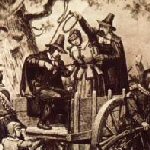
Nonetheless, the magistrate had already made his decision and hurried from the courtroom. Ignoring the girl's pleas, the sheriff carted the convicted witch off to the overcrowded jail.
* * *
Mercy was imprisoned for more than a month. Thanks to a sympathetic guard, Bathsheba was able to pay a brief visit to her. The girl was distraught by her parent's appearance: the prisoner's clothes were tattered and filthy, she had lost a good deal of weight and her skin was deathly pale.
"Mother, forgive me," she begged. "I brought this calamity upon you."
"Hush, child. 'Tis not your fault. The suspicion and terror that started in Salem Village has spread like the plague."
Bathsheba lowered her voice and confided, "I have saved some money. In a week or two, I will have enough to bribe the guard and buy your freedom."
"Even if I could get out of jail, I would have nowhere to go."
"You could escape to another colony."
Mercy thought for a few moments.
"Aye, I suppose we could flee Massachusetts. The two of us might start a new life in New York or even further south."
Bathsheba shook her head.
"I do not have enough money to bribe the guard and pay for two passages aboard a ship. You must go yourself."
"Nay, I would never leave you here alone."
"I will not be alone for long. I am with child."
Dumbfounded, Mercy stared at her daughter with both fear and sympathy.
"You must take the money and escape, dear child, for your husband is in his watery grave; and after your talk of the Devil coming to you in your sleep, people will look with suspicion on the babe you carry."
"My dearest Abel may now be dead, but the child I carry is his."
"A year ago, most people would have regarded your unexpected pregnancy as a miracle of God, but these are dangerous times. It seems as though everyone is full of fright and doubt. I fear that unless you leave Beverly soon, you will join me on the gallows."
* * *
That night, while she slept, Bathsheba Abbot was again visited by Hester Fairfax and the Dark One she served. This time, however, the dream had none of the nightmare qualities of the preceding ones.
"Bathsheba," the Dark One in the guise of her beloved late husband said gently, "Mercy is right. You must leave Beverly. There is only danger for you here now."
"I cannot desert my mother while she is condemned to hang," Bathsheba protested.
"Do not fear; I will not let her die. She will remain in jail until this madness is over, and then she will be released."
"When?"
"Soon. Already, some of the people of Salem Village are beginning to question the validity of the inflicted girls' testimony. The tide will turn, and your mother will be set free. You have my word on that, but now you must gather your things and leave."
"Where shall I go?"
"Ebenezer Wickes's ship, the Lady Mary, sets sail with the tide the day after tomorrow. Go to the wharf in Salem Town, and he will take you aboard and deliver you to safety."
When Bathsheba awoke the next morning, she was disturbed by the dream she had had the previous night. Was it a warning, or was it yet another figment of her imagination, borne of her grief for her husband and concern for the safety of her mother and her unborn child?
"I must go and talk to my mother," she decided, unsure of what course she should take.
As Bathsheba neared the jail, a familiar voice hailed her.
"Where do you go, Bathsheba Abbot?" Hester Fairfax called.
"To see my mother," the young widow replied angrily, turning away from the woman who had accused Mercy.
"You are wasting precious time. You should be home getting ready for your voyage."
Bathsheba stared at the old woman with surprise.
"I don't know what you're talking about."
"I'm talking about saving your life and the life of the child you carry."
"How could you know of this?"
"How indeed?" the old woman cackled.
"You are a witch!"
"It will do neither of us any good for you to denounce me now. I will turn the pointing finger of accusation on you, as I did on your poor mother, and I will tell the court about your pregnancy."
Bathsheba's hand instinctively went to her abdomen, as if to protect the unborn child in her womb.
"Go! Leave Beverly," Hester urged. "Governor Phipps will soon step in and abolish the existing court. Your mother will be retried by the new court and will be found innocent. I will pay her jailer's fees myself and secure a passage for her on Captain Wickes's ship."
"Why would you help her when you are the one who accused her in the first place?"
"I did it only to save my own life. Are you forgetting that you testified against me?"
"You were torturing me with those nightmares."
"I cannot fully explain my gift to one who knows nothing of the spiritual world, but I was merely carrying out your husband's wishes. His spirit wanted to be with you. I was but the medium that he traveled through."
Bathsheba's eyes widened with wonder.
"Do you mean that it was actually my beloved Abel and not the Dark One who came to me?"
"It was your husband, the father of your child," the old woman cryptically contended. "Now, go home and pack your things and be at the wharf in Salem Town tomorrow to board the Lady Mary."
* * *
Captain Ebenezer Wickes sailed to the Colony of Pennsylvania, far from the watchful eyes of the Puritans of Massachusetts Bay. Three months later, as Hester Fairfax had prophesied, Mercy Corwin was retried and found innocent of the charge of witchcraft. True to her word, the old woman paid the prisoner's jailer's fees and purchased passage for her aboard Captain Wickes's ship. Thus, soon after she was released, Mercy was reunited with her daughter in Philadelphia.
As her delivery date drew near, Bathsheba and her mother prepared for the birth of the baby.
"I wonder if it will be a boy or a girl," Mercy mused as she hemmed the infant's bed linen.
"I don't know," Bathsheba answered, "but I hope it's a boy and that he looks like Abel."
A week later, Bathsheba went into labor. Since Mercy had assisted in several births while living in Beverly, there was no need to call in a midwife. It was a long and difficult birth, but both mother and child survived it. Bathsheba was silent and somber after the initial shock of seeing the child.
"It looks like its father," she announced with horror, before turning her head away.
Mercy tried to place the tiny infant in her daughter's arms.
"Nay! I don't want to touch it! I can't stand the sight of it."
"She's only a helpless baby."
"It's evil! Just like the witch and her dark master that tricked me into giving birth to it."
"She's your baby, too."
The tiny creature squirmed and whined with hunger.
"Are you going to feed her, or are you going to let her die of starvation?"
"I want you to take it outside and smother it," Bathsheba responded.
"She's your child. If you want to murder her, you must do it yourself."
Bathsheba looked down at the little girl and, for the first time, saw not the two stubby horns that protruded from her forehead but rather the blue eyes that were so like her own and the tiny fists that curled trustingly around Mercy's finger.
"I suppose when her hair grows out, it will cover those—things," Bathsheba assumed, feeling the first stirrings of maternal affection.
"Aye," Mercy eagerly jumped in. "Until that time, we can put a little bonnet on her head when we take her out in public."
"Nay," her daughter insisted firmly. "We must take her away from here. We escaped the madness that spread through Salem Village and the surrounding towns. I do not want to tempt fate now. We might not be so lucky the next time."
Thus, the following week, she and her mother packed their belongings, bundled up the tiny infant and headed for the Colony of New Jersey. There, the two women looked after the little girl who, despite her "birth defects," grew up to become a beautiful young woman.
At the age of sixteen, Bathsheba's child met a local farmer, Jonas Leeds, a lonely man who was smitten by the young woman's beauty and willing to overlook the strange protuberances on her forehead. The two were married, and over the next twenty years, they produced thirteen children, all of whom carried the tainted blood of Bathsheba Abbot's nightmarish "husband."
In the years that followed, as more people settled in the Pinelands region, word of the unusual Leeds children spread throughout the colony and eventually gave birth to the legend of the Jersey Devil.

You don't believe in the Jersey Devil? What about my cat, the Massachusetts Menace? (Photo created using Bing's AI Image Creator. Apparently, Artificial Intelligence doesn't include knowing how to spell!)


