
Postmortem
"The boundaries which divide Life from Death are at best shadowy and vague.
Who shall say where the one ends, and where the other begins?"
—Edgar Allan Poe, "The Premature Burial"
By right of primogeniture, Godric Skeffington, the firstborn son, stood to inherit both the family estates and the earldom of Chatham upon his father's death. Historically, second sons either entered the church or embarked on a military career. However, Tristam Skeffington, who came into the world two years after the future earl, lacked the faith necessary to preach God's word; and as for joining the military, he believed better minds and more patriotic hearts than his ought to lead the queen's army or navy in defense of the British Empire.
As he sat in his room at Eton, the teenager gave serious consideration to what he wanted to do with his life. It was expected he would go on to Oxford or Cambridge, but what should he study? At that time, medicine was not the respected profession it would later become. Being a doctor would be viewed as beyond the pale by his parents. Likewise, becoming a merchant would be seen as tawdry.
I suppose I could become a scholar, he mused. That's a respectable enough vocation for the son of an earl.
Science did not tempt him, however, neither did history. He was much more interested in art, music and literature, but he did not want to be a mere spectator or dilettante in that world. He preferred to be an active participant.
Tristam first tried his hand at music. He spent days listening to the works of Beethoven, Mozart, Bach and Handel. Stirred by these great composers, he learned to read and write music. Yet when he sat down at his desk with a pen and sheet of manuscript paper, no original melody came to him. Not only could he not compose music, but he had a great deal of difficulty playing it. He was all thumbs at a keyboard and even less adept with a stringed instrument.
Perhaps I'm better suited to art, the young student thought.
Inspired by the masterpieces at the National Gallery in London, he attempted to paint but succeeded only in creating a simple landscape of blue sky, green grass and yellow flowers.
"This is hardly a painting worthy of the Dutch Masters," he declared after critically eyeing his work.
He did little better with sculpture.
Literature it is then. Surely, writing does not require any great talent. After all, it is only putting words down on paper.
However, words alone, even those with proper sentence structure and punctuation, do not make for compelling reading. He needed an idea, a plot and characters, and these key elements eluded him.
"I might as well give up and become a vicar!" he cried, throwing his hands up in defeat.
Then a classmate brought back an unusual item from his recent holiday: a portrait of him and his family which he placed beside his bed. This was not one made of canvas and oils. It was a thin metal plate that had been treated with chemicals.
"What's that?" Tristam asked.
"It's called a daguerreotype. It's all the rage on the continent, and now several daguerreotypists have set up shop in London."
"This is an incredible likeness of you! How was it made?"
"I haven't the slightest idea. I believe a Frenchman by the name of Niépce invented the process."
Tristam was so impressed by the early photograph that, at the end of the term, he traveled to London where he sought out one of the photographic studios. The daguerreotypist, who found it increasingly difficult to accommodate the growing number of customers that came to his shop each day, readily offered the student an apprenticeship. Without consulting his parents, the Earl of Chatham's second son jumped at the opportunity.
Unlike his forays into music, art and literature, Tristam had a knack for photography. He learned quickly, and his skill soon exceeded that of his teacher. Equipped with a Voigtländer camera, a new Petzval lens and a passion for his work, he set out to make his fortune in the nascent field of photography.
* * *
Tristam had been pursuing his career as a photographer for three years when his father passed away and Godric came into his inheritance. Immediately upon the earl's death, a black-bordered letter was hand-delivered to the deceased's second son, informing him of the sad news.
Please come at once, the communiqué from his older brother instructed. And be sure to bring your camera, as we will want you to photograph Father before his body is placed in the grave.
This request may seem morbid or macabre to people born in the twentieth and twenty-first centuries, but to the Victorians, it was perfectly normal. With photography being a relatively new science, many people had never had their pictures taken while alive. Their loved ones often wanted a photographic remembrance of them to cherish after they died. Even though the late earl's painted portrait hung on the wall of Skeffington Manor for all to see, it had been painted when he was a young man. His wife and son wanted a photo of him as he was before death took him.
Oddly enough, despite the popularity of postmortem photography, Tristam had never taken a picture of a corpse before. He had always shied away from what he considered to be an unpleasant task. Family portraits and wedding photos were more to his liking. On more than one instance, he had even had the opportunity to photograph members of the royal family.
"But this is for my mother," he told himself. "Surely, I can do that much for the woman who gave me life."
Tristam's visit to Skeffington Manor was a bittersweet one. His joy at seeing his mother and brother after more than sixteen months was tempered by the sorrow of the occasion. After a welcome-home dinner, for which the cook prepared his favorite dishes, he enjoyed a glass of port in the study with his brother. After finishing his drink, he steeled himself for the grim task at hand.
"I suppose we best get to it," Godric announced as he placed his empty wineglass on the fireplace mantel. "Do you need any help setting up your camera?"
"No. That won't be necessary."
"Father is in the sitting room."
"Have you and mother given any thought as to how you would like him posed?" Seeing the look of confusion on his brother's face, he added, "I mean would you like me to photograph him lying in the casket or perhaps propped up in a chair."
"A chair would be better, I think."
Although he had no personal experience with positioning dead bodies, he had learned from colleagues several tricks to make the deceased subjects look as though they were still alive.
"Eyes open or closed?" Tristam asked Godric, who was looking out the window to avoid seeing his father's body.
"Open. Mother always admired Father's blue eyes."
As he opened the dead man's eyelids, the photographer tried not to gaze at the cloudy corneas.
I can't understand why anyone wants to remember their loved ones like this, he thought. I, for one, would prefer to think of my father as he was in life.
Memories of his childhood came to mind as he posed the corpse on the wing chair, propping it up with pillows to prevent it from slumping to the side. As he coated a glass plate with collodion in preparation for taking the photograph, he recalled his father's infectious laughter, his fine singing voice at church, the kindness he showed to the servants and the love he felt for his wife and sons.
That's the image of my father I'll hold in my heart.
In spite of his own aversion to the developed print, he was pleased with his mother's reaction.
"He looks as though he's still alive!" she exclaimed, her eyes misting with tears. "I must admit that I was more than a little disappointed when you chose to be a photographer, but this ... this ...."
Then her tears fell in earnest. When she finally composed herself, she hugged her younger son and kissed his cheek.
"I don't know how to thank you. This means so much to me."
When Tristam returned to his London studio at the end of the week, Sylvester Norbrook, his clerk, who took care of all the necessary non-photographic aspects of the business (scheduling appointments, ordering supplies, collecting and depositing fees and paying bills) expressed his condolences for his employer's loss.
"Anything happen while I was gone?" the photographer inquired.
"Nothing I couldn't handle. But I better warn you, you're not going to have much free time in the next month or so."
"You won't hear me complain. I'm glad the business is doing so well. In fact, I've reconsidered my position on postmortem photos."
"Really?"
"Yes. My personal feelings about them aside, I couldn't help noticing how much the picture of my father pleased my mother. If I can bring comfort to others in their time of mourning, it's selfish of me not to do so."
Sylvester knew his employer well enough to understand the young man spoke from the heart. It was not greed that changed his mind about photographing the dead; he sincerely believed he could aid people in their time of grief.
"That means you're going to be even busier than before. And you'll most likely have to take those photos in the customers' homes. It's not very likely they'll come to the studio with their deceased loved ones in tow."
"Well, I'm a bachelor," Tristam reasoned with a laugh. "I've got no wife or children to put demands on my time."
No, Sylvester thought. And unless you step away from behind that camera more often, you're not likely to.
* * *
When Tristam entered the Pratchett home, toting his camera and equipment behind him, his first instinct was to turn around and leave.
What was I thinking? he wondered. I'm glad I was able to make my mother's widowhood a bit less devastating, but did I really think about what this aspect of my job would entail?
The photographer looked down at the bodies of the young mother and her three-month-old child and inwardly cringed. How could he touch them? How could he prop up that woman, cut down in her youth, and place the baby in her arms?
"Excuse me a moment," he apologized to Jubal, the widower, and ran outside the house to vomit.
He returned several minutes later and began the grim work. His hands immediately pulled back when they came into contact with the child's cold, dead flesh.
"I CAN'T DO THIS!" his brain screamed.
"Is something wrong?"
The grieving widower's question fortified his failing resolve and reminded him why he agreed to take on the gruesome mission.
"No," he replied softly. "I need a pillow if you have one."
Keeping his mind on a more cheerful subject, he posed the mother and child and prepared to take their photograph.
"Would you mind ...?" Jubal began hesitantly.
"What?"
"If I got into the picture, too? We always wanted to have a family portrait, be we never got around to it."
Tristam felt his stomach turn and feared he was going to vomit again. He swallowed, cleared his throat and answered.
"No. I don't mind at all. If that is what you want."
Jubal Pratchett lovingly placed one arm around his dead wife's shoulder. The other arm rested in her lap, the hand protectively supporting his daughter's body.
Never having been in love himself, the photographer was in awe of the tableau before him. This man's life would forever be changed by the death of his wife and child. Someday, he might remarry, and that wife might give him children. But he would never look upon these loved ones this side of heaven again—except in a photograph.
That's why I have to continue doing this.
* * *
Two years went by, during which time Sylvester Norbrook became a father for the third time.
"I suppose I'll need a new family portrait," he announced with pride.
"I'll be glad to do it," Tristam told his clerk. "Just bring your wife and children into the studio anytime it's convenient."
"And what about you? Isn't it high time you got married?"
"I have to find the right woman first. It's not easy in my line of work. I take pictures of brides, young mothers and elderly ladies."
He purposely did not mention dead women, but the thought had crossed his mind.
"Doesn't your brother's wife know any eligible young ladies?"
"My sister-in-law is too busy being Lady Skeffington to worry about my domestic situation."
The conversation came to an end when the son of an MP entered the studio to have his picture taken in his naval uniform before embarking upon his first voyage with the Royal Navy. Tristam was glad for the interruption since he did not want to get into another discussion about his single status.
When the post arrived midmorning, Sylvester stopped adding numbers in the ledger to go through the stack of envelopes.
"Well, speak of the devil!" he exclaimed.
"What's this about the devil?" the photographer asked, emerging from the darkroom.
"It's a letter to you from Lady Skeffington. We were just talking about her earlier."
"I wonder what she wants."
"Maybe it's an announcement of a future heir."
A dark, brooding frown clouded Tristam's face as he read the missive. Sylvester recognized that look. He saw it every time his employer was called upon to photograph the dead.
"It's not bad news, is it?"
"Not exactly. One of my sister-in-law's friends has died, and she would like me to photograph the girl."
"Do you want me to reschedule your appointments for the next few days?"
"Yes. I don't suppose I can refuse a member of my own family. I'll finish up here this afternoon and leave first thing in the morning."
When his train pulled into the station, it was met by Barnabas Wingrove, the father of the dead woman.
"I can't thank you enough for coming here. As you can well imagine, my wife is beside herself with grief. I think a photograph of our daughter will help ease her pain."
"I've seen other mourners find comfort in such remembrances."
"India is in the parlor," the mournful father announced when they arrived at the house.
When Tristam crossed the threshold and saw the young woman's body laid out on a makeshift catafalque, he was mesmerized by her beauty. He drew closer and stared down at her stunning features. Her fiery curls were held in place by an ivory comb studded with emeralds, and he longed to set those precious red locks free to fall around her face and shoulders. The complexion was not waxy and pale like that of most corpses but soft and the color of fresh buttermilk with a pink tinge on her cheeks as though she were blushing. But it was her open eyes that fascinated him most. They were bright and clear and were a shade of green one frequently sees in spring gardens.
How cruel fate was to introduce him to the woman he would have eagerly married had not death snatched her to its bosom before he had the opportunity to meet her.
He gingerly reached out his hands to lift her body and place it on a nearby sofa and was astonished to find the skin still warm to his touch. Surely by now, she ought to have grown cold. But he was a photographer, not a doctor. He had no idea if some medical condition might prolong a body's temperature after death.
As he positioned her arms in a more natural pose, he recalled Jubal Pratchett, the young man who lovingly sat beside his deceased wife and daughter as Tristam photographed them. He longed to join India on the sofa, to enfold her in his embrace, to kiss that perfect cheek.
What am I doing? he mentally chastised himself. This behavior is most unprofessional.
He reminded himself why he was called to the home and tried to maintain proper decorum as he followed the usual steps in preparation for taking a photo. However, when he looked back at the subject, his eyes made contact with hers and he saw a smile form on her lips.
"My God! You're still alive!"
Her smile widened.
Tristam ran from the room to tell the girl's parents the good news.
"Mr. Wingrove," he yelled. "There's been a dreadful error. Your daughter's not dead!"
"What? But the doctor said ...."
"She looked me in the eyes and smiled."
Barnabas peeked through the parlor door and, seeing India sitting up on the sofa, jumped to the same conclusion as Tristam had.
"I must tell my wife!" he cried with joy and headed up the stairs to her bedroom.
"Thank God your parents called for me," he told the smiling young woman. "If they had gone ahead and buried you ...."
He shuddered at the idea.
"But they didn't. I'm grateful to you."
Her voice was soft and melodic, a fitting accompaniment to her flawless face and form.
"I'm afraid I don't know your name," India said.
"I am Tristam Skeffington. I understand you are acquainted with my sister-in-law, Lady Skeffington."
"Yes. We were ...."
India stopped speaking when her parents burst into the room.
"Can this miracle be true? India, my dearest, are you really alive?" Mrs. Wingrove asked, racing across the room toward the sofa and expecting her daughter to answer. "What's wrong? Can't she talk?"
The parents looked down at their only child. She showed no sign of life.
"Perhaps we should send for Dr. Sturgeon," her husband suggested.
"Yes. In light of this young man's claims, he ought to reexamine her."
Two hours later, when the elderly family physician emerged from the parlor after a second examination of his young patient, his bearded face was stern and unsmiling.
"There's been no mistake. I'm sorry. India is dead."
"But she smiled at me," Tristam argued.
"After death, muscles often contract. Limbs sometimes seem to move, and facial muscles twitch. What you saw was no real smile."
Theodora Wingrove, her hopes for a miraculous recovery dashed, fled back upstairs to her room in tears. Her husband followed.
"I tell you that girl is alive!" the photographer insisted.
"Listen, young man. I've been a doctor longer than you've been alive. I know death when I see it, and India is dead. Now I don't want you upsetting the Wingroves any further. They've been through enough hell already. Do you hear me?"
Tristam nodded his head.
"I certainly didn't intend to distress anyone. I'll just take my photograph, pack up my supplies and return to London."
"Good. I suggest you do so forthwith."
Downcast, Tristam returned to the parlor to take the photo. He silently watched the body as he waited for the required exposure time. With each passing minute, he came to believe the doctor. India was dead. Finally, he turned his back on her to remove the plate from the camera.
"They didn't believe you."
Her voice startled him. At the same time, he felt his heart burst with joy.
"You are alive!"
"To you I am. To them, I'm dead."
"How can that be? One's heart is either beating or it is still. It can't be both."
"What do you know of such matters? Do you know what the doctor said when he first examined me?"
"No."
"That I had consumption, that I would slowly waste away. I did start to go, but it was no disease that sapped my strength; it was lack of love."
"But your parents ...."
"Oh, I've no doubt they love me. But I longed for the love of a man. Other young women were getting married and having children, but I was destined to remain a lonely spinster."
"You mustn't say that. You're young and beautiful. A man would be a fool not to want to marry you. I certainly would."
"I sensed that the moment you walked into this room. That's when my still heart began to beat again."
"Then how can we convince your parents of this? For if we don't, they will continue with their plans to bury you in the family cemetery."
"I'm afraid I will not be of much use, for I cannot appear alive for them until they believe. You, my dearest, need to be my advocate. If we are to have a life together, you must stop them from consigning me to my grave."
A true romantic at heart, Tristam would move heaven and earth to save India's life. He paced the floor of the foyer for nearly an hour before Mr. Wingrove came downstairs.
"Have you taken the photograph yet?" the bereaved parent asked.
"Yes, but I need to talk to you."
Barnabas noticed the wild look in the young man's eyes and wanted him out of his house.
"I'm afraid I don't have the time. I have to see to the funeral arrangements."
"That's what I want to discuss with you. You can't bury India. She isn't dead."
"Please, young man. Don't start that again. Dr. Sturgeon ...."
"The doctor is wrong. I spoke with your daughter. She ...."
"Enough! Please. Go back to London and let my wife and I mourn our daughter in peace."
"There's no need to mourn!" Tristam said, his voice filled with passion. "She's alive. She's agreed to marry me."
Barnabas realized any further argument was useless. In fact, he believed his best course of action was to humor the photographer for the moment.
"That's wonderful news," he said. "Let me go upstairs and share it with my wife."
"Great! I can't wait to tell India."
Tristam returned to the parlor; but rather than ascend the staircase, Barnabas went to the carriage house in search of his coachman.
"I need you to do me a favor," he instructed. "Go to Skeffington Manor and ask the earl to come here quickly. Tell him something has happened to his brother."
When Barnabas returned to the main house, he found Tristam in the foyer.
"You didn't tell your wife the news, did you?"
"No. I had to attend to some business first. I'll go upstairs now."
"You're lying!" the photographer angrily accused the older man. "India said you were just pretending to believe me, that you are still convinced she is dead."
Barnabas headed not toward the staircase but toward to parlor door.
"If my daughter is, in fact, alive, I will believe it when I hear it from her own lips."
Being a much younger man, Tristam beat him to the parlor. Once inside, he slammed the door in the father's face and locked it.
"What are you doing?" the master of the house demanded to know.
"I won't let you bury India alive!"
"And how long do you intend to keep her hostage in there?"
"Until you see reason and agree to let us marry."
That, dear sir, will be a very long time, indeed!
The standoff lasted the greater part of a day. By early evening, Lord and Lady Skeffington arrived.
"Has there been an accident?" Godric asked, clearly worried about his brother's well-being. "Have you sent for a doctor?"
"I'm afraid your brother's problem is not of a physical nature. In short, he has taken leave of his senses. He has locked himself in the parlor with my daughter's body and won't allow us to bury her."
"I'll speak to him," the earl declared. "Maybe I can reason with him."
It was emotional blackmail at its finest. Godric told his younger brother that their mother's health was failing. If she were to learn of her second son's deplorable behavior, it might bring about her death.
"Do you want that on your conscience?" the earl asked through the door. "Why, it would be tantamount to matricide."
"How can I be expected to choose between my mother and the woman I love?" Tristam asked himself.
"You must go," India declared, making the choice for him. "I do not want my happiness to come at someone else's expense."
"But if I go, they will bury you."
"It doesn't matter. It is clear to me now that our love was never meant to be. Go. And take your camera with you. But promise me one thing."
"Anything, my love. Just name it."
"Know that I will always love you."
"And I you."
* * *
When Tristam arrived at Skeffington Manor, he found his mother in perfect health.
"You lied to me!" he told his brother, in a low, angry voice that she could not overhear.
"I had to get you out of that house. You'll spend the night here, but tomorrow I'm putting you on the early train back to London."
"And what makes you think I'll stay there?"
"You had better. If you keep on behaving in this manner, you'll wind up in Bedlam."
The threat of being committed to the notorious asylum seemed to put the proverbial fear of God into the photographer.
"I suppose my behavior has been somewhat erratic as of late."
"Erratic?" his brother laughed. "You claimed you were going to marry a dead woman! I'd say that goes beyond the definition of erratic."
"In my own defense, I must tell you I've been working too much lately. I think what I need most is rest. Would you mind terribly if I remained here for a few days?"
"Not at all."
The following day, after a brief church service, India Wingrove was laid to rest in the family cemetery. Tristam, who for obvious reasons was not permitted to attend the funeral, waited until dark and then slipped out of the house. Taking a fast horse from his brother's stable and a shovel from the gardener's shed, he headed for the Wingrove estate.
"Take heart, my beloved!" he cried as he frantically shoveled the dirt from the freshly dug grave. "I'll soon have you out of there. Then we can run away, perhaps to America. I have quite a bit of money saved to tide us over until I'm able to establish a studio in New York, Philadelphia or Boston."
With the full moon illuminating his endeavors, he worked quickly. He soon heard the shovel hit the wooden coffin.
"Only a few more minutes."
At last, the dirt was cleared away. He used the tip of the shovel to pry the lid off the casket.
"You're still alive. Thank God I was in time!" Tristam cried and took India in his arms.
"Hurry, dearest. Let's get out of here," she urged.
Before they could make their escape, they heard a fallen branch break under the weight of a horse's hoof. Moments later, the light from a lantern shined upon them.
"Sweet Jesus!" Godric exclaimed, his complexion paler than that of the dead woman in his brother's arms.
"I wasn't about to abandon the love of my life to a premature burial. As you can plainly see, she's not dead."
The sight of his brother clutching a corpse to his chest was not one Lord Skeffington would ever forget. Furthermore, Tristam's belief that the girl was still alive was proof of his insanity.
"Mr. Wingrove," the earl called to the man who had joined the search for his brother. "He's over here."
"Stay away! I'm going to America, and I'm taking India with me."
A number of the earl's tenant farmers soon appeared and surrounded Tristam. Unarmed, he had no hope of resisting.
"What are you going to do with him?" Barnabas asked Godric.
"I'm going to take him back to the manor."
"He'll only try to get free again, and he'll come back here for my daughter."
"I intend to put a lock on his door. I assure you, Mr. Wingrove, he won't get out again."
* * *
Being kept prisoner in the comfort of his family home was much better than being held in Bedlam Asylum. Tristam ate regularly, was given access to books and other "approved" forms of entertainment and had two strong servants to see to his needs. Although he did not have the freedom to leave his suite of rooms, he lived better than the majority of people in London did.
In time, he became complacent and ceased all attempts to escape. On those all-too-frequent nights when loneliness threatened to engulf him, he opened a small wooden chest and took out his ambrotype photograph of his beloved. The sight of her beautiful eyes and radiant smile sustained him.
"I'm not insane. India was and still is alive."
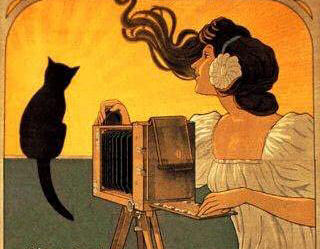
In my younger years, I learned to take daguerreotypes, but Salem had the annoying habit of stepping in front of the camera.


