
Dreamland
Every morning, as Clifton Swindell drank his cup of Maxwell House coffee, he thumbed through the Daily Herald, missing only those rare days when the paperboy was late in his deliveries. Since he and Alma moved into the house, there had been quite a few enterprising youngsters who rose early and biked through the development, dropping off copies of the Herald in all kinds of weather—so many that he could not remember all of their names.
Like most newspapers, the Herald put the national and world news on the front pages. Having lived through both the Great Depression and World War II, Clifton had grown accustomed to eye-catching news stories. None of them, except for the Kennedy assassination and the end of the war, caused the deep emotional upheaval that the attack on Pearl Harbor had—although the recent attempted assassination of Ronald Reagan did come close.
As he sipped his hot coffee that April morning, he briefly scanned the headlines. The lead story concerned the space shuttle Columbia, which was scheduled to launch on the twelfth. The sixty-year-old had no interest in the space program. To him, everything NASA did after the moon landing was anticlimactic.
"Good morning," his wife called cheerfully as she entered the kitchen in her bathrobe and slippers and headed for the Mr. Coffee. "Would you like me to make you some breakfast?"
Alma—God bless her!—was from the generation of women who proudly called themselves "housewives." They did not have outside jobs. Instead, they cleaned the house, washed laundry, starched and ironed their husband's shirts and made them breakfast in the mornings.
"No, thanks. I'm not hungry."
"I think I'll make a pot roast tonight," she announced as she sat down across from him at the kitchen table.
"That sounds good."
"Mashed potatoes or candied yams?"
"Mashed potatoes. I like the gravy you make with the pot roast."
"Anything interesting in the news?"
"Not really," he replied, turning pages and scanning headlines, few of which enticed him to read the articles beneath them.
Once he was finished with the first section of the paper, he folded it and put it to the side. The second section covered local news and sports. It was also where the classifieds, comics and puzzles were located. The story given priority in this section, and thus had the largest font for its headline, was one on a proposed tax increase to pay for the construction of a new school.
"Property taxes are going up," he grumbled. "What else is new? We don't have any kids. I don't see why we should have to ...."
As his eyes traveled to the bottom of the page, he caught sight of a photograph that literally left him speechless.
"You don't think we should have to what, dear?" Alma asked.
"Dreamland," he said to himself, not in reply to his wife's question.
"What?"
"This picture. It's of Dreamland."
"You mean that abandoned amusement park by the lake? Why do they have a photograph of that old eyesore in the paper? It's been closed down since the Sixties."
Clifton quickly read the short accompanying article before answering.
"They're tearing it down," he finally announced.
"It's about time! I hear it's become a hangout for vandals and drug dealers. Your parents must have taken you there when you were a kid. Do you remember much about the place?"
He turned his head so his wife could not see his tears.
Do I remember Dreamland? he asked himself. How could I ever forget it?
* * *
Clifton, who took over management of the family music store when his father retired, had a busy morning. Mondays were always hectic; it was the day his new stock of eight-track tapes, cassettes and vinyl albums was delivered. According to record industry scuttlebutt, these products would soon be replaced by something called a compact disc. He sympathized with his customers who purchased a Sony Walkman and would soon find their high-tech cassette player as old-fashioned as the transistor radio.
Such is life, he thought stoically. We're all on a roller coaster ride to obsolescence.
Of course, his business involved more than selling Queen albums, AC/DC cassettes and Journey eight-tracks. He also sold musical instruments: everything from grand pianos down to harmonicas. Additionally, nearly one-third of his revenue came from music lessons. And there was always the need to tune someone's piano or replace a guitar string.
Cora Garson, who started working at the shop while Clifton was off fighting in the Pacific, arrived promptly at nine to wait on customers while her employer stocked the shelves. Like the Edison phonograph on display in a glass case at the center of the store, she was a fixture at Swindell's.
"Did you read the paper this morning?" she asked when Clifton took a midmorning coffee break.
"Yes," he replied, steeling himself for her next words.
"Did you see that they're going to tear down Dreamland?"
There it was! All morning, he had tried to put the old amusement park out of his mind and had succeeded in keeping those bittersweet memories at a safe distance. With one question, Cora opened the floodgates.
"That's progress for you," he said, forcing himself to appear calm and emotionally undetached.
"I suppose so. Still, I wish some company like Six Flags would have bought it."
"If they had, they would have torn the old park down anyway and built a new one. No one has been on those old rides in close to twenty years. It's doubtful they're in working order. Besides, kids these days want thrill rides, not Ferris wheels and carrousels."
"But Dreamland was so much more than an amusement park. They had a beach on the lake, the picnic grounds and the dance pavilion."
Clifton closed his eyes. He could feel the lump in his throat and the tears behind his eyelids.
A man doesn't cry, he reminded himself. Especially not in front of an employee.
"Oh, well," he managed to say once he got his emotions under control. "I best get back to work. The new stock isn't going to put itself out."
He made it to the stockroom with his dignity intact; but once he was alone with the unpacked cartons and empty cardboard boxes destined for the dumpster, he gave in to the grief he had so desperately attempted to keep in check. With no one to see or hear him, he sat down at the receiving desk, put his head in his hands and wept.
By the end of the week, Dreamland will be gone. And another link to Bernice will go with it.
When the moment of weakness passed, he stood up and dried his eyes with the back of his hand. Then he called out to Cora, who was replacing the receipt tape in the cash register.
"I've got to go out for a few minutes."
"Okay. I'll hold down the fort while you're gone."
He walked out the rear door rather than pass by her with his red eyes and tear-stained cheeks. When he got behind the wheel of his Oldsmobile Cutlass, he had no exact destination in mind. His only goal was to get away from the music store, in hopes of escaping his past. However, as though his car were on autopilot, he found himself on the long, narrow, tree-lined road that led to Waldron Lake and Dreamland.
Seeing it after all these years, abandoned, its paint chipped and faded, its rides vandalized, its buildings defaced by graffiti, was heartbreaking. The Dreamland of his memories was brightly colored, clean and cheerful. Children laughed, and there was music everywhere. At the western end of the park, there was the carousel's Wurlitzer. A calliope played near the funhouse and concession stands. In the evenings, big bands could be heard in the vicinity of the dance pavilion.
It was the latter building that drew Clifton's attention. He got out of his Cutlass, crossed the cracked and pitted pavement, which now looked more like a war zone than a parking lot, and stood in front of the dilapidated ballroom. Through the eyes of old memories, he saw not rotted boards barely held together by rusted nails, shattered windows and thick webs stretching from rafter to rafter but a room softly lit for ambiance and festooned with streamers. He heard not the scurrying of anonymous rodents across the littered floor but a distant strain of melody, one that played every night when the pavilion closed its doors.
Meet me tonight in dreamland,
under the silvery moon;
meet me tonight in dreamland,
where love's sweet roses bloom.
Forty-two years slipped away, and he was a young man of eighteen. Nearly every Friday and Saturday night during late spring, summer and early fall, Clifton would hurry from his father's music store, pick up Bernice Conyer from her parents' house and drive to Waldron Lake and Dreamland. The two would then dance until closing time.
When he shut his eyes and concentrated, the sixty-year-old man could almost smell the captivating fragrance of Worth's Je Reviens perfume.
"The name is French," Bernice had told him. "It means 'I will be back.'"
"Odd name for a perfume, isn't it?"
"Not really. I like to think it'll keep you coming back to me."
And I did come back to you, Clifton thought, but it had nothing to do with your perfume. I came back because I adored you. I lived through four years of war, surviving each hellish day, knowing you were waiting for me, but then ....
Another car drove up and parked near his. Through the open windows of the beat-up Thunderbird, he could hear Van Halen blasting on the stereo. The music died when the engine cut off, and two teenagers got out of the car, one carrying a Kodak Instamatic camera. He stopped when he saw Clifton, fearful that the old man might be there to keep people away.
"I just want to take a few pictures before they tear the place down," the teen explained, holding up the camera.
"Go ahead," Clifton told him. "I was just leaving anyway."
"Were you ever here while the place was still open?" the teenage girl who accompanied the young man asked.
"Yes, I was. I used to come here all the time with my wife. That was before we were married, when she was still my girlfriend. I imagine we weren't much older than the two of you are now."
"I would love to have seen it!" the girl exclaimed. "Dreamland. What a great name!"
The young man with the camera was snapping photos of the old ticket booth and the souvenir shop. As he approached the dance pavilion, he got a closer look at Clifton.
"Hey, I know you," he said. "You work at Swindell's Music Store."
"I own it. Speaking of which, I better get back there. I still have several boxes of new releases to unpack."
With a last look at the pavilion, he said goodbye to the teenagers, got into his Cutlass and drove away.
* * *
When Clifton opened his front door that evening, the mouth-watering aroma of pot roast wafted from the kitchen. Alma was in the dining room setting the table. As usual, supper would be served promptly at 6:30. Their life ran on schedule, but neither seemed to mind. Mondays, Tuesdays and Wednesdays the music store closed at six, giving the owner half an hour to close up shop and drive home. Thursdays, Fridays and Saturdays, when it stayed open until nine, the music teacher from the local high school took over the helm from six until closing. It was a mutually beneficial arrangement for both employer and employee. The store was closed on Sundays, like most of the mom-and-pop shops in town, the closing a remnant of the blue laws that used to prevail when Clifton was a kid.
Although he was not a religious man, he enjoyed his day of rest. It was also the one day a week he could spend time with Alma. When they were first married, they would often go to the movies on Sundays or to a concert or a museum. Now, as they faced their golden years, they usually stayed at home and watched television.
Clifton washed his hands and then sat down at the table. Alma always insisted on filling her husband's plate and putting it down in front of him, even though he was more than capable of managing the task himself.
"How was your day?" he asked, knowing full well it was probably much the same as every other day.
"I went to the grocery store. They had a sale on ground beef. Maybe I'll make a meatloaf tomorrow."
"That sounds good. We haven't had it in a while. I like meatloaf, and yours is the best I've ever tasted."
Clifton looked at his wife and saw that she was smiling ear-to-ear at his compliment.
She's a good woman, he thought—not for the first time and probably not the last.
She was not Bernice, but then Bernice was one of a kind. Still, in his own way, he loved Alma, a woman who had come out of the war years with her life shattered. The two met at a Memorial Day service in 1950, five years after peace returned to the world. Her husband had been a paratrooper with the 82nd Airborne Division and was killed at Nijmegen in 1944. It was shared grief that brought the couple together. They were two lonely people for whom going to dinner once a week eventually led to marriage. Although they had never been blessed with children, theirs was a happy union nonetheless. For thirty years, Alma had been more than a wife; she was his best friend.
"And how was your day?" she asked.
"Busy. Mondays usually are. I did take a break in the morning, though."
"Oh? Did you drive to Dunkin' Donuts and buy yourself coffee and a donut?"
"No. I drove out to Waldron Lake to see Dreamland before they tear it down."
"Before you know it, there'll be a shopping center there. Nothing will remain of the amusement park."
Except for the memories, Clifton thought. They won't go away.
While Alma washed the supper dishes and straightened up the kitchen, her husband went into the living room and picked up the TV Guide to see what was on television. He did not particularly care for sitcoms, nor did he like primetime soap operas like Dynasty and Dallas, shows he considered "women's programs." He preferred more manly entertainment. What America needed was more police shows like The F.B.I., which went off the air in 1974.
"Anything good on?" Alma asked as she entered the room, drying her hands on the dish towel.
"No."
"What about HBO?"
"It's that same horror movie we watched last Thursday night."
"We'll put a tape on then," she said, perusing their collection of Betamax movies. "How about The Godfather? We haven't seen that in a while."
"Sure. I never get tired of the Corleones."
"Why don't you put it on, while I go make us some Jiffy Pop?"
When Clifton turned on the television, the evening news was just going off. The final story of the night was a farewell to Dreamland, a collage of photographs taken during the amusement park's heyday. There was no reporter to provide commentary, just a song playing while the images flashed like a slideshow across the screen.
Meet me tonight in dreamland,
under the silvery moon;
meet me tonight in dreamland,
where love's sweet roses bloom.
Come with the love light gleaming
in your dear eyes of blue.
Meet me in dreamland,
sweet dreamy dreamland;
there let my dreams come true.
As the last notes of the song faded away, one last photograph filled the screen, that of Dreamland as it looked today, in April of 1981: abandoned, dilapidated and ready to face the wrecking ball.
With his wife at the stove, Clifton let his tears slide silently down his cheeks.
Bernice! his mind screamed. I loved you so much!
* * *
Tuesday morning, when Alma went down to the kitchen to have coffee with her husband, he was not there. Nor was there a dirty coffee cup in the sink waiting to be washed.
"Clifton?" she called.
There was no answer. Maybe he had to go to the music store early and didn't have time for breakfast. When she glanced out the living room window and saw the Cutlass still in the driveway, she revised her theory. Perhaps the car wouldn't start and he had to find another way to get to work. Most likely, he called Cora and asked her for a ride.
Then, upon closer examination, she saw someone sitting behind the wheel of the Oldsmobile. Her heart plunged. Was something wrong?
"Please, God! Let him be all right," she prayed as she ran out the door in her bathrobe and slippers.
"Alma," her befuddled husband said when she wrenched open the passenger door. "What are you doing out here in your nightclothes?"
"What are you doing sitting out here in the driveway?" she countered.
"I was just about to ...."
"Have you been crying?" Alma asked, noticing his red, puffy eyes.
He turned his head away, embarrassed.
"What's wrong?" his wife asked, fearing the worst. "Have you been to the doctor?"
"I'm not sick," he said, refusing to turn in her direction.
"Then what's wrong? Is it the business? Are you having financial troubles?"
"I just want to be left alone now."
"No! You're my husband. If something is bothering you, I want to know what it is. Tell me!"
"It's all this business about tearing down Dreamland. It's stirred up some painful memories."
"About your first wife?"
"Yes."
"We never really talked about her. Maybe you would feel better if we did. I never brought her up before because I didn't want to cause you any pain by asking questions," Alma explained. "But she's been gone for more than thirty years now."
"Time doesn't heal all wounds," he said.
"Come inside. I'll make us a cup of coffee, and we can talk about it."
When they entered the house, Alma went to the Mr. Coffee and her husband went to the phone. He called Cora Garson to tell her he was running late.
"Can you open up the shop for me?"
"Sure. I've got the key in my purse."
Alma put milk and sugar in their coffees and then sat down at the table.
"Let's talk. All I know about your first wife was her name and the fact that she died back in 1945."
"Funny, isn't it? I survived four years of war overseas, and she gets killed crossing a street here in our hometown."
"Is that how she died? She was hit by a car?"
"Yes. Just three days after I returned from the Pacific."
"Why don't you visit her grave? I would visit my husband's, but he's buried in Holland."
"She was cremated. I sprinkled her ashes at Waldron Lake, so she could be near the dance pavilion at Dreamland. It was where I asked her to marry me."
"No wonder all this talk about tearing down the place has upset you."
"I can't stop thinking about it or about her. I knew her all my life. We went to school together. We dated throughout high school. She wanted to have a big wedding, but then there was Pearl Harbor, so we wound up going to a justice of the peace."
"How long were the two of you married before you shipped out?"
"A week. It was the best week of my life! Those seven days got me through the next four years—those memories and her letters."
"Boris and I got married right out of high school. Everyone told us we were too young and that we should wait. I'm glad I didn't listen to them. At least we had two years before he enlisted."
"You're lucky. I wish Bernice and I had had more time."
"Tell me," Alma said, her face darkened with worry. "Are you content being married to me?"
"You know I am," he quickly reassured her. "You're a good woman. I know I don't tell you this often enough, but I love you."
"I love you, too."
"I suppose I ought to get to the store," Clifton announced, finishing the last of his coffee. "I don't like to leave Cora alone too long."
"How would you like lasagna for supper?" Alma asked, glad to return to her role of housewife.
"That sounds good."
After an affectionate kiss on the cheek, he went out the door. Minutes later, the Cutlass backed down the driveway and headed in the direction of Main Street.
In twenty-four hours, demolition crews would arrive at Waldron Lake and begin tearing down Dreamland.
* * *
Throughout the day, Clifton felt a sense of impending doom, as though dark clouds were amassing around him like an invading army. Cora, as usual, had her radio tuned to the easy-listening station. As her employer sat at his desk going through a stack of sales receipts, he could hear the soft instrumentals through the open office door. It was almost noon when the deejay announced a dedication.
"This one is going out to all the old-timers who fell in love while dancing cheek-to-cheek at Dreamland's dance pavilion," he announced.
What followed was one of the few songs with lyrics he would play during the day. It was an old song that had been played a lot recently.
Meet me tonight in dreamland,
under the silvery moon;
meet me tonight in dreamland,
where love's sweet roses bloom.
Come with the love light gleaming
in your dear eyes of blue.
Meet me in dreamland,
sweet dreamy dreamland;
there let my dreams come true.
Unable to concentrate on the figures in front of him, Clifton pushed himself away from his desk.
"I'm going out for a while," he called to Cora.
"Oh? Out to lunch so soon?" she asked.
He did not bother answering. There was no need to. He was the boss; he was not accountable to his employees.
As he sat behind the wheel of the Cutlass, driving along the long, narrow, tree-lined road that led to Waldron Lake, he wondered what his life would have been like had Bernice not died back in 1945.
This year would have marked our fortieth wedding anniversary, he mused. We would most likely have grown children and grandchildren. We'd be looking forward to handing the music store over to one of them and retiring. Maybe we'd spend our golden years traveling. Except for during the war, I've never been out of the country.
Clifton sighed as he thought about all he had missed. Then his mind went to his second wife. This year would mark their thirty-fifth anniversary. They ought to be thinking about retirement and travel.
It won't be the same thing. Alma is a good woman, but she's not Bernice.
Unlike his most recent visit to the abandoned Dreamland, this time there were dozens of cars parked in the derelict lot. A temporary barricade had been erected around the defunct amusement park to keep people away from the site. Law-abiding spectators craned their necks to get one last look at the place while others tried to find another way inside.
A respectable businessman, Clifton would not dream of trespassing; he simply stood in front of the fence and squinted his eyes against the glaring sunlight. The door to the dance pavilion was ajar. It was as though the old place were tempting him with an invitation it knew he could not accept. Over the sounds of laughter and chatter, he thought he could hear band music coming from that darkened entrance.
If I only had a time machine, he thought, fighting back his tears. I could go back to being eighteen. You'd be right there, and we could be together again.
A gentle wind blew, and it carried the scent of Worth's Je Reviens perfume.
I came back to you then, my love. If only you could come back to me now.
* * *
Alma was awakened by the sound of retching coming from the downstairs bathroom. She quickly got out of bed and went to see if her husband was all right.
"Are you sick?" she asked, a foolish question since he would not be vomiting if he wasn't.
"It must be the pork chops you made last night."
"I ate them, too, and I feel fine."
"Maybe I caught a bug then."
"Do want me to get you some ginger ale and saltines?"
"No. I don't want anything. I'm going to spend the day in bed and get plenty of rest. Hopefully, this will be gone by tomorrow."
"I'll call Cora and tell her not to expect you."
As Alma was driving to the grocery store later that morning, Hugo Schrank climbed into the cab of his Caterpillar bulldozer. He put the key into the ignition, turned on the engine and drove toward Dreamland's ticket booths.
Meanwhile, Clifton lay in bed, staring up at the ceiling. His stomach had settled, but he could not shake the feeling of dread that had come over him. He was certain it must have something to do with the demolition of Dreamland.
"It's nothing but an old amusement park," he reasoned aloud. "I haven't been there in years. Hell! Up until I saw that article in the newspaper, I didn't even think about it."
Now, he could not get the place out of his mind. He tried reading a Robert Ludlum novel but could not comprehend what was written on the page. Next, he turned on the television and watched The Price is Right with Bob Barker. But he had no interest in people winning vacations, new cars or kitchen appliances.
If I could just get that damned place off my mind!
When Clifton heard his wife's car pull into the driveway, he turned off the television and went out to help her.
"I'll bring the bags in," he told her.
"Are you sure you feel up to it?"
"Yes."
Alma was putting a package of chicken drumsticks into the freezer as Hugo Schrank steered his bulldozer toward the dance pavilion. Clifton sat at the kitchen table, spreading French's mustard on an Oscar Mayer bologna and Kraft cheese sandwich.
"Maybe I'll go the store after lunch," he announced.
"Can't Cora handle things for the rest of the day?"
"She's good with the customers, but I prefer to do the paperwork myself."
Precisely at 12:24 p.m., as he was washing his bologna and cheese sandwich down with a glass of milk, another wave of nausea hit Clifton. It struck him with such force that he did not have time to get up from the table, much less make it down the hall to the bathroom.
"I'm sorry," he apologized to his wife after throwing up his lunch onto the Formica tabletop.
"It's all right," she said. "I think you can forget about going to work this afternoon."
At that same moment Clifton's stomach erupted, Hugo had a similar urge to vomit. He managed to control it, but he turned off the engine of his Caterpillar and stared down at the shallow grave that was uncovered beneath the dance pavilion's bandstand.
* * *
"I don't want to hear another word from you!" Alma cried as she ushered her husband out the front door and down the driveway. "You're going to see Dr. Wolfson, and that's final!"
For close to an hour, Clifton had been bringing up bile and alternately shivering and sweating.
"It's just a twenty-four-hour thing," he argued. "It'll be completely gone by tomorrow."
"And just when did you get a medical degree?"
"You worry too much."
As she backed down the driveway, the Top 40 station Alma always listened to in her car played Rick Springfield's "Jesse's Girl." It wasn't Mozart or Beethoven, but Clifton thought it was better than the heavy metal or punk rock some of his customers preferred. They were halfway to Dr. Wolfson's office when the hourly news came on.
"Police have been called to the scene of a grisly discovery at the former Dreamland amusement park," the broadcaster announced.
Clifton's stomach roiled again. Thankfully, there was nothing in it for him to spew out onto his wife's dashboard.
"While demolishing the park's dance pavilion, a bulldozer driver uncovered a human skeleton."
The newscaster's subsequent words were drowned out by the sound of Clifton's screams. Alma quickly pulled the car onto the shoulder of the road and put it in park.
"What's wrong?" she cried. "Are you having chest pains?"
"Make it stop!" he screamed.
"Make what stop? Darling, how can I help you if you don't tell me what's wrong?"
"It's that damned song. It haunts me."
"What song?"
"'Meet Me Tonight in Dreamland.' I hear it all the time. Can't you turn the radio off?"
"But they're not playing any music now. They're giving the weather forecast."
"No. I can hear it. If it's not coming from the radio, then where is it coming from?"
Alma suddenly feared her husband's sickness was not in his stomach or his chest but in his head.
"You must be imagining it. I don't hear anything. Maybe you have a fever and you're becoming delirious."
She put her hand to his forehead. It was cool, not hot.
"Never mind about seeing Dr. Wolfson," she said, turning the car around and driving in the opposite direction. "I'm taking you to the hospital emergency room."
* * *
"I've given your husband a sedative," the physician on duty explained after his examination. "He's sleeping peacefully now. I think we ought to keep him here overnight. I want to be sure he's not going to do anything rash."
"If you think that's best, Doctor," Alma agreed.
"Why don't you go home and get some rest yourself? We'll call you if there's any change in his condition."
On the way back to her home, the worried woman stopped by the music store to let Cora know Clifton was in the hospital.
"It's nothing serious, is it?" her husband's employee asked with concern.
"I hope not. He probably just needs some rest. He's been so upset lately. Ever since he read that they're tearing Dreamland down. It's brought back so many painful memories of his first wife."
A confused look clouded Cora's face.
"First wife? I didn't know Clifton was married before."
"She died right after he came home from serving in the Pacific."
"He couldn't have known her very long."
"She was his childhood sweetheart."
"That's not possible. I've known your husband all my life. If he got married to a local girl, I'd have heard about it."
"You know how things were at the start of the war. Couples were running to the justice of the peace to get married before the grooms shipped out. That was the case with Clifton and Bernice."
The color drained from Cora's face, and she stared open-mouthed at Alma.
"Bernice?" she echoed after the shock wore off. "Not Bernice Conyer?"
"I'm not sure. Clifton didn't mention her maiden name. Why? Did you know her?"
"I can remember your husband having a crush on her when he was a teenager. I think they even dated for a while, but Bernice was—how can I put this delicately? She was 'popular' with most of the young men in town."
"You mean she was wild?"
"Yes. Clifton was only one of the men she was seeing."
"What happened to her?"
"No one knows. She started hanging around with a wild crowd during the war. Once peace was declared, she left town, presumably with one of the men she was seeing. Rumor has it she was pregnant."
"Clifton told me he got married before the war and that his wife was hit by a car just days after he returned."
"I don't know why he told you such a thing. It simply isn't true."
After leaving the music store, rather than go home to an empty house, Alma drove to the public library. In a time just before computers found their way into everyone's homes and businesses, back issues of the Daily Herald were stored on microfiche. She spent several hours searching issues from 1945. There was no mention of any automobile-pedestrian deaths. Her next stop was the vital records department at the town hall. There was neither a marriage license nor a death certificate for Bernice Conyer on file.
Cora is right. Clifton and Bernice were never married, and she wasn't hit by a car. Why on earth would he lie to me?
* * *
When Alma went to the hospital the following morning to visit her husband, she found two uniformed policemen outside his door and a detective inside his room.
"Mrs. Swindell? I'm Detective Dion Uecker. I'm here to question your husband in connection with the discovery of a body found buried beneath the dance pavilion at Dreamland."
Fear stabbed at her heart like a sharp dagger.
"What has my husband got to do with it?"
"He was a known associate of the dead woman."
Another stab, one that went much deeper than the first.
"I understand you're not from around here. You didn't meet your husband until 1950. Is that correct?"
"Yes. I lived in Pennsylvania before then."
"So, you never met Bernice Conyer."
Oh, God, no!
"I never even heard her name until a few days ago."
"Oh?" the detective asked. "What did you hear about her?"
What could she say that would not incriminate her husband? Surely, she could not tell the police that Clifton lived under the delusion that he was once married to Bernice.
"Mrs. Swindell? What did you hear about the murder victim?"
"Murder?"
Suddenly, Alma's eyes went to the back of her head. Moments later, Detective Uecker caught her before she fell to the floor.
* * *
Once the investigation began, it was not long before police gathered enough information to arrest Clifton Swindell.
"Bernice Conyer told the defendant she would marry him when he returned from the war," the state's psychiatrist testified during the trial. "During four years of fighting, all he could think about was coming home to her. When he finally got back, however, he learned it had all been a lie. She had no intention of marrying him. In fact, she was carrying another man’s child."
"Yet he told his wife that they were married before he shipped out and that Bernice was hit by a car and killed just days after he returned," the prosecutor pointed out. "Is it your expert medical opinion, Doctor, given Mr. Swindell’s delusion, that his mental state fits the legal definition of insanity?"
"No. It isn't. The fact that he went to great pains to hide the body by burying it beneath the dance pavilion is proof he knew that what he had done was wrong. But he couldn't live with the guilt of killing the woman he loved, so he created the delusion of a previous marriage and a tragic accidental death."
A strong prosecution coupled with a weak defense led to a guilty verdict. At that time, the sentence for first-degree murder was death by lethal injection. Clifton Swindell, who could not bear living with his guilt, did not pursue an appeal.
Since Alma had no family to support her in her time of tribulation, Cora Garson stepped in. On the day of the execution, her husband's former employee went to the prison with her. The two women sat in the witness room, holding hands, steeling themselves for the ordeal.
When Clifton was strapped to the table, his eyes sought his wife's. He found them and smiled.
She's a good woman, he thought. She is definitely nothing like Bernice.
He turned away, so as not to see her tears. As the needle was placed in his arm, he closed his eyes. In his mind, he heard "their song" for the last time.
Meet me in dreamland,
sweet dreamy dreamland;
there let my dreams come true.
"Meet Me Tonight in Dreamland" lyrics by Beth Slater Whitson and music by Leo Friedman; published in Chicago in 1909.
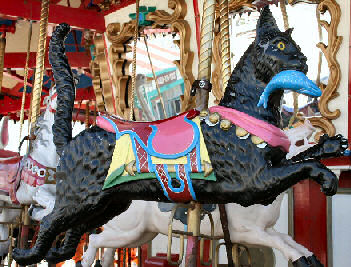
Salem once took a summer job at an amusement park. Nothing too strenuous. He cast a spell and turned himself into a carousel cat. All he did all day was ride in circles.


