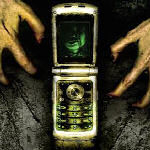
There's an App for That
Barclay Redgrave had two framed portraits on the wall, flanking the large window that looked down from the spacious top floor corner office of the Redgrave Building. One was of Microsoft co-founder Bill Gates; the other was of Apple's entrepreneurial CEO, Steve Jobs. Had it not been for these two men and the other technological geniuses who helped revolutionize the electronics industry, Barclay would not be the communications icon he was.
What began as an interest in programming his Commodore 64 eventually led to his earning a doctorate in computer science. After completing his graduate studies, he opened his own software development company. While he was moderately successful designing inexpensive word processing and desktop publishing applications, bookkeeping and spreadsheet packages and photo editing programs for the home consumer market, he faced stiff competition from Microsoft, Adobe, Lotus, Corel and others who had more resources to invest not only in development but, more importantly, in promoting their products.
It was not until the advent of the smartphone, which was capable of running mobile applications—more commonly known as "apps"—that he became a billionaire computer guru known the world over. With four out of five Americans owning such devices, Barclay no longer had to concentrate on designing programs for the personal computer. A man of nearly limitless imagination and the technical expertise to put his ideas into practice, he created apps that assisted people in nearly all aspects of their life, from making grocery shopping easier to managing medical records, from editing and organizing photographs to completing and filing tax returns and from handling vacation and travel plans to determining what caused a car's check engine light to come on. One of the ten wealthiest men in the world, he still had no intentions of slowing down despite his advanced years.
Jesse Greenfield, a prodigy who had graduated top of his class at MIT at the age of just seventeen, was offered jobs with nearly all of the prominent high-tech companies. With Steve Jobs deceased and Bill Gates retired, there was only one man still active in the programming field whom he admired. Thus, he accepted a position with Redgrave Software and soon earned himself a position as the senior programmer.
One day, as Barclay was nearing his sixtieth-fifth birthday, the mentor called his young disciple into the top floor corner office for a brainstorming session.
"What are you working on these days?" asked the Old Man, the cognomen the latest generation of programmers affectionately used to refer to the founder of the company.
"Something you're going to love," Jesse predicted. "It's a DVR for your phone."
"As opposed to the one hooked up to a TV set?"
"Say you're at work or otherwise unable to be home to watch game number seven of the World Series. You don't have to worry about programming your DVR and then going home and finding the time to watch it. Instead, you record the game with my app. You can then watch it on your phone or, if you prefer a bigger screen, access it through your TV or computer."
"How far along are you in development?"
"I estimate the beta program can be ready for testing in six to nine months."
Barclay seemed less enthused than Jesse had anticipated.
"Don't you like the idea?" he asked.
"Yeah, yeah. I'm sure there are millions of people out there who don't want to miss an episode of their favorite show. Keep on with what you're doing for now, but I may need your help on something I'm working on."
"Oh? What is it?" Jesse asked, knowing whatever the Old Man put his hand to was bound to be the next great innovation.
"An app that will allow you to communicate with the dead," Barclay replied with no change in facial expression.
Jesse laughed uneasily and asked, "It's not April Fool's Day, so what is this, some kind of hazing?"
"Do you think I'm joking?"
"You can't be serious."
"Thomas Edison believed it was possible. In October of 1920, he announced that he was working on his spirit phone, which would open up lines of communication with the spirit world. He hoped to tap into what he called life units."
"In 1920, Edison would have been in his seventies. It's fair to say he might not have been of sound mind."
"Nonsense! He was just as sane as I am."
The look on the young man's face spoke volumes.
"So, you think I'm becoming senile, too?"
"No."
"You're a terrible liar, kid. But I assure you, I haven't lost my mind. Hell, if you were to go back in time and tell Edison about the latest smartphone, he'd no doubt think you belonged in a straitjacket."
"Granted, communications have grown in leaps and bounds since Edison's day," Jesse conceded. "But talking to the dead? We don't even have scientific proof of life after death. There may not be anyone out there to communicate with."
"You know my religious beliefs," Barclay, an outspoken agnostic, stated. "I don't for one moment think the spirits of the dead are either up in heaven playing harps or burning in the fires of hell below. Still, I often wonder if people's memories, hopes and fears don't remain after their bodies are gone. It's possible that a human soul is nothing more than a charge of electric energy. I believe it might be possible to tap into that."
"I think you'd have better luck communicating with a thunderstorm. At least we know they exist."
Ignoring his employee's comment, the computer genius explained, "I've been in contact with Rutgers University in New Jersey and read through many of Edison's papers. I think he was on to something. Even if you don't share my vision, I hope I can rely on you to help me from time to time."
"Sure. I'll be in my office just down the hall. Now, if that's all, I'll get back to work on the DVR app." Then, as he opened the office door, Jesse added, "Oh, and give my regards to Tom Edison if you do manage to talk to him."
* * *
Although Jesse Greenfield and Barclay Redgrave were both workaholics who arrived way before the company's normal start of business and stayed several hours after closing, Jesse saw less and less of his mentor in the following months. To avoid distraction, the two men each worked behind closed doors and rarely left their desks. When he finally encountered the CEO in the parking lot some six months after their discussion of Edison's spirit phone, he was shocked by the Old Man's sickly appearance.
"How's the DVR app coming?" Barclay asked as the two men entered the dimly lit, deserted lobby.
"I'm making good progress on it," Jesse replied, tactfully avoiding any comment on the other man's loss of weight, sallow complexion and dark circles beneath his eyes.
"Good. Glad to hear it."
"What about you? How are you doing on your project?"
"As you might well imagine, communicating with the dead is a daunting prospect! I've been working on the program every waking hour of the day, but I feel I'm finally getting close to a breakthrough."
The two men were silent as they rode the elevator to the top floor. Barclay's mind was on his work, and Jesse was plagued by doubts of the other man's sanity.
Does the board of directors know what the Old Man is working on? he wondered. I doubt they do. I wonder if I should tell them.
The elevator stopped, and the two men got out of the car.
"I'll see you around, kid," Barclay said as he headed toward his corner office.
"Yeah, sure."
Jesse remained outside the elevator, watching until the legendary programmer, whistling an early Beatles' tune, disappeared behind his closed door.
The Old Man clearly needs help. I really ought to do something before it's too late.
When he entered his own office, however, and sat down at his computer, an irresistibly seductive siren sang to him in Objective-C, and all thoughts of being a Good Samaritan were banished from his mind.
* * *
Long used to the casual attire that was permitted at the software company, Jesse had some difficulty with his tie. He was a man more at home in a sweatshirt and jeans than in a dress suit. Still, the annual company Christmas party was a formal affair. Surely it would not hurt him to dress up one day out of the year.
I don't look half bad, he thought, admiring his reflection in the mirror. Maybe I ought to step out of my sartorial comfort zone more often.
He suddenly realized how much he was looking forward to the evening. Not only did he want to celebrate the completion of his DVR app, but this was the first company Christmas party where he would bring along a "plus one." Previously, he had attended all corporate social functions alone. The fact that it was a date arranged by his sister-in-law did not matter. Tracey Beecher was an intelligent, friendly and attractive young woman, and he hoped to have the opportunity to get to know her better.
On the way to the restaurant where the party was to be held, Jesse spoke to her in glowing terms about Barclay Redgrave.
"The man is a genius!" he exclaimed. "I can't tell you how much I've learned from him since I started with the company."
"During my sophomore year at Princeton, he was a guest speaker there," Tracey said. "The talk he gave was fascinating. He's bound to go down in history as one of the greatest minds of his generation."
"I'll have to introduce you to him. Despite his wealth and celebrity, he's a real likable, down-to-earth guy."
"I can't wait to meet him."
When Jesse walked into the hotel ballroom, however, the CEO was nowhere to be seen.
"Maybe he's not here yet," Tracey suggested.
That was a fair assumption for most people, but not in the case of Barclay Redgrave. He was never late for anything. Early, yes, but late—never! By the time the guests sat down for their first course, word was spreading through the room: the Old Man is not here.
Jesse heard the whispered conversation of those around him.
"Something might be wrong."
"He hasn't missed a single Christmas party since he founded the company."
"Should we call him and make sure everything is all right?"
"I already tried. He doesn't answer."
"Maybe he had car trouble."
"Why wouldn't he call if that were the case?"
No one had an answer, and by the time dessert was served, most people stopped wondering what had become of the CEO. It was a party, after all, and there was an open bar. And for Jesse, there was Tracey Beecher and the possibility of a blossoming romance.
* * *
Monday. It is a word that causes most of the workforce to groan with dismay as they struggle to get out of bed in the morning, wishing they could extend the weekend by one more day. Normally, Jesse looked forward to the beginning of the week, but after having spent Sunday with Tracey, he would have liked a few more hours of sleep.
He arrived at the office at five minutes to eight, which was for him close to two hours late. Curious as to why the Old Man had not attended the Christmas party, he headed toward the corner office to talk to the CEO.
"He's not in," Madge Pfister, Barclay's secretary, informed him.
"Where is he?"
"Home. He phoned me on Saturday and told me that until further notice, he was going to work out of his house."
"Has he ever done that before?"
"Not in the thirty-four years I've worked for him."
"You don't suppose he's sick, do you?"
"He didn't sound it over the phone."
"How did he sound?" Jesse asked, worried by the Old Man's uncharacteristic behavior.
"Excited. I got the distinct impression he's working on a new app and doesn't want any interruptions."
"Has he discussed his latest project with you?"
"You must be joking!" Madge laughed. "I may work for a computer genius, the vanguard of the telecommunications field, but I'm technologically impaired. I have difficulty sending a text message on my TracFone, much less understanding programming applications for a smartphone."
With Christmas just eight days away, most of the employees' minds were on the upcoming holiday and not on their work. Having finished the DVR app, which was now being tested by in-house personnel, Jesse had little to do except answer questions and fix minor bugs in the program. By five o'clock, he was ready to call it a day.
"You're leaving early!" Madge said when she saw him approach the elevator with his coat on. "It's not like you to be out on time."
"Slow day. I thought I'd do some shopping on the way home."
"This close to Christmas, the stores will be packed. I don't set foot in a mall from Thanksgiving until after the New Year. Thanks to amazon.com, I do all my holiday shopping online."
"I only need to buy a few gifts for my girlfriend. I thought I'd check out the lingerie selection at Victoria's Secret."
The secretary smiled. She had always thought Jesse was such a nice young man. It was about time he found a suitable woman. No one, she believed, should sacrifice a full personal life for success on the job.
Jesse had not been exactly truthful with Madge, however. He had no intention of going to the mall. Like her, he did his Christmas shopping online. Rather, he intended to stop by Barclay's house and make sure nothing was wrong.
Standing on the stoop of the Old Man's sprawling mansion, he pressed the doorbell a second time.
"Come on and answer," he said to no one in particular. "I know you're at home. I see the lights are on, and your car is in the garage."
It was not until he pressed the bell a fourth time that the front door was opened.
"Jesse!" Barclay cried with surprise. "What are you doing here?"
The man looked even thinner than before. Wasn't he eating? Furthermore, his eyes were wide and glassy, and his face looked feverish.
"I was worried about you. You weren't at work today, and you didn't go to the company Christmas celebration."
"I'm fine, better than fine. I'm great!" Barclay exclaimed, ushering the young man inside.
"Where were you Friday night?"
"Right here—working. I didn't want to interrupt what I was doing for some stupid party."
"Why didn't you call and tell someone? People were trying to get in touch with you."
"I turned my phone off. You, of all people, should know what it's like to just want to be left alone while you're at that crucial stage of development."
"Do you still think you're on the verge of a breakthrough with your app to talk to the dead?" Jesse asked, fearing that the Old Man's crackpot idea was becoming dangerously close to a full-fledged obsession.
"I'm no longer on the verge!" Barclay cried with exuberance. "I've actually done it! I've completed my magnum opus!"
What new madness is this? Jesse wondered.
"Come, let me show you."
Barclay led him to a capacious home office where state-of-the-art hardware vied for desk space with stacks of computer printouts, dirty coffee cups, empty Coke cans, disposable microwave dinner trays and plastic forks.
"Here it is: the FoxFōn!" the Old Man announced, holding up what looked like one of those cheap disposable phones sold at convenience stores.
"The what?"
"FoxFōn. I named it after the Fox sisters of Hydesville, New York, who in 1848 claimed to have made contact with the dead and thus gave birth to the nineteenth-century spiritualism movement."
"How does it work?" Jesse asked, not believing for one moment that the device actually did what the programmer claimed. "How can I call someone on the other side?"
"I haven't figured that part out yet," Barclay admitted sheepishly. "Right now, it only serves as a receiver, not a transmitter."
"You mean the dead can talk to me, but I can't talk to them?"
"No, that's not what I meant. You can have a two-way conversation, but you can't initiate the call. You must wait until the deceased person contacts you."
"And it works?"
"Yes, it does! Last night, I spoke to my father for close to two hours."
"Oh, come on!" Jesse cried with frustration. "Do you honestly believe you spoke to a man who was killed in Vietnam back in 1968?"
Barclay took no offence at the young man's dubiety. Who could blame him for doubting such a miracle?
"I know it's hard for you to believe me, not without some proof," he said, opening his desk drawer and taking out a second disposable phone. "You'll have to see for yourself. I've downloaded a beta version of the app on this. Take it. I'm sure eventually someone will call you."
After a moment's hesitation, Jesse took the phone and put it in the pocket of his jeans.
"When are you planning on coming back to the office?" he asked as the two men headed toward the front door.
"Maybe I'll stop by on Friday afternoon. I usually like to hand out the Christmas bonuses myself; it's good for company morale."
"I'll see you then."
During the short drive to his own apartment, Jesse tried not to dwell on his mentor's rapidly deteriorating mental health. He planned on spending Christmas Eve and Christmas Day with Tracey Beecher; he preferred to think about that.
Having stopped at the drive-thru restaurant half a mile from his apartment, Jesse sat down at the kitchen table and ate his cheeseburger and fries. Periodically, his eyes went to the phone that he had removed from his pants pocket and placed on the counter.
No one in his right mind would think you can speak to the dead over a cell phone.
Once again, he wondered if anyone else knew about Barclay's diminished capacity. His secretary did not seem to have a clue, or perhaps she was keeping any suspicions she had to herself.
What if I'm the only one who knows he's insane? If he doesn't get help, something might happen to him, and I'll have to live with that for the rest of my life.
Vowing to call Sterling Womack, the chairman of the board of directors, first thing the next morning, Jesse finished the last of his undercooked, over-salted shoestring fries and took the half-full large soda to the living room. As he reached for the remote to turn on the television, the phone on the counter rang.
"It must be the Old Man," he told himself. "He's the only one who knows I have that phone."
Jesse went to the kitchen and looked at the phone's screen. The caller ID read UNAVAILABLE. This was nothing out of the ordinary; the message routinely came up when the wireless service provider was unable to retrieve the caller's phone number. He picked it up and answered, fully expecting to hear Barclay's laughter.
"Hey, buddy! Long time, no see! How the hell are you?" the caller asked.
It was a voice he had heard so often in his childhood that it was unmistakable, yet it was also one he had not heard since high school and never expected to hear again.
"Chuck?"
"You remember me."
It was impossible! Chuck Appleton was killed in his senior year. Driving drunk on the way home from a late-night football game, he ran his Mustang into a telephone pole at seventy miles an hour.
* * *
Despite having slept very little the previous night—who could have a good night's sleep after a trip down memory lane with your childhood best friend who's been in his grave for close to a decade?—Jesse was wide awake at four in the morning. After drinking a strong cup of coffee to clear the cobwebs from his addled brain, he phoned the office and left a message that he would not be in. He quickly showered and dressed, and then, after a second cup of coffee, he drove to Redgrave's house.
Along the way, he practiced what he was going to say. He would begin by apologizing for his lack of faith in both Barclay and Thomas Edison. He did more than doubt the ability to communicate with the dead; he had been absolutely certain it was impossible. But, as they say, seeing—or hearing, in this case—is believing. Once the apology was made and hopefully accepted, he would ask, even beg if necessary, to be allowed to assist with the project.
Up until the previous evening, Jesse had thought Barclay's eBabel app was the greatest programming achievement since Facebook. It enabled users to speak into a cell phone in their native language and have it instantly translated and played back in any one of more than five thousand languages. Not only was eBabel immensely popular with teachers who taught non-English speaking students, but nearly every person who traveled out of the country for business or pleasure used the app to break the language barrier.
The young programmer stood on the stoop for more than fifteen minutes, alternating between knocking and ringing the bell, but no one answered the door. Jesse was determined to see the Old Man at any cost, even if it meant breaking the door down, not that he had the physical strength to do so. Fortunately, he was spared risking serious injury in the attempt; when he tried the front door, he found it unlocked.
"Barclay!" he called as he entered the home. "It's me, Jesse. Are you up yet?"
He went from room to room, but there was no sign of his boss.
"Where are you?" he shouted as he mounted the stairs to the second floor.
When he entered the master bedroom, he found the Old Man sprawled across the king-size bed.
"You're still asleep? I'm sorry to wake you, but I just had to talk to you. I want to apologize. The FoxFōn—it really does ...."
He saw the Old Man's face and stopped speaking. Barclay Redgrave was beyond hearing him.
* * *
The funeral was a somber affair. Most attendees were far too stunned by the sudden death of the company's founder to talk much, and when they did, they spoke in whispers.
"I can't believe he's gone," Madge Pfister sobbed, dabbing her eyes with a Kleenex tissue. "You work for a man all those years, and you never know he has heart trouble."
Sterling Womack, the former chairman of the board, was chosen to be the new chief executive officer. Unlike Barclay Redgrave, a creative genius whose seminal programs made his company the gold standard of mobile apps, the new CEO was strictly a businessman. He did not know the difference between Pascal and FORTRAN, and Jesse doubted he was capable of understanding the most basic HTML commands. What he did know was money and how to make it.
"I was told you were the one who found him," Sterling said, taking Jesse by surprise since the two men had rarely spoken before.
"Yes, I did."
"It must have been terrible for you. He told me the two of you were close. He had great faith in your abilities."
"I thought the world of him."
"We'll have to talk sometime after the holidays. Loyalty like yours ought to be rewarded."
"Thank you," the senior programmer replied.
There was no "Merry Christmas" when the two men parted. That would have been "out of keeping with the situation," as Mrs. Dilber, Ebenezer Scrooge's charwoman, said in the 1951 movie version of A Christmas Carol.
Later that evening, as Jesse watched that selfsame adaptation of Dickens's holiday classic on DVD—not on his yet unreleased DVR app—he nibbled on homemade gingerbread cookies given to him by Madge Pfister and sipped a glass of alcohol-free, store-bought eggnog. Despite the sad occasion, it was still December 23, and he made every attempt to adhere to his holiday traditions. Once the movie came to an end, he began wrapping Tracey's gifts on the dining room table.
He was in the process of cutting off a length of poinsettia festooned paper when the disposable phone Barclay had given him rang. The unexpected sound startled him, and he dropped the scissors from his hand.
Who could that be? he wondered, his heart racing with apprehension.
Although he already had a good idea what he would see, he looked at the phone's screen anyway. The caller ID read just what he had expected: UNAVAILABLE.
"Hello?" he answered.
"I'm sorry about leaving you the way I did."
Tears came to Jesse's eyes, and his lower lip quivered as he recognized the Old Man's voice.
"That's okay. It's not as though you had a choice."
"So, what do you think of the FoxFōn app? Is it everything I said it was?"
"That and then some."
Once he got over the shock of his second call from beyond, dozens of questions ran through the young man's head. Do heaven and hell exist? Is reincarnation possible? What do people do once they're dead? Will they queue up to call loved ones once FoxFōn is released? Barclay, however, gave him no opportunity to ask anything.
"I contacted you to ask you a favor," the recently deceased man explained.
"Anything. What is it?"
"I want you to continue my work. There must be a way for the living to reach out to people on this side."
"I'd be more than willing, but I don't know if I'm able to. For one thing, I'll need company approval. Then, if I get it, I'll need to go over all your existing research and hope that I can comprehend it."
"Oh, I'm not worried about that. Despite your youth, you're one of the most intelligent people I've ever met. As for approval, bring your demo phone to Sterling Womack. I'll try to contact him through it. Once he is convinced that it works, he's bound to assign the project to you. If there's any money to be made with FoxFōn, he'll be all for it."
"There's so much I want to say."
"Sorry, kid, maybe some other time," Barclay said, his voice beginning to fade.
Jesse looked at the battery charge indicator on the phone. It was fully charged.
Maybe the Old Man is the one with the weak battery.
* * *
Barclay Redgrave's assessment of his former chairman proved to be accurate. Once Sterling Womack was convinced that his conversation with the dead CEO was not an elaborate hoax, he immediately became excited about all the commercial opportunities the new app would create.
"Imagine what this would mean to police departments!" he exclaimed. "Detectives could question murder victims and identify their killers. As far as education goes, historians and biographers can speak directly to first-hand sources. It might also revolutionize medicine. Doctors and pathologists can talk to their deceased patients and perhaps gain valuable information about the causes of death. And the military! They're the ones with the deep pockets. I'm sure they'll find a use for it."
"I never thought of that," Jesse said.
"Barclay probably didn't either. He most likely envisioned it only as a way for someone to contact his or her dear long-lost Aunt Agatha and wish her a happy birthday. That man may have been a computer whiz, but when it came to business, he couldn't see past the end of his nose."
The programmer frowned. He had the highest respect for his former boss and did not appreciate Womack speaking about him in such a derogatory fashion.
"Now, I want you to drop whatever it is you're currently working on and get up to speed on FoxFōn. Meanwhile, I'll contact a few friends and try to stir up interest in it. Do you think we could arrange a demonstration of the app?"
"As a receiver, yes, but I still need to work on the transmitter program."
"That's fine. Once they can speak to the dead themselves, they'll be sold."
No man gets to be, first, chairman of the board and then CEO of one of the top-grossing companies in the world without making powerful friends, and Sterling Womack cultivated those friendships over the years. After placing several phone calls, he arranged a meeting with potential backers that included top military brass, representatives of major corporations, civic organizations and even one of the president's closest advisors.
"What's this all about?" an internally known media magnate asked. "All I got was an announcement claiming that your latest product will revolutionize the communications industry."
"And one that could have numerous military implications, as well," a high-ranking general added brusquely.
When Womack yielded the podium to Jesse Greenfield to explain FoxFōn's capabilities, he was met with not only disbelief but also anger.
"You've got a hell of a lot of nerve bringing us all here for some goddamned practical joke!" a well-known Wall Street fixture shouted. "Do you know how valuable our time is?"
"Yes, I do," the CEO replied. "Let me assure you all that this is not a joke. Now, I don't want to use up any more of your time than is absolutely necessary. I'm going to give each and every one of you a phone with a preloaded FoxFōn app. I want you to take them with you and leave them turned on. I've no doubt someone will contact you, and you'll see we're on the level."
Although all the attendees pocketed the phones as they left the meeting, there was not a pleasant parting word from a single one of them. There were only grumblings and a few expletives as the men exited.
By the end of the following week, Sterling received a personal phone call from each of the men who were at the meeting. All of them were convinced beyond the proverbial shadow of a doubt that the FoxFōn was on the level.
"Communicating with the dead by a telephone!" the general exclaimed. "What in the hell is the world coming to?"
"Pretty impressive. Isn't it?" Womack asked.
"It would be if it weren't so dangerous."
"Dangerous?"
The general then pointed out several hypothetical instances in which communication with the dead could pose a serious threat to national security.
"What if someone from Al-Qaeda could get in touch with Osama bin Laden? Or some neo-Nazi group could just dial up Adolf Hitler?"
The most ardent detractor of the new app was surprisingly a prominent man of the cloth, a pillar of the conservative religious right and a staunch proponent of family values.
"Every established religion will fight you if you try to release this app," the fundamentalist Christian minister threatened. "Catholics, Muslims, Jews ... you'll have them all up in arms."
"Why? This proof of life after death validates what they've all been preaching for centuries."
"What are you, an atheist? Don't you realize what will happen once the mystery of faith is gone? When some skinny teenager with braces can talk to his dead grandmother, why would he need to go to church? Let me put this in language you can understand: You'd be cutting out the middleman."
Everyone who attended the meeting expressed a similar interest in having the project quashed. They were all men of importance in the world, men for whom public image was a major factor in their success. They had secrets and firmly believed that some secrets ought to remain buried with the dead.
* * *
Since his mentor's death in December, Jesse Greenfield busied himself reading through Barclay's notes and punctiliously analyzing every algorithm and line of code the Old Man had written for the FoxFōn app. With a fairly good understanding of the workings of the program, he was chomping at the bit for Sterling Womack to give him the official go-ahead to immerse himself in the project. Finally, he received a phone call from Madge Pfister, who was now assigned to assist the new CEO.
"Mr. Womack would like to meet with you in his office at three o'clock this afternoon. Will that time be convenient for you?"
"I'll be there," he replied, bristling with anticipation.
At five minutes before the hour, Madge ushered the eager programmer through the door to the corner office, now redecorated to fit its new occupant's tastes.
"Come in, Jesse," Sterling greeted him. "Would you like some coffee? Maybe something stronger?"
"Coffee will be fine."
"Good. Madge, will you go downstairs and get us two cups of coffee from the Starbucks in the lobby?"
After the secretary left the office, Womack invited his employee to have a seat.
"I'm really impressed with the work you've done for this company," he began. "Barclay was right to grab you right after you graduated rather than risk losing you to Microsoft or Apple."
While Jesse appreciated the compliment, he was anxious for the CEO to give him the necessary approval to begin work on Barclay's app.
"I'll get right to the point," he said. "I'm giving Frazier Scopes, the current president of the company, my old job as chairman of the board, and I want to promote you to president."
The offer of a promotion was as unexpected as the recent death of the company's founder.
"I don't know what to say."
"You can take your time to think it over, but I'm sure you'll accept, especially once you've reviewed our generous offer."
"If I take the job, I'll be leapfrogging over a number of vice-presidents and other senior men who I'm sure will be expecting the promotion themselves."
"There are more important things to consider than seniority. I'm willing to place my money on the assumption that you're the right man for the job. And I'm sure Barclay would have felt the same way."
"We can always ask him the next time he calls one of us."
The smile faded from Womack's face as he added, "That brings me to the other matter I wanted to discuss. The consensus is that the FoxFōn program might pose a serious threat to national security."
"That's ridiculous!"
"Now, hear me out. Homeland Security has its hands full keeping an eye on domestic and foreign terrorists. How can they hope to safeguard us from the dead as well?"
"Homeland Security? Really?" Jesse said, unable to keep the sarcasm out of his voice.
"The decision has been made. Now, as president of the company, you'll have complete creative control. You can let your genius run wild."
"But I can't continue Barclay's work."
"FoxFōn is dead. End of story. I want you to burn all the paperwork, wipe all the hard drives clean, destroy all the demo phones and erase any backups that might have been created."
Although Sterling Womack did not put it in words, Jesse knew a condition of the promotion was that he made sure FoxFōn never again saw the light of day.
"Are we clear?" the CEO asked as Madge returned with their coffee.
"Yes."
* * *
Three weeks later, Jesse Greenfield received a second summons via Madge Pfister. This time it was not to appear in the CEO's corner office, but to meet him for lunch in an exclusive French restaurant. When Jesse arrived, Womack was seated at the table, polishing off his second martini.
"Ah, there you are! Have a seat. What are you drinking?"
"I'll just have a Coke."
Womack signaled the waiter and ordered a soda and another martini.
"Now that we've completed the salary negotiations, is everything to your satisfaction?"
"Yes. When do you want me to officially assume my new position?"
Although it broke Jesse's heart to shelve the FoxFōn program, he decided to accept the promotion. He and Tracy were at the point in their relationship where the "M" word routinely crept up in conversations, and if he planned on getting married, the increased salary would come in handy.
"I've scheduled a stockholder meeting for Friday. We'll make the announcement then. You can move into your new office immediately after. You'll need a secretary, of course. Do you want to pick one out yourself or do you want human resources to handle that for you?"
"Honestly, I wouldn't know what to look for in a secretary."
When the drinks were delivered to the table, Womack picked up his martini and said, "I want to propose a toast to the new president of Redgrave Software."
Jesse raised his Coke and tapped the CEO's glass.
"And that other matter," Sterling said quietly. "I trust it has been taken care of."
"All the files have been destroyed and the memories wiped clean," Jesse replied, sounding like a doctor who was giving a grim prognosis to the family of a seriously ill patient.
"Good. I knew I could count on you."
After a delicious lunch of duck àl'orange, the two men ordered coffee and crème brûlée for dessert.
"I can't eat another bite!" Jesse exclaimed as he laid his fork across his plate. "I hope I don't fall asleep at my desk when I go back to work."
"Once you're president, that won't be a problem. No one will dare object if you take a nap in the afternoon."
After Womack settled the tab, the two men left the restaurant.
"Oh, damn it!" Womack exclaimed. "I forgot my credit card. Would you do me a favor and hail us a cab while I go get it?"
"Sure thing."
Sterling went back into the restaurant as Jesse stood at the curb, looking for a taxi. Once inside the lobby, the CEO glanced at his watch and waited.
"Did you forget something, Mr. Womack?" the hostess asked.
"I seem to have misplaced my cell phone," he replied, theatrically patting his pockets. "Ah, here it is."
A sudden screeching of tires was followed by an ominous thud and shrill screams. Sterling stepped outside the door, and after making sure the company's newest president had joined his deceased mentor in the hereafter, he stepped aside and took his cell phone out of his pocket.
"Yeah, it's me," he said. "FoxFōn is now officially dead. The last memory has been erased."
* * *
A week after Jesse Greenfield was laid to rest, Tracey Beecher was getting ready for work. As she opened her closet and tried to decide between a navy suit and a beige dress, she heard the faint, muffled sound of a cell phone ringtone. At first, the sound confused her. It was not coming from her iPhone, which she kept in her purse.
It sounds like it came from inside my dresser.
When the ringtone repeated, she opened the bottom drawer and found the cheap disposable phone Jesse had given her the previous Christmas, along with a selection of Victoria's Secret lingerie. At the time, she thought it was an odd gift and had not even bothered to activate it.
How is it working? she wondered.
Although the caller ID read UNAVAILABLE, she was curious and answered it anyway.
"Hi, honey," a familiar voice said from the phone's FoxFōn app. "It's me, Jesse."
Thomas Edison really did work on a spirit phone to contact the dead. It's a good thing the plan never came to fruition. I can't imagine how much that phone bill would cost!
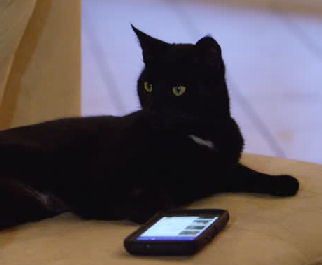
The first of Salem's nine lives tried to contact me from beyond, but I blocked the call.


