Note: The links on this page are to U.S. Patent Office image files that work best with a .tiff viewer such as AlternaTiff's free plug-in for Netscape, Opera, Mozilla, etc. or Active-X control for Internet Explorer.
A very few "utility" patents, and a larger percentage of "design" patents include representations of the human figure in relation to the item being patented. The design patents also include drawings or photos of mass-produced art works such as the "Rogers Groups," political campaign items, etc.
The original plan for this portion of the HISTORIC PATENT IMAGES listings was to give the patent numbers for a substantial sample of such patents. As of January 2006, this plan is scaled back to a very few per decade, arranged in roughly chronological order. Another sampling appears in a FLICKR account at stans_pat_pix.
The United States began issuing patents in 1790. Forty-five years' patents were lost to fire in 1836; some have been "restored." The "modern" U.S. patent system began in 1836; the design series began in the early 1840s.
July 20, 2006 -- as a favor to another devotee of patent topics never dreamt of by the patent office, I've added an "ethnic" subset at the end of this page. I'm taking "ethnic" to mean images that appear to reflect any of several stereotypes about human appearance.
| 
|
 |
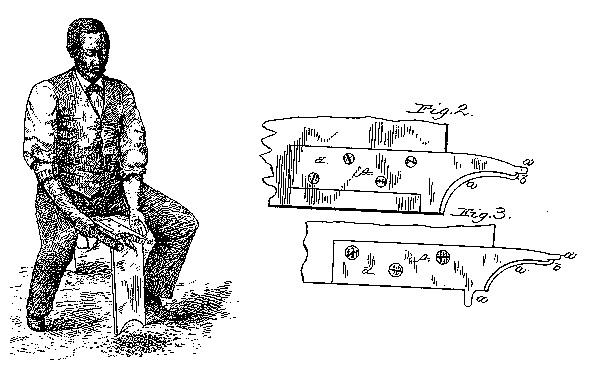
Numbers 1,557, 2,590 and 3,130 represent evolving sartorial splendor?? 3,779 hussar. No. 5,335 is notable because the small vignette showing two men operating McCormick's Reaper was also used in the promotional materials used to sell the machine, and is repeated in several subsequent McCormick patents related to this machine. 6,385 is an insight into mid-19th Century medical practice.
|
Number 9,389 (Nov. 9, 1852) features an intrepid submariner.
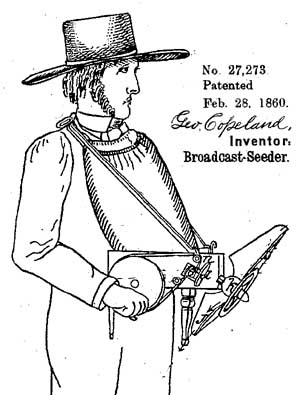
Number 9,731 (May 17, 1853) has a very dapper looking farmer sowing seed.
Number 13,011 (June 5, 1855) proposes an elaborate suspender system underlying a stylish gown.
At the close of the decade, 26,001's pickpocket and 26,250's hardworking wheelwrights are glimpses of obscure corners of daily life.
 |
Number
28,155 (May 8, 1860) is a male "falsy".
Number 41,934 (March 15, 1864) is a Civil-War era artifical limb patent shown on a woman's body. There are many, many artificial limb patents in the second half of the 1860s; Number 56,838 (July 31, 1866) describes a hammer for one-armed workmen. Design patents nos. D1,250 (June 12, 1860), D1,971 (July 19, 1864), D2,082 (June 6, 1865), D2,084 (June 13, 1865), D2,096 (June 13, 1865), D2,108 (July 4, 1865), D2,134 (July 18, 1865), D2,139 (July 18, 1865), D2,159 (August 8, 1865), D2,161 (August 8, 1865), D2,173 (September 19, 1865), D2,208 (October 24, 1865), D2,218 (November 7, 1865), D2,250 (January 30, 1866), D2,255 (January 30, 1866), D2,290 (April 3, 1866), D2,292 (April 3, 1866), and D2,983 (March 31, 1868), include Abraham Lincoln's image in some fashion. |
The skater in number 45,093 (Nov. 15, 1864) should not be flirting across the lake. Number 47,798 (May 23, 1865) proposes a photo I.D. to prevent unauthorized use of railroad passes; number 53,883 (April 10, 1866) shows a foundry floor in action; number 63,234 (March 26, 1867) may be close to the "ultimate" in hoop skirts. The three ladies in the second page of the drawings cover a lot of floor space!
D3,750 (November 18, 1869) is a proposed tobacconist's sign -- Whoopee!
A surprising number of mid-19th Century "patent peeple" images show incidental tobacco use (pipes & cigars) where the patent has nothing to do with tobacco.
 | Number
126,767 (May 14, 1871) shows a cigar smoking dandy watching a ball game. 139,121 (May 20, 1873) describes the rivet-reinforced pantaloons made famous by Levi Strauss. What percentage of those now living have benefited from this patent? 160,701 (March 9, 1875) depicts night soil removal from an outhouse pit. Guess who gets that job! 169,381 (Nov. 2, 1875) has a dramatic encounter between a handsome shoe salesman and a lovely customer.
D11,023 (Feb. 18, 1879) is A. BARTHOLDI's design for "LIBERTY ENLIGHTENING THE WORLD"; |
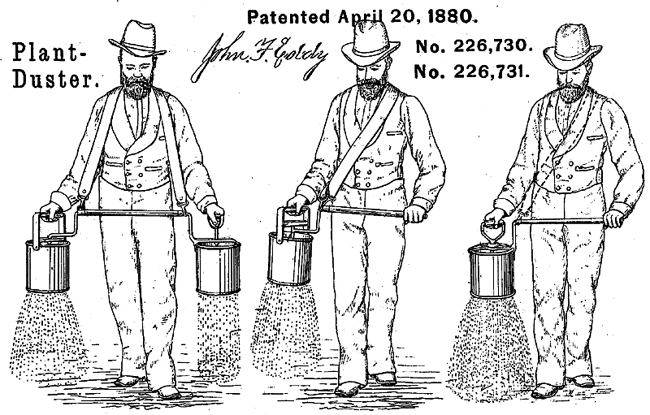
 | On April 20, 1880, plant pests and diseases were confronted with a lanky gent spraying in (226,588 ) and the "Plant Dust Triplets" who look vaguely like Ulysses S. Grant, and who appear in 226,730 and 226,731 . On August 3, 1880 pat. no. 230,750 immortalized a recumbent reader. John Henry's nemesis appears in 235,080 (Dec. 7, 1880). |
| The pipe-smoking youth in 264,967 (Sept. 26, 1882) must be resting from his wheelbarrow labors. |  | ||
| Is it only coincidence that the cigar smoker in no. 269,268 (Dec. 19, 1882) has need of a fire escape? | |||
| How does your 21st Century sensiblity respond to the elegant lady in no. 278,727 (June 5, 1883)? | |||
| As noted above, many images are "skipped" in this selection; on to 1889. | |||
 Pity the cotton picker shown from front and back in no. 401,223 (April 9, 1889) | 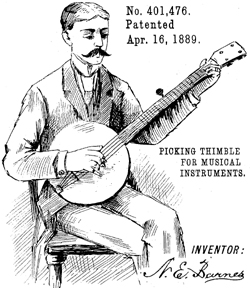 | ||
| Maybe the elegant lady was waiting for the banjo player in no. 401,476 (April 16, 1889) | |||
 | Self-improvement has always been a component of American society, so we'll close out the 1880s with a wish for good health. The elastic cord exercise apparatus in no. 418,257 (Dec. 31, 1889) has an almost 1980s look.
The process of compiling the data underlying this web site is slow. The only way to find these images is to browse the patents one by one. To get some idea of the universe from which this site is assembled, 116 "Utility" patents from 1889 include representations of the human form. 23,360 "Utility" patents were issued in 1889. |

875,845 (January 7, 1908) lays claim to "Sexual Armor."
 44,378 |
 160,701 |
 D46,188 |
 400,055 |
 401,223 |
||||
A number of design patents for "dancing toys" and the like, and a smattering of other patents with representations of the human figure appear to show stereotypical images. Inclusion here is purely subjective, based on personal reaction the first time the image was viewed. We in the 21st Century likely find these depictions regretable or repulsive. Nevertheless they are part of our social history & at some level we have to come to grips with them and all they represent.
A few "ethnic" images present positive rather than stereotype views. This is gratifying.
The compiler ( mvwcnews at neb.rr.com ) welcomes "heads up" notes for other patents containing images of this type.
44,378 (September 27, 1864) "Dancing Toy"
160,701 (March 9, 1875) depicts night soil removal from an outhouse pit. Guess who gets that job!
143,082 (September 23, 1873) and reissue #
RE6,875 (January 25, 1876) "Automatic Toy Dancer"
213,749 (April 1, 1879) "Toy Hand-Car"
222,571 (Dec. 16, 1879) "Toy Dancer"
246,044 (Aug. 23, 1881) "Sponge Cup" [To clean pens; part of an inkwell set]
D12,733 (Feb. 7, 1882) "Cap Pistol" ["The Chinese Must Go"]
D12,814 and
255,090 (March 14, 1882) "Toy Savings Bank"
271,273 (January 30, 1883) "Mechanical Toy"
292,652 (January 29, 1884) "Toy Target"
296,724 (April 15, 1884) "Toy And Advertising Medium"
298,937 (May 20, 1884) "Hand Corn Shelling Device" -- Lockrum Blue's patent is cited in many lists of "African-American Patents." The "American Artifacts" web site includes this image.
400,055 (March 26, 1889) "Mechanical Toy"
401,223 (April 9, 1889) "Brace for Back and Legs"
693,339 (February 11, 1902) "Figure Toy"
D46,188 (July 28, 1914) "Pen Wiper"
D100,187 (June 30, 1936) "Figure Toy"
D100,751 (August 11, 1936) "Smoker's Stand"
D100,752 (August 11, 1936) "Smoker's Stand"