The following article was published in the Pueblo Chieftain
newspaper Friday October 3, 2003Organist hopes to showcase Pueblo's
Pipe Organ
CHIEFTAIN PHOTO/MIKE SWEENEY
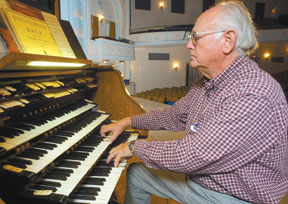
Bob Flinn plays the pipe organ at Pueblo's Memorial Hall Thursday.
By KAREN VIGIL
Flinn plays the 80-year-old organ once a week to help keep it in working shape.
THE PUEBLO CHIEFTAINColorado City resident Bob Flinn envisions himself as a sort of 'Piped' Piper of Pueblo.
The 67-year-old Flinn is hopeful that people will take him up on his offer to play the
city's Austin grand electric-action pipe organ at Memorial Hall for anyone who wants to
listen - community groups, school classes, veterans, choirs or whomever - at no cost.Flinn says the pipe organ is a nearly forgotten gem that rarely is used, other than his
two-hour sessions each Thursday afternoon. "This is a treasure in Pueblo that is underused
and little known about," Flinn said.Flinn said the pipe organ was built in 1920 at a cost of $35,000, and couldn't be replaced
today for less than $500,000. The organ has been a piece of Memorial Hall since soon after
its construction in 1919-20.Flinn said he has played for a couple veterans and senior home groups to date. Mostly, he says,
he has been disappointed in people not taking an interest in the organ concerts he's offered.
"I would really like to get high school kids, busloads of them, to come watch it," Flinn said,
adding that a computer-generated video presentation would be a great way to explain how the
organ works to audiences.He thinks people may not be attracted to the organ because they think of it only being an
instrument of "real classical, real stodgy" music. "If they realize it's not going to be your
typical church concert, they would change their minds," said Flinn, who can play 1,000 show tunes,
movie themes, Latin music, gospel music, and "all kinds of music" by memory.He also plays to keep the organ's wood and leather parts in working order, Flinn added. "If I don't
play, the relay starts sticking together. . . #32; The wood and leather needs to be used," he said.
"If you let it stand idle for a long time, they (the organ parts) will stick and they won't play."Flinn said he fell in love with Pueblo's historic pipe organ about six years ago, not long after
he moved to Colorado City. But playing an organ has been a part of Flinn's life for a half-century.
"I started playing the organ at 16. I started with the piano when I was 6. I picked up the accordion
when I was 13," Flinn said of his musical career.He grew up in Las Animas, left for the Navy and later had a working career as a nuclear power plant
manager/consultant. Expensive, elaborate, and complex pipe organs fascinated Flinn during his working
years, whenever he was in an unfamiliar city, away from his family. "As I traveled to large cities I
would find out where they had a major organ, and learn the history of the organ. On weekends off,
I would run into the city and sit down and play for a couple of hours," he said.Flinn said he learned of Pueblo's pipe organ when his sister sent him newspaper clippings about a
$165,000 community restoration effort completed in 1987. Flinn, who serves as the chairman of the
Colorado City Metro District Board, may be reached at 676-3190 or his e-mail mail address flinnrl@codenet.net.Pueblo's grand pipe organ
- Located at Memorial Hall's stage, the electric action pipe organ is divided into two main parts - the keyboard and the pipes.
- The performance organ with its four keyboards is located on the stage and must be moved when programs not utilizing the organ are presented there.
- More than 4,600 organ pipes are located on the upper floor above the stage. The sound from the many pipes radiates through aerated panels towards the audience.
- The pipes vary in size from 6 inches to 32 feet in length and represent 62 different instruments. The organ, with 88 stops, is the third largest of its kind in the United States; in comparison the organs at Colorado State University-Pueblo and First Presbyterian Church each have 44 stops. Salt Lake City's Mormon Tabernacle organ has 11,623 pipes, 206 ranks of voices and five keyboards.
- How pipe organs work: After being pressurized by an electric blower and stabilized by a reservoir, air enters each windchest of a pipe organ flowing into individual organ pipes when two conditions are met. An organist must turn on a stop action with a draw knob of stop tablet on the console to allow a particular rank or set of pipes to be played. Then, any keys pressed on one of the keyboards will open note action
values allowing air to enter the pipes which sound the corresponding notes. Each pipe, having precise length, diameter, shape, material, and so on is unique in its sound.Source: City manager's office