
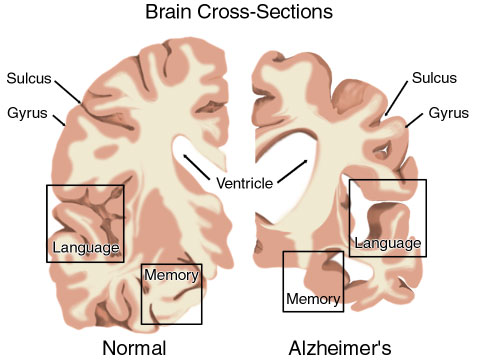
Imagine your brain as a house filled with light. Now imagine someone turning off the one by one. That's what Alzheimer's disease does. It turns off the lights so that the flow of ideas, emotions and memories from one room to the next slows and eventually ceases. And sadly as anyone who has ever watched a parent, a sibling, a spouse succumb to the spreading darkness knows - there is no way to stop the lights from turning off, no way to switch them back on ones they have grown dim at least not yet.

Ever since 1906, when German physician Alois Alzheimer (1864 - 1915) described the degenerative brain disorder that bears his name, doctors have argued about what exactly causes the disease. Dr. Alzheimer carefully noted two main features of the autopsied brains of his patients: the dense clumps, or plaques, of protein that showed up where nerve cells should have been and the tortured tangles that many of the neurons had become. But whether the plaques or the tangles triggered the illness or they were both just the most visible effects of some other, more obscure process no one could say for sure. Now the century - old mystery is on the verge of being solved. Thanks to a series of discoveries - some of which have been made only in the past couple of months - they should soon be able to demonstrate once and for all whether getting read of plaques is the most important step in halting the progression of Alzheimer's disease. They have already started preliminary clinical trials in human volunteers of the first anti - Alzheimer's compounds designed to treat the cause, and not just the symptoms, of the disease.
The most straightforward approach to fighting Alzheimer's plaques is to target their main ingredient, a protein called
beta amyloid. In July 1999, scientists from Elan Pharmaceuticals, a biotech firm located in Ireland, reported that they had developed a vaccine that could shrink the plaques - at least in mice. Here the idea is to prime the immune system to treat amyloid proteins just as it would any foreign invader and target them for destruction. The concept is somewhat counterintuitive, since most researchers believe that at least part of the damage in Alzheimer's disease is caused by the immune system's overreaction to the presence of plaques and tangles.
Another approach, favored by several large pharmaceutical companies, is to try to block the body's production of amyloid proteins. It turns out that everyone makes beta amyloid throughout his brain and body (more on later). But people who, for genetic reasons, tend to get Alzheimer's at an early age - in their 40s or 50s - seem to shape the protein into a stickier version that is more likely to clump together. By inhibiting an enzyme called gamma secretase, which facilitates amyloid production, researchers hope to push amyloid production so low that no new plaques will form.
As much as has been learned in the past few years about how Alzheimer's progresses, a lot more study needs to be done. The latest research could wind up proving that plaques and tangles are not causes of death, but more like tombstones - they tell you where people are buried but are not responsible for killing them. Or it could be that the only way to prevent Alzheimer's is to stop the plaques from forming decades before any symptoms appear. Even if scientists figure out precisely how Alzheimer's destroys brains, it is not clear that they will be able to stop it. But it's also clear that no one will be able to treat the disease - let alone cure it - until they do.

