The Board of Judges
There will be a board of at least four judges, with a board of five preferred, to minimize the chances of suggested or accused favoritism towards home-bred models.
Each judge will thoroughly read this handbook before judging, and will refer back to it if at any point there is a question as to how to judge a class.
Collusion between judges shall be kept to a minimum until all classes are scored. A judge will not change their scoring on a horse once the points for a class have been tabulated. This prevents "gang voting" or a "stacked" point system.
In classes where there is only one horse, such a class will be considered "winner-takes-all." One horse=that horse is automatically first place.
In classes where there are as few as two horses, those horses will be given points exactly as if it were a class of ten or more.
The Scoring System
Every horse in a class begins with the same 0 rating. Horses will then be "graded up" using the rating systems below until a final score for that horse has been reached. The judge will then move on to the next horse and repeat the process. Once all horses have been rated, the horses with the highest scores will be rated again in a judge-off to achieve the final ten placings.
Very Poor: 1
Poor: 2
Mediocre: 3
Good: 4
Very good: 5
Perfect and faultless: 6
(Yes, this is the same format used in Olympic figure skating. But, fortunately, none of us are French! LOL)
Bloodstock Classes
Bloodstock classes are judged using the three C's:
Color
Confirmation
Consistency
Each judge will look over the "foals" presented as compared to the parent, and evaluate each for the consistency in confirmation and color to that parent. Two scores will be generated: one for consistency in color, the other for consistency in confirmation. These two scores will then be added together and divided by two to find the final score. Horses will then be placed according to those scores, as stated above.
Gender Classes
Gender classes are normally abnormally large, and that's not the only reason they're tough to judge. Basically, what you are looking for is the horse that is the "best overall representative of its gender." For mares, this means you want a very "feminine-looking" model. For stallions, this generally means, likewise, a very "masculine" look. This can be very subjective indeed. To break it down further, and hopefully make things a bit easier, basically what one needs to do is think in terms of the dream S/D list. Which are the most "breedable"? It's what our president likes to call the "runaway" factor. LOL Again, still rather subjective, but how well the horse would fare in a photo S/D add should be an important factor in determining the overall "femininity" or "masculinity" of the horse. Color and confirmation also play a factor. Therefore, one should arrive at a final score for each horse by giving a score for color, confirmation, and then for "gender qualities", and then divide those by three for the final total.
With geldings, one should look for a "willingness" in the overall "temperament" of the horse, and whether or not they appear to still have "stallion" qualities (crest, etc.). This should then be averaged with color and confirmation as above.
Foals are also a bear to judge, as one tends to get caught in the "cute factor." Overall, what you are looking for is a mare/stallion in miniature. Look at the possibilities of what they will "be" in future. Then, average this together with color and confirmation as above to arrive at a final score.
Color Classes
Blanket Appaloosas: A blanket Appaloosa is defined by the ApHC as "a horse with a white blanket [on loins, hips, etc.] which has dark spots within the white. The spots are usually the same color as the horse's base color." Therefore, we are looking for overall quality and clarity of base coat color, quality and clarity of blanket, and clarity of spots. Each will be scored seperately and then averaged to arrive at the final score.
Leopard/Near-Leopard: A leopard/near-leopard Appaloosa is defined as a horse having spots over all or most of its body. Here we are looking for overall quality, clarity, and number of spots. With near-leopards, base coat color should be taken into account, as with blankets above, as should quality, clarity, and extensiveness of blanket. Leopards will be rated for quality, clarity, and number of spots, with the three averaged to arrive at the final score. Near-leopards will be rated for quality and clarity of base coat color, quality and clarity of blanket and extensiveness of blanket, and quality and clarity of spots, similar to blankets above.
Varnish Roan: The varnish roan is defined as "Body is roan with spots. Mane and tail are dark or mixed. Legs are dark. Eyes are dark." With this color it is important to keep in mind how much the horse still LOOKS like an Appaloosa. We are looking for quality and clarity of roan base coat, quality and clarity of any marbling which may be present, and quality and clarity of spots and blanket (if present). These will each be scored separately and averaged together to arrive at the final score.
Other Appaloosa Color: This includes, but is not limited to snowflake appaloosas, snowflake leopards, frosty tips (white spots on a dark base color overall or in parts). We are looking for quality and clarity of base coat color and uniqueness and clarity of pattern. Each should be awarded points separately and averaged together to arrive at the final score.
Snowcap: Appaloosas having a non-spotted blanket. We are looking for quality and clarity of base coat color, and quality and clarity of blanket (should be completely free of spots).
Fewspot: Appaloosas with very few spots; similar to a leopard, but with fewer spots. Mottling and hoof striping are particularly important in this class, though they should be taken into consideration when evaluating all Appaloosa color classes here, as they would be with breed classes elsewhere. Clarity and quality of base coat color and presence and clarity of spots make up the rest of the marks.
With all Appaloosa color classes here, remember to take special notice of skin mottling and/or hoof striping. Although these figure much more prominently in determining the standings in breed classes in most other shows, here we will include them with color, since we do not have breed classes.
If you require added assistance, please refer to the Appaloosa Color Reference at Rio Rondo.
Bay: Bay horses should have a healthy, glowing brown to reddish brown basecoat with black mane and tail. Any other markings should highlight the overall impression of the horse. Points should be awarded for overall color and quality of the base coat. The winning horse should be the best overall example of his/her color.
Bay Color Reference at Rio Rondo
Black/Grulla: Black horses should be black overall and any markings hsould highlight the overall impression of the horse. Grulla horses are typically a slate grey (blue) or sandstone color, with black manes and tails. They are grouped together because grulla is dun over black. Grulla horses may have primitive markings, as with duns or buckskins, and this should be given special notice when awarding points. Points should be awarded for overall color and quality of the base coat.
Grulla Color Reference at Rio Rondo
Primitive Markings at Rio Rondo
Buckskin: Buckskins are generally peachy to golden to bronze-red with black manes and tails, and occasionally have primitive marks as well (black face mask, transverse and dorsal stipes, zebra striping or leg bars on the legs). Points should be awarded for overall color and quality of the base coat, and points should not be deducted for primitive marks, regardless of the AQHA's dispensation that buckskins do not exhibit dun-factor primitive marks. (Buckskin can result from a number of dilution factors, including dun and creme).
Buckskin Color Reference at Rio Rondo
Primitive Markings at Rio Rondo
Palomino: Here, you are looking for gold. Palominos range from creamy yellow to deep gold with light manes and tails. Points will be awarded for overall color and quality of the base coat.
Palomino Color Reference at Rio Rondo
Chestnut/Sorrel: Chestnut horses are the "redheads" of the horse world, ranging in color from the darker browns of the liver chestnut to the bright, glossy reds of horses such as Man O' War. Sorrels may be similar in appearance to palominos (honey sorrel)or, more commonly, a rich reddish brown with pale mane and tail, to deep brown (similar to liver chestnut) with pale mane and tail (chocolate sorrel). Points should be given for overall quality and clarity of coat color.
Chestnut Color Reference at Rio Rondo
Dun: Duns may be red, yellow, or peach. The red dun will be almost chestnut in appearance. Yellow duns are dusky gold, almost indistinguishable from buckskins. Peach means exactly that: almost the pinkish orange color of a peach. Duns typically have primitive (dun factor) markings. Poins should be given for overall quality and clarity of coat color, with extra consideration being given to particularly clear primitive markings.
Buckskin and Dun Color Reference at Rio Rondo (includes some yellow duns)
Primitive Markings at Rio Rondo
Red Dun Color Reference at Rio Rondo (includes red, claybank, and peach)
Roan: On a roan horse, the hairs are white at the base and tipped with color. Typically, the horse will be darker about the head. Points should be given for clarity of roaning and overall quality and clarity of coat color.
Roan Color Reference at Rio Rondo
If in doubt, please use the links provided within each color section.
Showmanship Classes
English Showmanship: Horses will be shown with an English bridle with an O-ring, D-ring, eggbutt, or full cheek snaffle bit. Common white-lined dressage bridles may also be used with the same bit restrictions. In the absence of a handler, the lead rein must be in the proper position as if being shown from the ground. Bareback entries do not count as English Showmanship entries. Handler (if present) should be properly dressed in English attire and should in no way obscure the view of the horse. If a handler is present, there will be .5 points given for the appearance and position of said handler. Bit should be noted. A horse off the bit should be penalized accordingly. Marks should be given as follows:
Presenter: Possible .5 (to be added to final average)
Bit/Bridle/Lead Rein: Position, appearance; on the bit; lead rein position)
Horse: Presentation; overall look
Scores for Bit/Bridle/Lead Rein and Horse will be averaged together to arrive at a final score, to which any points for the handler will then be added.
Hunter In Hand: Horses will be shown with an English bridle with an eggbutt, O-ring, D-ring, or full cheek snaffle bit. Handler should be properly dressed in English attire (exra points to be given for dark hunt coats, otherwise handler is not judged) and should in now way obscure the view of the horse. If a handler is not present, the lead rein must be in the proper position. Bareback entries will not be judged as Hunter In Hand entries. Bit should be noted. A horse off the bit should be penalized accordingly. The horse however, receives primary consideration. We are looking for proper conformation required for a working hunter (athletic, but somewhat wiry, promising elasticity for jumping, etc.), proper grooming (roached or braided mane; braided or thinned tail), and overall appearance of willingness and an easygoing, eager temperament. Marks should be given as follows:
Handler: only given points if wearing dark jacket, otherwise, you are looking at the HORSE! (+ .5)
Bit/Bridle/Lead Rein: Position, appearance; on the bit; lead rein position--.75 possible points (averaged with score for handler, where applicable, otherwise, added to final score)
Conformation
Grooming
Manner
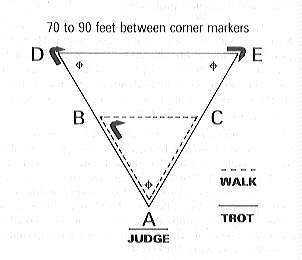
Suitability for Dressage: Horses should be exhibited in an English bridle with eggbutt, O-ring, D-ring, or full cheek snaffle bit or in a dressage bridle with the same bit restrictions. Horses are asked to stand in an "open position" (with all four legs visible) at A for judge's inspection, and then are asked to walk ABCA, followed by a trot ADEA. We are looking for willingness and ability to perform when asked (is the horse that's supposed to be trotting actually posed in a trot, for example), appropriate conformation for dressage ("stylish" head, good neck, proper hindquarters for the forward impulsion required in dressage), and movement (does there appear to be forward impulsion, or a potential for forward impulsion?). Horses should have bridles, but not saddles, and lead rein must be in the proper position as if being shown from the ground. Bareback entries will not be judged as Suitability for Dressage entries. Horse should be on the bit. Marks will be given as follows:
Movement
Willingness/Ability
Conformation
Performance
English Pleasure: Horse should be exhibited with English saddle and bridle (snaffle bit preferred) peforming a walk, trot, canter, or halt within a fence, ring, or arena. Horse should be on the bit and exhibiting the gait described. Rider (if present) should have their feet in the stirrups and hands on the reins in as accurate position as possible, and the rein should run in a direct line to the horse's mouth, showing contact with the bit. In the absence of a rider, reins and stirrups must be in the correct position. Marks should be given as follows:
Rider: position and attire; absence of a rider does not affect final score
Tack: position of bit, stirrups; overall appearance
These two are averaged together and then added to the Performance score:
Performance: exhibiting gait described in a willing and easygoing manner; quality conformation for a pleasure mount; overall impression of presentation)
The two will then be averaged together for the final score.
Hunter Under Saddle: Horses should be exhibited with English saddle and bridle (snaffle or pelham bit) performing a walk, trot, canter or halt within a fence, arena, or ring, unless it is noted "working hunter". Horses should be on the bit and exhibiting the gait described. Horse should exhibit proper conformation and grooming for a working hunter as described in Hunter In Hand. Rider (if present) should have their feet in the stirrups and hands on the reins in an accurate position and should be properly attired (.5 points will be given to those with darker hunting coats, but no points will be deducted for other coat colors). In the absence of a rider, reins and stirrups must be in the correct position. Marks should be given as follows:
Rider (position; added points for attire; absence of a rider does not affect final score)
Tack (position of bit, stirrups; overall appearance)
These two are averaged together and then added to the Performance, Confirmation, and Grooming scores:
Performance (exhibiting gait described; overall impression of presentation)
Conformation (Athletic, but somewhat wiry, elastic conformation)
Grooming (Roached or braided mane; braided or thinned tail; overall neatness of appearance)
The four will then be averaged together for the final score.
English Trail (Arena): Horse should be exhibited with English saddle and bridle or an Australian stock saddle and bridle (or other English style tack) performing some sort of trail activity (moving over poles, halt in a "box", halt for dismount/remount, working a gate, etc.). Arena suggests that said activity is taking place within a ring, fence, or arena. Horse should be on the bit. Rider (if present) should be properly attired and have feet ni the stirrups and hands on the reins. In the absence of a rider, reins and stirrups must be in the correct position. Marks should be given as follows:
Rider (position and attire; absence of a rider does not affect final score)
Tack and Setup (position of bit, stirrups; overall appearance; required obstacles are present and are properly used)
These two are averaged together and then added to the Performance score:
Performance (exhibiting activity described; proper pose for activity described; overall impression of presentation)
The two will then be averaged together to arrive at the final score>
English Trail (Natural): Horses should be exhibited with English style saddle and bridle (Aussie stock permitted) performing some type of natural trail activity (pausing to look at scenery, halt for dismount/remount, working a gate, tack check, hoof check, crossing a bridge, etc.). Fence is not required. Horse should be on the bit. Rider (if present) should be properly attired and have feet in the stirrups and hands on the reins. In the absence of a rider, reins and stirrups must be in the correct position. Marks should be given as follows:
Rider (position and attire; absence of rider does not affect final score)
Tack and Setup (position of bit, stirrups; overall appearance; required obstacles are present and well-presented)
These two are averaged together and then added to the Performance score:
Performance (exhibiting activity described; proper pose for activity described; creativity and realism of description and presentation; overall impression of presentation)
The two will be averaged to arrive at the final score.
Hunter Over Fences: Horses should be exhibited with English saddle (preferably huntseat) and bridle (pelham, snaffle, or double bridle) with a proper jump (hunt jumps are smaller than showjumping jumps and are generally muted colors, representative of jumps seen on hunt trails; they are unnumbered and unflagged). Horse should be properly groomed with braided or pulled mane and braided or thinned tail. Horse should be on the bit. Flags should not be present with jump. Rider (if present) should be properly attired (+.5 for hunt coat) with feet in the stirrups and hands on the reins. In the absence of a rider, reins and stirrups must be in the correct position. Marks should be given as follows:
Rider (position and attire; absence of a rider does nt affect final score, nor will those without dark riding coats be penalized)
Tack and Setup (Position of bit, stirrups; overall appearance; appropriate jumps)
Grooming of Horse
These three are averaged together and then added to the Performance score:
Performance (exhibiting activity described; proper pose for activity described; overall impression of presentation; +.5 if actually clearing a jump)
The two will then be averaged to arrive at the final score.
Showjumping: Horses should be exhibited with English saddle and bridle (Aussie stock okay) with a proper jump (these jumps are taller and more brightly colored and should be numbered and flagged). Horse should be on the bit. Horse may be braided or unbraided (most often showjumpers are loose). Rider (if present) should be properly attired, with feet in the stirrups and hands on the reins. In the absence of a rider, reins and stirrups must be in the correct position. Martingales/breastcollars are allowed. Marks should be given as follows:
Rider (position and attire; absence of a rider does not affect final score)
Tack and Setup (position of bit, stirrups; overall appearance; appropriate jumps; presence of flags; +.5 for proper leg protection on horse)
These two are averaged together and then added to the Performance score:
Performance (exhibiting activity described; proper pose for activity described; overall impression of presentation; +.5 if actually clearing a jump)
The two will then be averaged together to arrive at the final score.
Dressage: Horse should be exhibited with English tack: a simple huntseat or all-purpose English saddle with shaped or square white saddle pad are acceptable in tests below the Second Level; Third Level and above should have a dressage saddle. Bridles should have a cavesson, dropped, flash, or crossed noseband and a snaffle bit. Fourth and Fifth levels may use the same equipment, but with the addition of a simple double bridle with bridoon and curb and curb chain, if so desired. Breastplate and crupper are permissible; sidesaddle riding is allowed. Absolutely no: Martingales, tie downs, bit guards, side reins, running reins, any kind of boots or bandages, tail bandages, blinkers, ear muffs, nose covers, seat covers, hoods. Decorations in the tail, such as flowers or ribbons, are prohibited. Pelham bits are NOT allowed (a double-reined bridle with one headstall with reins attached at the curb position). Horse should be on the bit and reins should be in a direct line to the rider's hands. Braided manes and tails are permitted, but not required; mane should be short. Tails may be banged or pulled, but braiding is unpopular in the US. For MApSHA competitions, patterned dressage pads are permissible for freestyle competition, particularly in extreme freestyle, which we hope to encourage in future (more rules regarding this at a later date). Rider (if present) should be properly attired (conservative riding coat and general hunter attire, with choker and appropriate hat at levels below Fourth and Fifth; Shadbelly and bowler required Fourth and Fifth Levels) and should have feet in the stirrups and hands on the reins. The rider should be seated in the saddle--posting riders should have notation in the description as to why they are posting. In the absence of a rider, reins and stirrups must be in the proper position. It is preferred that a rider not be equipped with a crop or whip. A test and full description of movement are absolutely required, as is an arena marker of some sort. Horse must be performing the movement described. Numbered competitors (with a small white oval with black number attached to browband or saddlepad) will be given .5 extra credit, as will those who include a complete copy of the test, or a link to the complete copy of the test. Freestyle entries which include music will be given .75 extra points. Marks will be given as follows:
Rider (proper attire and position; horses without riders will not be penalized, however, a rider greatly increases the overall presentation in dressage)
Tack and Setup (position of bit, stirrups; proper equipment; arena's presentation; overall apearance)
These two are averaged and added to the combined total average of the following:
Movement (horse is exhibiting the movement described; forward impulsion is evident; proper pose for movement described)
Presentation (description is detailed and matches test; overall look of entry)
The two are then averaged together to arrive at the final score.
Cross Country: Horse should be exhibited in English tack (Aussie stock or endurance saddles are permitted here). Running martingales, breast plates or breast collars and overgirths are allowed. Jumps should be flagged and numbered. A horse running on the flat should be noted as such with a detailed explanation as to where they are on the "course". Horses may also be exhibited in the start box, which should be three-sided and flagged. Horses may trot on course, and then speed up at intervals to make up for time lag. Rider (if present) should be properly attired (casual and functional with appropriate headgear) with feet in the stirrups and hands on the reins. In the absence of a rider, stirrups and reins must be in the proper position. Marks will be given as follows:
Rider (position and attire; absence of a rider does not affect final score)
Tack and Setup (position of bit, stirrups; overall appearance; appropriate jumps; presence of flags; setup is creative and realistic)
These two will then be averaged with the final Performance score:
Performance (horse is performing activity described; horse is in proper pose for activity described; overall impression of presentation)
Three-Day Eventing: Must include three photos: one dressage, one showjumping, and one cross country. Each photo will be judged seperately, as described in the individual competitions above, and the three final scores for each division will be averaged together to arrive at the final score.
Other English: This includes Foxhunting, English Games, Parade Pictures, etc. Entries should be judged individually on the required elements for whatever activity is being performed (if you do not know how to judge that skill, please take the time to look it up and do not award or dock points arbitrarily), creativity and realism used in the presentation, and overall presentation. These three elements will then be averaged together to arrive at the final score.
REMEMBER: All Showmanship and Performance classes REQUIRE a detailed description of the activity performed. This may be somewhat overlooked in Showmanship, with the exception of Suitability for Dressage, but it is ABSOLUTELY IMPARATIVE in ALL other Performance classes! It is at the judge's discretion to DQ an entry which does not have a description. ANY Dressage entry without an included test and/or description will be AUTOMATICALLY DQ'ed.
Judges are allowed to dock points for particularly blurry or dark images IF the quality of the image affects the ability of the judge to see the entry well enough to properly mark said entry. Otherwise, this competition is about the HORSES, not about photographic ability or $500 cameras.
|

