Black Elk: Holy Man of the Oglala Sioux, 1863-1950
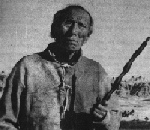 "Sometimes dreams are wiser than waking."

One might say that Black Elk had great vision, granted to him when he was nine years old. Black Elk's great vision was brought to him by the animals, spirits, birds and stones. Black Elk talked about how he had fallen ill, and laid as if dead in a tipi for twelve days, during which time he was in 'a wonderful place'. In his first and most powerful vision, he was greeted and escorted by horses, celestial horses of the four directions, and saw the celestial archetypes of all beings. There were twelves horses in each of the four directions, and their colours corresponded to the directional colours; there was, he said, a 'skyful of horses dancing all around me'. The horses changed into all the countless 'animals of every kind, and all the fowls that are', and dissappeared back into the four directions. Then he saw the six Grandfathers, and each of them spoke to him; after which he saw the suffering his people were to endure. A black stallion then sang him a song, and its song went out all over the universe, and was marvellous to hear. In Black Elk's words:
"There was nothing that did not hear, and...it was so beautiful that nothing anywhere could keep from dancing. The virgins danced, and the circled horses. The leaves on the trees, the grasses on the hills and in the valleys, the water in the creeks and in the rivers and the lakes, the four-legged and the two-legged and the wings of the air - all danced together to the music of the stallions song."
Black Elk was given a paradisal vision:
"The whole wide circle of the day was beautiful and green, with all the fruits growing and all things kind and happy."
Black Elk also said that he was at the sacred mountain at the centre of the world, at the 'place where the sun continually shines'. He continues with...
"...while I stood there I saw more than I can tell and I understand more than I saw, for I was seeing in a sacred manner the shapes of all things in spirit, and the shape of all shapes as they must live together in one being".
After his vision was over, it remained in him 'like a strange power glowing in my body; but when the part of me that talks would try to make words for the meaning, it would be like fog and get away from me'.
Black Elk emphasizes the transcendent power of his vision, beyond what words can say:
"It was the pictures I remembered and the words that went with them; for nothing I have ever seen with my eyes was so clear and bright as what my vision showed me; and no words that I have ever heard with my ears were like the words I heard. I did not have to remember these things; they have remembered themselves all these years. It was as I grew older that the meanings came clearer and clearer out of the pictures and words; and even now I know that more was shown to me than I can tell".
Black Elk also spoke of the time just after the battle at Wounded Knee in 1890, when the Sioux decided to surrender to the whites. He said:
"And so it was all over. I did not know then how much was ended. When I look back now from this high hill of my old age, I can still see the butchered women and children lying heaped and scattered all along the crooked gulch as plain as when I saw them with eyes still young. And I can see that something else died there in the bloody mud and was buried in the blizzard. A people's dream died there. It was a beautiful dream.
"...And I, to whom so great a vision was given in my youth - you see me now a pitiful old man who has done nothing, for the nation's hope is broken and scattered. There is no centre any longer, and the sacred tree is dead".
Black Elk's account remains the most moving ever of this fateful time for the peoples of the Plains...

b a c k