
Objective:
-
to learn about lenses and their applications
Applications:
-
lenses are used in such fields as photography, optometry, and many fields
of science (such as biology and astronomy)
Concepts:
-
2 types of lenses:
convex,
which curves out and converges light rays
(creates a real,
or upside down, image) - has a positive focal point
concave,
which curves in and diverges light rays
(creates a virtual,
or right side up, image) - has a negative focal point
- lenses can be used for the creation
of such instruments as camera lenses, eye glasses, or microscopes and telescopes
(to varying degrees of power), for practical, functional, or scientific
use(s)
Formulae:
1/f
- 1/do = 1/di or (f^-1) - (do^-1) =
(di^-1)
f = the focal point (the specified
distance from the center of the lens, on
both sides)
do = the distance to the object,
from the lens (always positive)
di = the distance to the image (projected),
from the lens (always positive)
di/do
or dido^-1
either will solve for the magnification
of the image (projected) from the
object (original)
Exempli:
- the first light ray from the object
is referred to as the initial ray one, or "ir1" (the second is referred
to as initail ray two, or "ir2")
- reflected rays are corresponding
to their initial ray, or as "rr1" and "rr2"
- a virtual ray, "vr1" or "vr2",
is a non existant ray, but is used to determine where the image appears
If an object is 15 centimeters away
from a convex lens with a focal point of 5 centimeters, what is the distance
to the image (di)?

1/f - 1/do = 1/di = 1/5cm - 1/15cm
= 2/15(cm)
If an object is 15 centimeters away
from a concave lens with a focal piont of 5 centimeters, what is the distance
to the object (di)?
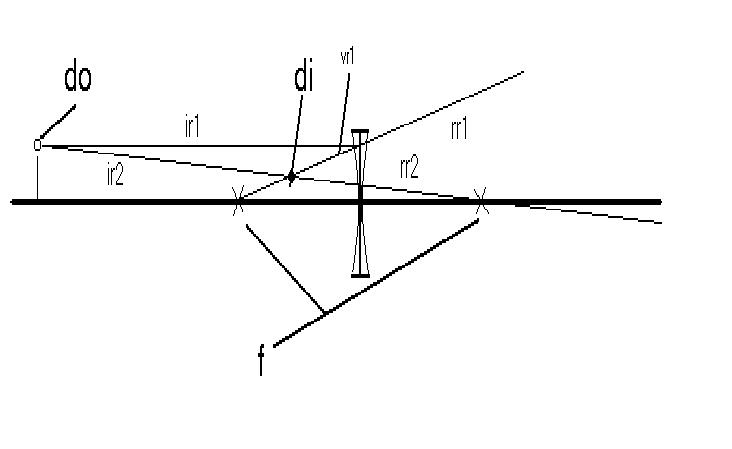
(f^-1) - (do^-1) = di^-1 = -(5cm^-1)
- (15cm^-1) = -4/15(cm)
In a double lens applicaiton, the focal length of lens one must be greater than the focal length of lens two. The focal length of lens one minus the focal length of lens two must be less than the focal length of lens two. Also, the secondary "di" will be a virtual image.

See Previous Page
Go Home
See Next Page
Click here to learn more about calorimetry.
Click here to learn about mirrors.
