
Kristen Nivling
I play the piano, so I take tuning
for granted. I press a C and I hear a C. I don't have to worry
about intonation, like you would on a violin or a cello. I don't
even have to tune every time I start to play. That is to say, I don't
have the option of tuning every time I play. Growing up I always
assumed that an A was an A and an E was an E because that's how it was.
That's not the case. So I'll try to explain what little I do understand.
First of all, what is pitch?
Sound travels in waves. As we
know, waves all have frequency, velocity, and wavelength. Pitch is
our brains' perceptions of the frequencies of sound waves.
What is an interval?
In music, an interval is the relationship
between two notes. The distance from one A to the next A is an octave,
or an eighth. Certain intervals are pleasing to the ear. The
best-sounding intervals are called perfect intervals: the 8th, the 1st,
the 5th, and the 4th. Why do these notes sound so good together?
Scientifically, an interval is the ratio of the frequencies of the two
notes. An octave's frequencies have a ratio of 2:1. The perfect
fifth has a ratio of 4:3.
Part of the reason certain notes sound
good together is a concept called overtones. When one note is played
on, for instance, the piano, you are hearing more than just the frequency
of the note being played. You hear the frequencies of other notes
at the same time. Their frequencies are mostly whole-number multiples
of that of the note being played. Two of the loundest (but still
imperceptible) overtones are the octave and the fifth of the given note.
How do we make a scale?
A scale is an attempt to divide the
octave into equal and good-sounding pitches. Over the years this
has been done in several ways. An ideal way to make a scale would
be to ascend in perfect fifths or major thirds, since their ratios are
so nice. Unfortunately, if you ascend in either of those manners,
you will never arrive at a whole-number ratio. So there's no perfect
way to make a scale. In centuries past, scales existed where some
intervals were nearly perfect, but others were terribly off.
So what do they tune keyboard instruments to now?
A system called the tempered scale
has been devised so that keyboard instruments can be tuned in one way and
the relationships betweent the notes, while not ideal, are acceptable to
the ear. The system compromises some intervals, but the octave remains
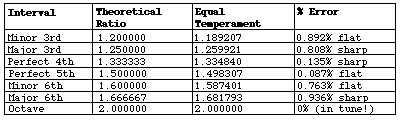
in tune. What follows is a chart of some intervals, their theoretical
and actual ratios with equal temperment. The chart is courtesy http://www.anu.edu.au/ITA/ACAT/drw/PPofM/scales/scales7.html
So when I play an F, for instance, it's not really
an F?
Nope, it's not an F that would be
in ideal relation with the notes around it. Good string players and
singers will play/sing notes differently when they're not being accompanied
by a piano.
