Series and Parallel
Circuits
Objectives: -Students will learn
what a series and parallel circuit is.
-Students will learn how to construct a series and parallel circuit.
-Students will learn how to solve for a series and parallel circuit
Real-life Application
for
Series and parallel
circuits
-People who build
computers, televisions, radio's, portable cd players, ect. work with series
and parallel circuits everyday, and without these circuits would never
have any of the luxuries that we have today.
-The holidays
are here, and without these circuits we would never have Christmas lights,
and it just wouldn't be the Christmas holiday, without them.
-Physics teachers,
definitely use this a lot, because we just learned it in.
Concepts for Series and Parallel
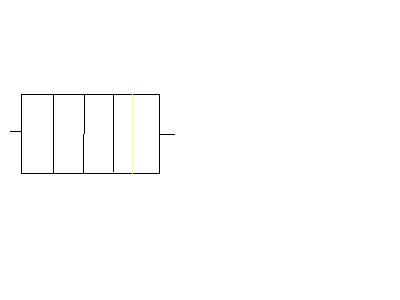
-Series-1 resistor wired after another
-Parallel-resistors are set up so
that the current can have more than one path
-The higher the amount of Ohms in
each resistor, the higher Rsistence Total
-Series and parllel circuits can
be all connected together.
Formulas
To Find Resistence
Total
-Series: Rt=R1+R2+R3+R4.................
-Parallel: Rt=(Inverse
of R1+Inverse of R2+Inverse of R3)then take the Inverse
Current=Amps
V=A
V-Volts, A-Amps
Ohms
-Watt=power
V*A=W
W-Watts, V-Volts, A-Amps
Resistor colors
0-Black 1-Brown
2-Red 3-Orange 4-Yellow 5-Green 6-Blue
7-Violet 8-Grey
9-White
-take the 1st
2 colors and wirte them down
Ex-red white=29
-the last color
add how many zeros that the color reads.
Ex. Red-add 2
zeros
Example Problems
1.)A.) Find Resistence
Total for the Series Circuit
Rt=90+50+20
Rt=160 Ohms
B.)Find Current
V/Ohms=5v/160=.03Amps
C.)Find Power
V*A=W
5v*.03A=.15W
2.)A.)Find the
Resistence Total for the Paraelle Circuit
Rt=(20¯¹+50¯¹+90¯¹)¯¹
Rt=12.33
B.)Find the Curent
5v/12.33ohm's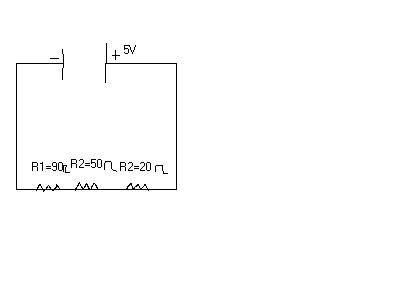
A=.406 Amps
C.)Find the Power
5v*.03A
W=.15 Watts
3.)A.)Find Resistence
Total for the Series Circuit
Rt=20ohms+50ohms+90ohms
=160ohms
B.)Find the Current
5v/160ohms R1=90,
R2=50, R3=20
R1=90,
R2=50, R3=20
=.03 Amps
C.)Find the Power
5v*.03Amps=.15
Watts
Click here to see another page about
circuits.
Click here to see another page about
electrical friction.

