

On this page you can learn about energy, different types of energy, and how energy can change from one form to another.
The idea of this such law existing
started back it the days of Galileo and Francis Bacon. They thought
that the universe had a fixed amount of total energy. According
to many we have the principle of the conservation of energy virtually formulated
for the first time in Newton's developing of his third law of motion
(action and reaction are equal and opposite). Since many papers were
sent to the Royal Scientific Society of Copenhagen, by different scientists,
no one man can be described as the father of the doctrine of the Conservation
of Energy.
In order to understand the Law of
Conservation of Energy, you must first know the two types of energy and
how they relate. Energy is the ability to do work. There are
two basic types of energy, kinetic energy and potential energy. Kinetic
energy is defined as energy that is in motion, potential energy is defined
as stored energy, or energy waiting to be released. The power of
doing work in the former case is due to the actual motion possessed by
the body, e.g. a cannon-ball on it's course, or a swinging pendulum. Potential
energy, on the other hand, is exemplified by a wound-up spring, or by the
bob of a pendulum when at its highest point; as the bob swings upwards
its velocity and kinetic energy continuously diminish, while its potential
energy is increasing. When at its highest point its potential energy is
at a maximum, and its kinetic is nil. Conversely, when, moving downwards,
it reaches its lowest point,
it will have recovered its maximum kinetic energy, while
its potential will have vanished.
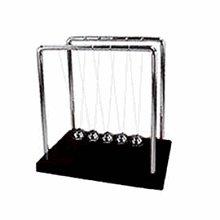
This law states that "energy can not
be created nor destroyed." This means that if an object has a certain
amount of energy it can only lose energy if that energy is transferred
to a different object. Newton's Cradle is a perfect example of this
law(see Picture). The end ball is pulled back and let go, when it
collides with the other balls the energy is transferred, because it can't
be destroyed, through the other balls. Because the energy is transferred
the ball on the other end receives the energy and is flung in to the air.
It should reach the same height as the first ball started at.
The law is demonstrated in the equation
MGH=1/2MV^2, where M=mass(grams), G=gravity(9.8meters per second squared),
H=Height(meters), and V=Velocity(meters per second). The equation
can be used to determine any of the variables given the right information.
You can use it to find the velocity,V, of an object that has a mass of
1 g held at a height of 10m. (1g)(9.8m/s^2)(10m)=1/2(1g)V^2. You
can solve the equation to get a velocity of 14m/s.
98 = .5V^2
196 = V^2
V = 14m/s
you can also use it to solve for the height of an object,
if you were told that an object weighing 1 gram was dropped
from a unknown height. The ball had a velocity of 14 meters per second.
you could then solve for the height as shown below.
(1g)(9.8m/s^2)H=1/2(1g)(14m/s)^2
9.8H=98
H=10m
Or to solve for the gravity if you were on a different
planet or the moon.
if you were given that a 1 gram object was dropped from
a height of 10 meters. It had a velocity of 14 meters per second,
solve for the gravity on the planet.
(1g)G(10m)=1/2(1g)(14m/s)^2
10G=98
G=9.8
Click to Read About Rotational Energy Click to See Main Page Click to Read About Momentum
