|
|
|
Overview of Circulatory Systemblood flow left heart = blood flow right heart atrial function= early diastole:accepts blood / late diastole: contract to deliver extra blood to ventricle
· Conduit vessels = elastic /compliance of these vessels decrease afterload and promotes distal profusion · Resistance vessels = muscular: arterioles / contraction controls tissue blood flow · Exchange vessels = capillary system/ large cross sectional area/ slow flow · Venous system = capacitance system / reservoir of blood / low pressure / holds 2/3 total blood volume
Renal Consequences of Poor Heart Function1. AUTOREGULATION vasodilate afferent arteriole ( increase % of CO to kidney)
2. INCREASE FILTRATION FRACTION vasoconstrict efferent arteriole (increases hydorostatic pressure in glomerulus) GFR = glomerular filtration rate (pre-urine formation) RPF = renal plasma flow FF = filtration fraction ***** FF = GFR/RPF (amount of pre-urine per amount of blood that goes through)
3. DECREASE fractional EXCRETION of SODIUM ***** FENA+ = Na+ excreted / Na+ filtered (how much Na+ is not reabsorbed) Keep Na+ in order to INCREASE ECF \ blood return to heart and CO
4. POOR EXCRETORY FUNCTION and POOR REGULATORY FUNCTION ¯ ability to excrete metabolic wastes ¯ ability to excete Na+ (leading to edema)
Cardiac Consequences of Abnormal Renal Function1. INCREASED Na+ excretion = ¯ ECF, ¯ blood return to heart, ¯ CO 2. DECREASED Na+ excretion = ECF, blood return to heart, EDEMA 3. Electrolyte abnormalities (K+, Ca2+)
Homeostasis = maintenance of constant conditions in the internal environment ***** RATE OF DIFFUSION = (c1 – c2) / d (concentration gradient over distance)
SYSTEMIC VS. PULMONICVolume = larger Pressure = higher Resistance = higher Distance = longer Vessels = thicker
PRESSURES (mmHg) Left heart = 120/0Right heart = 25/0
Systemic artery (AORTA) = 125/80 Systemic capillaries = 25
Pulmonary artery = 25/10Pulmonary capillaries = 10
Veins = 10 ® 0
Large arteries store pressure ® decreasing pulsatile flow
Capillaries (exchange system) LARGE surface area SMALL blood volume LOW pressures
Veins (capacitance system) LARGE blood volume LOW pressures LARGE capacity (64% of total blood) THIN walls Valves
BLOODFormed elements = 45%RBC’s = 5 x 10⁶ /ml120 days Shape · increases membrane surface area for diffusion · is easily reversibly deformed
WBC’s = 5 –10 x 103 /ml Granulocytes: Neutrophils Eosinophils Basophils Agranulocytes: Monocytes Lymphocytes
Platelets
Plasma = 55% water = 90% electrolytes gases lipids carbohydrates amino acids urea vitamins hormones
similar to interstitial fluid except plasma has more protein
COLLIOD OSMOTIC PRESSUREOncotic effect = [protein] in capillaries than in interstitial space
RETAINS FLUID IN THE VASCULATURE
Albuminemia = ¯ albumin \ fluid would vasculature ® tissues \ edema Hemostasis = ability of blood to prevent its own loss
Hematocrit ratio = 38 – 50% (% of blood that is cells)APPARENT HEMATOCRIT – actual hematocrit is lower because plasma gets trapped in cell layer ***** \ H = Happ x .96 higher in men polycythemia = hematocrit anemia = ¯ hematocrit
VOLUME
Dye dilution method ***** Volume = mass injected / [dye] in a sample (ml = mg x ml/mg)
Blood distrubution
Total systemic = 84% Veins = 64% Arteries=20%
Pulmonary = 9% Heart = 7%
Central blood volume = thoracic blood volume
Compliance (capacitance) = DV / DP (volume increase per unit pressure)
Distensibility = % vol / P (% volume increase per unit pressure) Veins more distensible than arteries Age decreases distensibility
Mean circulatory (filling) pressure = 7 mmHgPressure right after heart is stopped / tendency for blood to return to heart
Normal O2 saturation levels Right heart = 70 – 80% Left heart = 95%
Ventricular septal defect = abnormally high O2 saturation value in right ventricle
HEMODYNAMICS
Poiseuille’s Law
***** Q (flow) = DP r4 p h L 8
h = viscosity
***** Q (flow) = DP / R ***** R = resistance = hL / r4 ***** R = DP / Q RADIUS IS MOST IMPORTANT FACTOR
GREATEST RESISTANCE WHERE PRESSURE DROP GREATEST (ARTERIOLES)
RESISTANCE DECREASED IN PARALLEL
VISCOSITY Hematocrit: directly proportional Fahraeus – Lindquist effect: radius directly proportional / blood thinner in small vessels Anomalous viscosity: velocity is indirectly proportional / blood thicker when slower Temperature: indirectly proportional / thicker when colder (frostbite)
Fluid near wall hardly moves / fluid near center moves greatest distance
Laminar flow = smooth, quiet Turbulent flow = when flow is to great may become disorderly, noisy Eddy currents = small whirlpools
Reynolds Number (tendency for turbulent flow)
***** Re = density x velocity x diameter / viscosity
Laplace’s Theorem
***** Tension = pressure x resistance / wall thickness
increased P = increased T increased r = increased T decreased wall thickness = increased T
Pressure Flow Curves
Critical Closing PressureAt 20 mmHg blood flow stops entirely because: 1. sympathetic tone 2. elasticity HEART STRUCTURE AND FUNCTION
Fibrous “skeleton” = 4 rings of dense connective tissue Insulate top chambers from bottom Electrical impulses can only be conducted via Bundle of His
Muscle layers Oblique fibers (2 layers) – shorten ventricular wall pulling apex to base Circumferential fibers (1 layer) – constrict diameter
Valves AV = mitral (left) and tricupsid (right) thin, soft, larger diameter prevent backflow of blood from ventricles to atria during systole Semilunar = aortic and pulmonic heavy, loud prevent backflow of blood from arteries into ventricles during diastole
*all valves open and close PASSIVELY via the pressure gradient *papillary muscles contract when ventricle contracts preventing valve from everting (pushing into atria) during systole
CARDIAC CYCLESystole = 300msec Diastole = 500 msec
AV valve opens (pressure in atria greater than ventricle)
1. Ventricular filling 2. Atrial contraction (extra 30%; late diastole)
AV valve closes (pressure in ventricle higher than atria) –START OF SYSTOLE
3. isovolumetric ventricle contraction
Semilunar valve opens (pressure in ventricle higher than aorta/pulmonary artery)
4. Ejection (also filling of atria begins here)
semilunar valve closes (pressure in aorta/pulmonary artery is higher than ventricle) – END OF SYSTOLE
5. Isovolumetric venticle relaxation
VENOUS PRESSURE WAVE a-wave = atrial contraction sends retrograde pressure wave c- wave = ventricular contraction sends retrograde pressure wave v-wave = slow build up of blood at end of ventricular contraction (goes away when mitral valves opens)
VENTRICULAR PRESSURE WAVE ATRIAL PRESSURE WAVE AORTIC PRESSURE WAVE VENTRICULAR VOLUME WAVE EKG HEART SOUNDS
***** STROKE VOLUME = EDV(all the way full) – ESV(empty as it can go)
3 CLASSES OF MYOCARDIAL MYOCYTES
1. Working 2. Rapidly Conducting (purkinje) 3. Pacemaker
RESTING POTENTIAL = no net movement of charge across cell membrane (influx = efflux) WORKING CELLS ONLY (PACEMAKER AND PURKINJE DO NOT HAVE A RP)
Generated by: diffusion K+ through non-gated ion channels OUT (ik1) membrane more permeable to K+ than Na+ / more non-gated Conductance: gk >> gNa channels for K+ \ RP is closer to K+ equilibrium potential (Ek = -95mV)
Maintained by: Na+/ K+ pump (Na+ pumped out / K+ pumped in)
OUTSIDE CELL = POSITIVE INSIDE CELL = NEGATIVE
RP’s magnitude depends on two factors 1. concentration gradients for K+ and Na+ 2. relative membrane conductances for K+ and Na+
Conductance is directly proportional to extracellular concentration of K+ gk1 ¯ if ¯[K+]e gk1 if [K+]e
Hyperkalemia [K+]e= depolarizes RP (conductance increases BUT decrease gradient) Hypokalemia = depolarizes RP (gradient increases BUT decrease conductance)
Ach opens ligand gated K+ channels, gk , hyperpolerizes RP
WORKING and PURKINJE Phase 0 (upstroke) voltage gated inward sodium channels open; depolarizes
Phase 1 (rapid repol.) inactivation of voltage gated sodium channels transient outward voltage gated potassium channels (work together)
Phase 2 (plateau) inward calcium voltage gated channels delayed rectifier outward potassium channels (work against each other)
Phase 3 (repolarization) inactivation of calcium channels outward potassium current from non gated K1’s and delayed rectifier K’s (work together)
working Phase 4 (resting potential) outward potassium flow from K1’s background inward current of sodium
purkinje Phase 4 (diastolic depolarization) outward potassium from K1’s inward background sodium inward funny sodium (hyperpolarization activated inward current)
PACEMAKER (no K1’s)
Phase 0 (upstroke) voltage gated inward calcium open; depolarization
Phase 1 (rapid repolarization) NONE
Phase 2 (plateau) None
Phase 3 (repolarization) inactivate calcium channels voltage gated delayed rectifier potassium outward channels
Phase 4 (diastolic depolarization) inward background sodium inward funny sodium inward calcium inactivation of voltage gated outward potassium channels
phase 2 · plateau distinguishes cardiac muscle AP’s from skeletal muscle and nerve AP’s · Ca+ induced Ca+ release from the SR · Longer the plateau the stronger the contraction
PROPAGATION OF ACTION POTENTIAL Positive charges neutralize negative charges on inner surface of membrane, thereby depolarizing distant regions to threshold.
SPEED OF PROPAGATION (conduction velocity) Depends on: 1. Cytoplasmic resistance (cell diameter and number of nexal junctions) 2. amount of positive charge carried by sodium or calcium (slope of phase 0) 3. body temperature
slowest in AV node (allows ventricles time to fill) fasted in purkinje fibers
chromotropic = changes in heart rate dromotropic = changes in AP conduction inotropic = changes in contractile strength
Ischemia
¯ ATP ® ¯Na+/K+ pump ® ¯ K+ efflux ® ¯RP (slow heart rate) ® ¯ Na+ influx ® ¯ slope phase 0 (¯ conduction velocity) reduced activity of calcium pump = ¯ force of contraction
NE/Epi
Gs ® cAMP ® PKA ® calcium channels phosphaorylated ® calcium current
Ach
Gi ® ¯cAMP ® ¯PKA ® ¯ calcium current ik,ach (hyperpolarization) EKG
P wave atrial activation
Q wave septal activation
R wave activation of anteroseptal region of ventricular myocardium Activation of major portion of ventricular myocardium from endocardial surface
S wave late activation of posterobasal portion of left ventrical and pulmonary conus
T wave ventricular relaxation
HEART RATE FROM EKG
Seconds .2 .4 .6 .8 1.0 Beats/min. 300 150 100 75 60
PR interval (atrial depolarization and conduction through AV node) depends on heart rate .12 -.20 QRS duration (ventricular depolarization) .08 QT interval (ventricular depolarization and repolarization) .4 ST interval (ventricular repolarization)(QT –QRS) .32
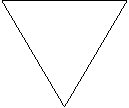
EINTHOVENS TRIANGE
II III
Leads are numbered counterclockwise Down is positive Right to left is postive
ELECTRICAL AXIS OF HEART AND HEXAXIAL SYSTEM Find lead that is closest to net 0 = perpendicular to that lead Find lead with largest deviation to find which direction on the perpendicular to point
EKG AND CARDIAC CYCLE P wave occurs during atrial contraction Q wave occurs just prior to mitral valve closing R wave peaks on the mitral valve closing S wave valleys during isometric contraction T wave begins at reduced rejection
Arrhythmia = disturbances of rate, rhythm, or sequences of depolarization due to either disorders of impulse formation or impulse conduction
Atrial premature contraction – atrial premature beat, T and P waves run together, QRS widened
Ventricular premature contraction – p wave gets eaten up by premature ventricular wave. QRS is widened.
Paroxysmal atria tachycardia – normal complexes Atrial fribrillation – irregular uncoordinated atrial waves dissociated from QRS waves
Ventricular tachycardia – rapid abnormal QRS complexes
Venticular fribrillation – very irregular uncoordinated QRS complexes
Incomplete AV block (first degree) – prolonged PR interval
Incomplete AV block (second degree) – 2:1 block. Ventricle responds to every other atrial beat.
Incomplete AV block (Wenckebach phenomenon) – progressive AV nodal delay and finally a p wave without a QRS wave.
Complete AV block – atria are activated by normal impulses from SA node but ventricular rate is slow and independent of atrial rate. SacromereA –both actin and myosin I – actin only H – myosin only During contraction decrease H and I bands
1. Calcium binds troponin 2. Tropomyosin moves 3. Actin binding site exposed 4. Myosin cross-bridge binds actin 5. Conformational change in myosin cross-bridge = power stroke 6. In presence of ATP myosin cross-bridge releases
Preload = extent to which muscle is stretch before contraction Afterload = load lifted
Isotonic contraction = longer latent period and slower raising phase
Total force = sum of active force + passive force contractile elements extension of elastic elements
ideal overlap = highest % max force
afterload ¯ distance (can’t carry it as far) ¯ velocity (can’t carry it as fast ) ¯ duration (can’t carry it as long) latent period (have to wait longer before I can carry it again)
SYSTOLE 1. AP 2. Activated voltage gated calcium channel on sacrolemma 3. Calcium enters cell 4. Activated calcium induced calcium release from sacroplasmic reticulum 5. Contraction DIASTOLE 1. Exhange of 3 sodium in for 2 calcium out by anti-port carrier (depends on ATP and Na+/K+ pump) 2. Sacroplasmic reticulum pumps Ca++ back in using ATP
Cardiac muscles can control calcium release to control contractile force
STAIRCASE PHENOMENON Increase in heart rate results in stronger subsequent contraction
Afterload and preload do not affect contractility. Inotropic agents do If there isn’t a change in Vmax then there is no change in contractility
+ inotropic NE ( cAMP, PKA, phosphorylate Ca++ channels activated / increases calcium entry and stores Digitalis (blocks Na+ / K+ pump so that Ca++ / Na+ exchanger doesn’t work leaving Ca+ \ contractility)
- inotropic Ach (¯cAMP, ¯ calcium channel activation, ¯ calcium entry, ¯ contractile strength)
AORTIC PRESSURE AND FLOW
Ascending limb (ejection) Affected by: · Stroke volume (directly to pressure) · Aortic distensibility (indirectly to pressure) · Ejection velocity (directly to pressure)
Dicrotic notch (dip in aortic pressure when aortic valve closes) Caused by: · Flow to coronaries (loss of blood to coronaries ¯ pressure) · Slight regurgitation into left ventricle (loss of blood to ventricle ¯ pressure) · Distention and rebound of aortic valve into left ventricle (increases volume of container ¯ pressure)
Descending limb (run off into peripheral vessels) Affected by: · Systolic pressure ( directly systolic pressure = diastolic pressure = aortic pressure) · Aortic distensibility (directly ¯ distensibility = aortic pressure falls off more quickly) · Heart rate (directly HR interrupts diastolic decline = diastolic pressure = aortic pressure) · Peripheral resistance (directly peripheral resistance = systolic pressure = aortic pressure)
ARTERIAL BLOOD PRESSURE
Pressure wave is shock impulse that is faster than blood
***** Pulse pressure (PP) = systolic BP – diastolic BP ***** MAP = diastolic pressure + 1/3 PP
MAP will decrease progressively even if pulse pressure increases
**PULSE PRESSURE Affected by: · Stroke volume (directly) · Arterial capacitance/compliance (inversely) · Peripheral resistance (inversely) ex. greatest drop in arterioles
Femoral artery has higher pressure than abdominal artery due to two pressure waves crashing into each other.
VENOUS RETURNMain factors: pressure built up by left venticle Systemic filling pressure = 7 mmHg (pressure when you stop the heart) Auxiliary factors: skeletal muscle pump Venous valves Respiratory pump Ventricular suction Increased venomotor tone
Respiration Inhale ® ¯thoracic pressure, ¯ right atrial pressure, DP, \ venous return
***** CO = SV X HR CO = venous return Cardiac index = CO / body surface
SYSTEMIC FACTORS DETERMINING CO Primary factor effecting how much blood the heart will pump is how much it receives
Systemmic filling pressure = 7 mmHg Determined by stopping the pump If quantity of blood filling system is too small, blood will flow poorly from periphery to heart. Thus systemic filling pressure is an important determinant of venous return and CO PSF with transfusion / ¯ PSF with hemorrhage
CARDIAC FACTORS DETERMINING CO PSF with sympathetic stimulation / ¯ PSF with sympathetic inhibition
regulation of SV 1. Preload: (diastolic filling) at first: direct then fibers over stretched: indirect 2. inotropic state: (contractility) direct 3. afterload: (aortic pressure) indirect 4. heart rate: indirect
MEASURING CO 1. The Fick Method: CO = vol O2 consumed / (AO2 – VO2) 2. Indicator dilution method with cardiogreen dye: CO = (Dinj x 60 sec/min) / ([D] x DT) 3. Echocardiogram 4. Radiocuclide imaging 5. Impedence cardiography
Arterial pressure must permit adequate perfusion of capillaries
***** BP = CO X TPR
DETERMINANTS OF VASCULAR RESISTANCE
1. Modulators of vessel radius (inversely proportional) · Inherent tone · Autonomic nervous system · Metabolic factors · Vascular endothelium (local control) 2. Vessel arrangement (parallel = ¯ resistance) 3. Fluid Viscosity (directly proportional)
DETERMINANTS OF CARDIAC OUTPUT
CO = SV x HR
1. Stroke volume · Preload (directly) · Contractility (directly) · Afterload (inversely)
2. Heart Rate · Metabolic factors · Nervous system · Response to stimulation of cardiovascular receptors
CARDIOVASCULAR RECEPTORS
1. High pressure (atrial) receptors · Located in arterial system (carotid sinus, aortic sinus, ventricular walls) · Respond to changing tension · Increase stretch of receptors decreases heart rate
2. Low pressure (volume) receptors · Located in cardiac atria and maybe the kidney · Respond to fullness of circulation · Function to preserve normal vascular volume by modulating renal NaCl excretion · Stretch of receptors leads to increased renal NaCl excretion, ¯ CO, ¯ BP
VESSEL COMPLIANCE
Compliance = DV / DP
Compliance ¯ in large arteries = Pulse pressure in capillaries
CIRCULATORY RESPONSE TO HYPOTENSION (BP = CO x TPR and CO = SV x HR)
1. Arteriolar vasoconstriction ( TPR) 2. Venoconstriction ( CO) 3. Increased heart rate ( CO) 4. Increased myocardial contractility (SV ® CO)
MANAGEMENT OF HYPOTENDION
1. restore CO · increase fluid volume (preload) · increase contractility · decrease afterload 2. increase TPR
MANAGEMENT OF HYPERTENSION
1. Reduce CO · Decrease ECF volume · Decrease HR · Decrease contractility
2. Reduce TPR · Vasodilators (nitrates) · Correct metabolic disturbance · Correct hormaonal imbalance · Exercise Capillary recruitment = increase in the number of perfused capillaries
***** Q = Qc Nc = Vc Ac Nc
Qc = flow per capillary Nc = number of capillaries Vc = velocity of flow Ac = cross sectional area
\ in order to increase flow you can increase velocity or the number of capillaries it is more efficient to increase the number of capillaries
TRANSCAPILLARY SOLUTE EXCHANGE
Diffusion = permeability x surface area x concentration gradient
REFLECTION COEFFICIENT
s = 1 – [lymph] / [plasma]
if most of compound passed through, s would be near zero if none of compound passed through, s would be near one
s = ¯ permeability
osmotic pressure = created by different concentrations across a membrane colloid osmotic pressure = created by the greater concentration of proteins inside the vessels oncotic pressure = due to difference in [protein] and to the slight effect of the Donnan euilibrium
donnan equilibrium = results from effect of negatively charged protein molecules have on small ions such as chloride and sodium.
two opposing pressures: 1. colloid osmotic pressure draws fluid in 2. hydrostatic pressure pushes fluid out
CONVERSION OF OSMOTIC PRESSURE TO mmHg Van Hoff’s LawColloid osmotic pressure in ATM = # dissociable particles x [total solute] x gas constant x temperature K ATM = 760mmHg
STARLINGS EQUILIBRIUM EQUATION
Q = perm coeff. [(Pc – Pi) - s (pc - pi )]
P = hydrostatic pressure p = colloid osmotic pressures
Competition: Pc , hydrostatic pressure in capillaries favors filtration pc , colloid osmotic pressure in capillaries opposes filtration
capillary hydrostatic pressure µ postcapillary resistance/ precapillary resistance
EDEMA 1. increased flow from vessels ® tissues 2. reduced absorption of fluid ® vessels 3. reduced or blocked lymph flow
LYMPHATICS
fluid enters lymphatics when tissue hydrostatic pressure ( ) exceeds the pressure in the lymphatics.
Lymph flow
¯ capillary colloid osmotic pressure increase in interstitial protein all cause tissue hydrostatic pressure ( ) ¯ reflection coefficient
Inflammatory edema –increase in gaps between endothelial cells causing a decrease in reflection coefficient (¯ pc , pi ) inflammation infection shock burns ischemia
Venous edema –increased venous pressure exceeding plasma oncotic pressure (favors filtration) ( Pc backs up venous system) Prolonged standing –elevated hydrostatic pressure in capillaries Left heart failure –leads to increased left atrial pressure and pulmonary edema Congested heart failure – elevates central venous pressure
Lymphatic edema – lymphatic obstruction ( pi ) Interstitial colloid pressure increases favoring filtration and edema formation
Hypoalbuminemic edema – results from low plasma albumin
Myocardial ischemia occurs when O2 supplied to myocardium is less than its demand Myocardial infarction is myocardial ischemia when there is permanent damage to the muscle
Arteriosclerosis is thickening and hardening of the arterial wall Atherosclerosis is arteriosclerosis when the result of a progressive growth of an atheromatous plaque.
work of heart must flow (can’t increase extraction of O2)
endocardium has lowest perfusion pressure \ most susceptible to compromised coronary blood flow
test for MI ® creatine phospokinase (CPK) is specific for myocardium
ischemic myocardium ¯ contractility ¯ CO ¯ compliance (stiff) chamber pressure irregular beating
ANGINA PECTORIS Dull pain Shortness of breath Radiation of pain down arm neck or shoulder Diaphoresis
MI Crushing pain Sx’s associated with angina
Treatment of IHD1. reduce O2 demand 2. monitor for arrhythmias
Chronic treatment 1. nitrates 2. calcium channel blockers 3. beta adrenergic blockers (sympathetic blocker) 4. ACE inhibiters
Preventive treatment1. stop smoking 2. reduce weight 3. exercise 4. improve lipid profile
HEART FAILURE In the presence of adequate venous return, a cardiac abnormality makes this organ unable to pump blood at a rate that satisfies the metabolic needs of tissues.
Circulatory failure –abnormal blood flow that compromises tissue function Heart failure –defective pumping of blood Myocardial failure –defective heart muscle
FORWARD HEART FAILURE Decreased tissue perfusion from ¯ CO Fatigue from exercising
BACKWARD HEAR FAILURE Tissue congestion caused by abnormally elevated venous pressures that promote extravasation of vascular fluid into tissue Shortness of Breath
LEFT HEART FAILURE (first) Weakness, SOB from exercise
RIGHT HEART FAILURE (second) Hepatic congestion, peripheral edema, pulmonary edema
SYSTOLIC HEART FAILURE Weakened ventricular contraction ¯ SV and ejection fraction end systolic volume (not getting it all out) end diastolic volume end diastolic pressure
DIASTOLIC HEART FAILURE Increased resistance to filling ¯ end systolic volume end diastolic pressure
Low output heart failure vs. high output heart failure
Frank Starling Curve When get to flat portion of curve increasing end diastolic volume does not increase CO.
Treatment for Heart Failure1. reduce preload diuretics venodilators NaCl restriciton
2. decrease afterload vasodilating drugs
3. increase contractility digoxin, sympathomimetics mechanically
SHOCK = inadequate perfusion of tissue
3 types of circulatory shock
loss of a substantial blood volume for a period of time must be large enough to produce decreased tissue perfusion for extended period not exsanguination (bleed to death)
loss of cardiac function cause: MI
entry of bacteria into circulation (surgery, trauma, ischemia to gut) bacteria into blood ® WBC recruited ® rxn radical O2 ® attacks phosholipids ® weakens membrane ® ¯ serum oncotic pressure ® lymph protein
Treatments1. fluids 2. steroids ® reduces membrane permeability 3. motrin or aspirin 4. hypertonic saline 5. Naloxone 6. Super oxide mutase 7. Dopamine 8. Atropine 9. O2
Monitoring1. CO (ultra sound doppler flow meter) 2. Cardiac performance (catheter) 3. Peripheral arterial blood flow (flow meters) 4. Arterial blood pressure (catheters) 5. Venous blood pressure (catheters) 6. Peripheral capillary permeability ([protein] in lymph) 7. Acid – base monitoring
CLINICAL PRESENTATION Hemorrhagic = low BP, low CO, decreased renal function, low blood volume
Cardiogenic = reduced MAP, ¯ mental function, ¯ urinary output, ¯ blood flow ® clammy skin
Septic = capillary permeability, and above
HYPERTENSION Essential = idiopathic Increases risk for: stroke, congestive heart failure, CAD, and renal failure Risk factors for hypertension: diabetes, smoking, high cholesterol, left ventricular hypertrophy, ethnicity
Treatment: 1. decrease NaCl 2. stop smoking 3. stop drinking alcohol 4. decrease weight if obese 5. increase physical activity
Drugs 1. diuretics: thiazides, loop diuretics decrease ECF
2. sympatholytics: methyldopa, clonidine, guaethridine, reserpine reduce sympathetic effect on blood vessels (¯ vascular resistance) reduce sympathetic effect on heart (¯ CO)
|