
List and explanation of "Jing"
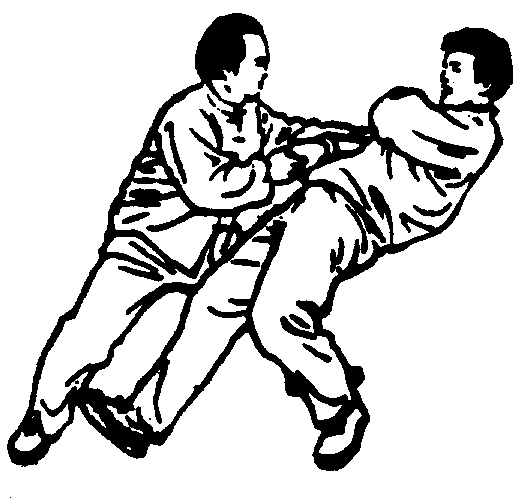
List of Jings as chronicled by Chen Yen Ling who "borrowed" the books
of the Yang Family. I.e., these jing reflect Yang family sayings but
can be found in most of internal and external traditional martial
arts. Most of them are present in the current form of Luohan Quan
depending of the level of practice : Ming Jing (bright energy), An
Jing (quiet energy) or Hua Jing (transforming energy).
Even though these are all called jing, you can easily see that many
of them are just techniques and skills that utilize the core strengths
of the internal martial arts.
Peng Jing (Pushing Power)
Peng is the very basic "power". It is the ability to transmit power,
strength, energy, etc, thru an "extremity" (one of the 7 stars : head,
shoulders, elbows, hands, hips, knees, feet).
Ding Jing (Listening Power)
Peng is considered also as the audible energy because it is through
peng that one can listen to the opponent's body. As the student
develops the core peng strength, work is begun on building a good
connection and communication between student and opponent. Through
the aid of practice to increase sensitivity, the student can precisely
detect the opponent's power, center of gravity, direction, pressure,
etc., as if actually hearing the vibrations. Understanding Power
(Dong Jing) motivation, one can continue developing and advancing
listening ability to the stage of under standing power. In other words,
the mind becomes able to analyze and measure the pressure, direction
character, speed, force, etc., of the opponent's movements in order to
be able to cope with them properly. In most chinese martial arts this
Power is trained thru Tuishou (pushing-hand) drills (f.e. called
Chi sao in wingchun).
Zang Lian Jing (Sticking Power)
Through Rolling Hands Practice, Pushing Practice and practice in
reversing the transfer of power process, the student develops the
sensitivity and controlling ability known as sticking power. In
other words, the student should be able to stick with an opponent
in order to control him, attack, or defeat his attack. Usually with
the initial contact between two people in a free-style fighting
situation, the student can use peng to sense the opponent's hand
(with advanced students the sensitivity will encompass the entire
body) and there is an almost magnetic feeling. That is, the opponent
feels as if he were stuck to the student almost like chewing gum
can stick to the body. The special application of sticking power is
the slowing of an opponent's speed and also the redirection of any
kind of energy emitted by the opponent (a straight push get deflected
without any apparent reason. This Power is also involved in the
"unpushable man" trick).
Zuo Jing (Following Power)
By combining all of the previously described types of power, one
can advance one's ability further and develop following power.
This type of power allows the student to follow the direction of
the opponent in all situations and respond accordingly.
Hua Jing (Neutralizing Power)
With neutralizing power the student is able to guide their following
power in a yielding manner, in order to counterbalance or make
ineffective the attacking and defending ability of an opponent.
Ce Jing (Borrowing Power)
Through borrowing power, the student is able to utilize an opponent's
power by adapting it to purposes that are beneficial to the student's
own designs. When an opponent attacks with, say, ten pounds of force,
the student not only neutralizes (yields) but also borrows that force
into his foot and reflects it back to the opponent, often at such an
angle that the opponent is tossed away by largely his own power.
In Luohan Quan this power is used at "An Jing" level for every move
that appear as a block at "Ming Jing" level.
Ying Jing (Drawing-up Power)
Should an opponent refuse to transfer power, the student is in the
situation of having no power to borrow from. In such a situation it
is up to the student to cause the attacker to yield his power so that
it can be utilized for reflection back to the opponent. This process
is known as drawing-up power from an opponent. A lot of this may just
be psychology and reflex.
Di Jing (Uprooting Power)
The ability to cause an opponent to bounce backward and upward,
thereby making him lose his root to the ground, is known as uprooting
power. When used in a more moderate fashion, i.e., by keeping peng in
an upward direction to the opponent's center, this power will cause him
to float. In Luohan Quan this power is used to prepare counterattacks
and throws, usually combining the power of the arms with the power of
the stance / hips.
Chen Jing (Sinking Power)
By reversing the practice of uprooting power the student is able to
develop the ability to sink using it against an attempt to uproot him.
Success in sinking power development can cause one's opponent to feel
that it is impossible to uproot the student. The relaxed, connected body
is the source of this.
Na Jing (Controlling Power)
Controlling power is applied during Rolling Hands practice or Free Hand
practice. The student will try different methods to take over control
of the situation and eventually lock the opponent into a position which
will defeat him. The constant and skillful use of peng and connection
are what power this skill. In Luohan Quan we all call this power the
"trapping power" as it allows to lead the opponent in a way / posture
that is uncomfortable and unstable.
Kai Jing (Open-up Power)
This is the application of internal power in such a manner as to cause
an opponent who has maintained a defensive position for an extended
period of time to open up his defenses and thus be defeated. Psychology
and reflex in relation to the opponent are vital for this.
He Jing (Close-up Power)
In this case the student directs his internal power inward in such a manner
as to cause an opponent to react by closing-up toward his center as a means
of defense. In the process of closing-up, it is possible to trap the
opponent because he is so drawn in toward his balance point that there
is no way that he can move outward; thus the student is able to control
the situation and defeat him. This is the perfect power to use against
a bully opponent, attracting him to a "unprotected" area and then let
him crash against a hard part of your body (knee, elbow, shoulder, ...)
Po Jing (Deflecting Power)
This is a specialized development of internal power. In applying deflecting
power the practitioner is able to bounce an attacker to the side, or divert
his force, to bring the student out of danger. Here the skill of
controlling not only your own peng but the opponent's force vector
(whether he uses peng or not) is critical.
Zhou Jing (Rubbing Power)
This transfer of power is achieved through a rubbing motion of the hands or
other parts of the body. The motion used is similar to that of rubbing clay
between the palms to form a long rope or coil. Often, qinna are applied
with this for attacking opponent's muscles.
Fa Jing (Exploding Power)
This transfer of power is achieved through a burst of energy, releasing power
suddendly and "overloading" the opponent. At "ming jing" level, this power
is used for every "attacking" moves of Luohan Quan.
Ce Jing (Twisting Power)
When applying internal power in this manner, the student twists an opponent
in an action similar to that of wringing out a wash cloth. This type of power
is used to lock an opponent into a position where he can be easily defeated
or just keep it secured. The internal version of this well known move
different in that it relies on physical law rather than muscle power.
Zhuan Jing (Spiral Power)
Because of this screwing motion, this type of power transfer is sometimes
referred to as screwing power. It is the base of Chansi Jing (silk reiling
power)Mainly use in Baguazhang this power is used in every turning move of
Luohan Quan, transforming a possibly weak posture into an even more powerful
motion. Of course a good grounding and lower body strength is required.
Ci Jing (Cutting Power) or Heng Jing (Crossing Power)
This type of power transfer, is a clean, sharp cutting type of motion which
is applied to an opponent from the side in order to disable or interrupt an
attack. Used with Zhuan Jing this can produce extremely powerful moves which
can inflict heavy damages.
Duan Jing (Interrupting Power)
Interrupting power usually refers to the skill of "leaving the jing in the
opponent.... mainly so no return which borrows" your power can be used.
This skill is very hard to train and requires a very trained mind.
Cun Jing (Inch Power)
Sometimes called short-power.... the ability to release great power with
very little motion. The most famous martial artist using this power is of
course Bruce Lee (the famous one inch punch), to achieve the maximum power,
Zhuan Jing, Fa Jing and Ying Jing are required.
Zuo Te Jing (Folding Power)
Folding power usually implies the skill of folding the body and hitting with
the closest body part, using fa jing. For instance, if an opponent holds
your wrist, hit him with Elbow using fa jing or cun jing; if he holds your
elbow, hit him with shoulder (Kao) or hip, etc.
Ling Gong Jing (Distance Power)
This is the power of supposedly hitting without touching from a distance.
I've personally never experimenced this power, but I've felt
"energy projection" (perceived as warm feeling moving accordingly
the expert's will and motions). BTW before even reaching that level
there is a lot of work with all the previous Jing.
For Greater Access To This Site... eMAILthe group and sign the guestbook. ,'0)
HISTORY OF KUNG FU , by various authors
TECHNIQUES & EXCERISE
TAI CHI LINKS
VIEW & POST MARTIAL ARTS FORMS
