
T'ai Chi Ch'uan
Training Tips
Breathing
The preponderance of information seems to indicate that beginners
should breath normally while doing the form. The complexity and details
involved in learning the forms requires enough attention without adding
breathing patterns or methods. Later when the form has been learned and
other details perfected (posture, relaxing...) then breathing techniques
should be added.
A few beginners tips.
Never hold your breath
Breath in and out through your nose
Keep your mouth relaxed
Keep the tip of the tongue against the roof of your mouth,
just behind the teeth
Postures
Stances
Beginners tips:
The knee should never extend past the toes
Move/rotate the foot to avoid twisting the knee
Sink into the stance to a level you can maintain throughout the form
Keep the head at the same level. Avoid up and down motions of the body
while moving between stances/postures.
Keep the legs relaxed
Touch the heel to the floor before the toe
Make sure the stance is open enough to be stable
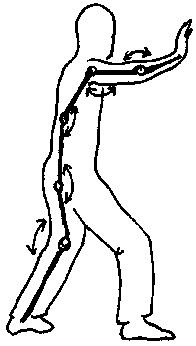
Standing or Zhan Zhuang
Many masters have stated that standing is the "secret" to advancing your T'ai Chi Ch'uan.
Traditional training involved learning each posture separately and holding it for periods
of time before advancing to the next. After all postures were learned and perfected, they
were combined in the form.
There are a variety of postures used. In fact, any posture from the form can be used for
standing and has different benefits for each posture. These standing positions are used
for a variety of reasons. To reduce stress, to benefit health, as well as for rooting,
strengthening the chi and developing body sensitivity.
Basic posture. It is with the feet parallel about shoulder width apart. Head is up
with a line between the top of the head (Bai hui), perineum (hui yin), and bubbling well
points (yung ch'uan). The back is straight, hips tucked under so the tan t'ien is in line
with the ming men. Hold your arms in a gentle circle as if embracing a tree or pillar at
shoulder level or a higher. Eyes are usually closed and focus the attention to the tan
t'ien and sink your energy down into the floor. Stay relaxed, especially the shoulders.
We do this posture for approximately five minutes, in preparation for training, at the
beginning of class.
Don't hold the posture initially for long periods of time. Build up slowly to longer
periods of standing. Perhaps do several postures, holding each for about 5 minutes and
work towards longer periods of time as your body acclimates. Most people, standing
still for only one minute will begin to experience difficulty, such as physical discomfort,
mental doubts and shortness of breathe. When confronted with these situations, a
practitioner should begin to develop different forms of concentration to reduce the pain
and focus the mind. One common method of focusing and eliminating difficulties is to
imagine standing in a quiet, relaxed place.
LEAVE YOUR MARK ON THIS PAGE,
eMAILthe group and sign the guestbook. ,'0)
| HISTORY OF KUNG FU , by various authors |
| TECHNIQUES & EXCERISE |
| TAI CHI LINKS |
| VIEW & POST MARTIAL ARTS FORMS |
