
Overview of Biodiversity Index Results
Students involved in South Carroll's Biofilm project use an indexing protocol obtained from the Maryland Sea Grant Website. Here is a sample of a completed Diversity Index, followed by description of the indexes we use. (Definitions for measures of Biodiversity from http://www.mdsg.umd.edu/Education/biofilm/glossary.htm.
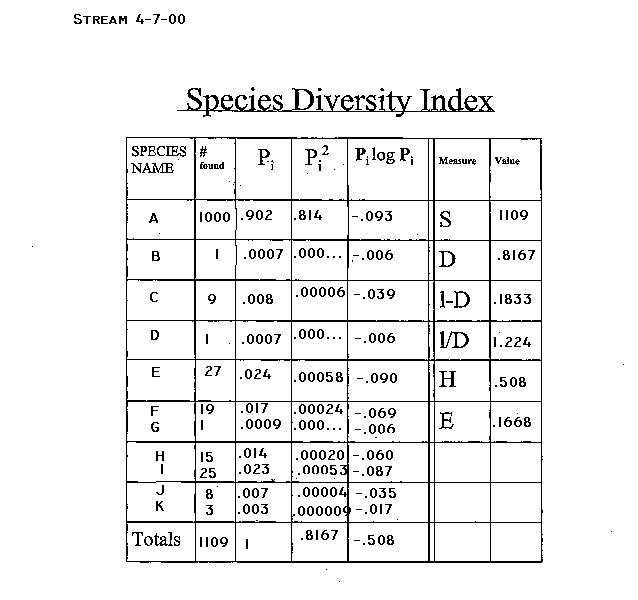
Species Name- We are rarely able to positively identify the species we observe. We have chosen to use letters to represent each species, letters which correspond to the order of organisms found on each analysis sheet, the sheet on which we make our initial observations and sketches.
# Found- This column contains the number of each species found on 3 squares of a sampling grid, one microscope slide, or one slide cover slip (depending, of course, on which protocol is followed).
Percent Index (Pi)- Each value in this column is the percent of the total number of organisms found comprised by the specified species.
Percent Index Squared (Pi^2)- This value is the square of the previous value.
PilogPi- This is the percent index times the natural log of the percent index. Please note that this should actually be written "Pi[ln(Pi)]".
S - The sum of the number of organisms found.
D - Simpson's Index- The probability that two randomly selected individuals in the community belong to the same species. (sum of Pi^2)
1-D - Simpson's Index of Diversity- The probability that two randomly selected individuals in a community belong to two different species.
1/D - Simpson's Reciprocal Index- The number of equally common species that will produce the observed Simpson's index.
H - Shannon-Weiner Index- The order (or disorder) observed within a particular system. (-sum(PilogPi))
E - Evenness of a community. (H/ln(s))
