|
GAVIN'S KRIS KRISTOFFERSON PAGE |
|
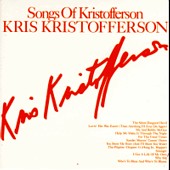
Songs of Kristofferson
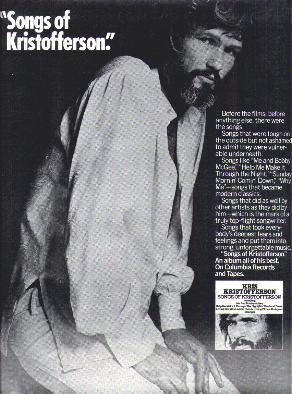
Original Ad:
Liner Notes By: Nat Hentoff He's a movie star now, the once and former Rhodes Scholar who used ot be a janitor in a Nashville bar and then became the first of the "new" country singers. That was when Kristofferson initially became a national presence--a stubbornly independent lonesome traveller whose music couldn't be confined to any one category. Sure, there was country in it, but it also spoke directly to listeners who , up to then, hadn't related much to country sounds. What made Kristofferson so singular and affecting a musical force was the reality of his stories. This was how it actually was, being hungover and alone on a sunday morning. It could be any city. And everyone understood right away how urgently important it could be to help you find someone who'll help you get through the night. And I tell you, I'm still mourining the fact that Kristofferson let Bobby McGee slip away because vicariously, that song made me feel right there and warm, on the road, with them windshield wipers slappin' time and Bobby clapping' hands. He's a poet, a lot of critics said then about Kristofferson. More to the point, he was and is a novelist. That's, for instance, why the dialogue in his songs is so right. He catches exactly the rhythms of language, all the kinds of cadences by which different people tell who they are by how they talk. And he spins tales, strong narrative threads, in deceptively simple ways that not only get you deeply involved, but actually give you a visual sense of what's going on. And then he can softly put a line in your head that will never leave it because it lays just right.--"Loving Her Was Easier Than Anything I'll Ever Do Again." But now Kristofferson is a movie star.A Star is Born, Alice Doesn't Live Here Anymore, Pat Garrett and Billy The Kid, The Last Movie and others. Does he still think about singing and writing those songs which put together, make up one of the more distinctive achievements in popular music for a long time. I asked him the questions while he was filming Semi-Tough, based on Dan Jenkins' novel. The role is going to make Kristofferson an even bigger movie star. What does he need songs for anymore.? "It's a central part of my being, writing songs," he said."No way I can stop . I got lines from songs in my head all the time. It takes me longer to finish songs these years because I take more care with them. But ideas keep coming. And I'm not leaving the road for good either. I'll be touring with my band from time to time, because that's a central part of my being too." This collection, a cross-section of Kristofferson songs and performances which have proved most magnetic through the years, is intended by him as a reminder that he has not at all stopped focusing on music. Also, he hopes that listeners who may not know all the albums on which these songs were initially released may now be stimulated to pick them up and explore all the other songs in them. "The Silver Tongued Devil" has a touch of vintage Anglo-American balladry--a universal story of betrayal with no overlay of sentimentality ("We take our own chances and pay our own dues") but also with a note of inescapable candor ("And some people swear he's my double, and some even say we're the same"). Kristofferson's ability to put inside music the sensual rhythms of open, easeful love--not fantasy love, but bodies coming together--illuminates "Loving Her Was Easier (Than Anything I'll Ever Do Again)." I've already paid tribute to the compelling delights , as well as the poignant loss, in "Me and Bobby McGee," and Kristofferson's footnote to the song is an intriguing illustration of how he works. "I'd been wrestling with different lines for months," Kristofferson recalls. "but I couldn't find a way to make them work. What kept me going was that the basic rhythms were running through my head, and I knew they were right. Then, one day I got that windshield wiper line--'with them windshield wipers slapping time and Bobby clapping hands'-- and it all got tied together. I knew it was finished then." "Help Me Make It Through The Night" could hardly be more simple and yet more difficult for most to write. Each word has to both sound and fall right. One wrong image or one tangled rhythm can break the spell. This one is flawless--as flawless, I believe as certain folk ballads which have endured for centuries. I think this one will. "For The Good Times," as Paul Hemphill has pointed out in a New York Times profile of Kristofferson, is "about the reluctant and inevitable breakdown of a marriage," Kristofferson's own, his first. It too , is simple and precise, and yet so evocative are the lyrics that in a very short compass of time, he creates a pyramid of memories each with its own specific weight of regret. "Sunday Mornin' Comin' Down," was written during a hard time for Kristofferson, but also a transition time to a new life. The son of a retired air force major general, Kristofferson had, for most of his life up to then, gone the straight arrow route--ROTC commander in college , a Rhodes Scholar at Oxford, five years in the army, and an assignment to teach English literature at West Point. But a stay in Nashville changed it all. Way back, he had won a number of prizes in Atlantic Monthly short story contests, and he'd also written unpublished novels. The part of him--the writer, the watcher--finally overcame the other part , the dutiful son. And he stayed in Nashville. "Sunday Morning Coming Down," was written while Kristofferson was scuttling to stay together in that city; but, as I said earlier, it could be any city. I've felt just that way in Boston and Paris, and New York. It's a classic of the dreadful-Sunday-syndrome . "You Show me Yours (And I'll Show You Mine)," amiably distills what happens, every night, in bars and lounges just about everywhere. unattached folks are pitched and being pitched too. It's another song through which you can see the action, inner and outer. "The Pilgrim," as Kristofferson says in his introduction here, was written with a lot of people diversely in mind, from Johnny Cash to Rambling Jack Elliot.. It is also, I expect, about himself, in past times in his life. Stark, the song is also not without a candle of hope. At that too is realistic. Johnny Cash found his way and so has Kristofferson. "A lot of things that used to bother and fluster me," Kristofferson said as we were talking about this album," don't anymore. I'm cured of the critics, for instance. And despair, which used to be their sometimes, isn't anymore. Actually, things look very good." But for those times when you don't know where you're going, and so any road will take you there, "Stranger" is a classic epiphany of how for just one night, if only that night, you can touch somebody's loneliness, and for a while, put it as well as your own loneliness aside in the dark. "I Got A Life of My Own" is another variant on being alone, on prizing the freedom of not being part of anyone's plan, and yet also knowing that there's a hole in your soul. And that leads to "Why Me". Describing it once to Geoff Lane of Music City News, Kristofferson said "It's about a personal, religious thing. It became a hit, but it's not what I ever though a hit was. I went to church by chance one Sunday at Jimmy Snow's. Larry Gatlin was there and he was singing and he sang 'Help Me.' It moved me in a weird way. It really affected me. It got to be a kind of profound experience and blew my mind wide open. It may have been on the way home that I started writing--It just came to me." "Who's to Bless, and Who's To Blame" is Kristofferson in a much more existential frame of mind and memory. In William Buroughs' phrase, it's the naked lunch at the end of the fork. There are indeed times when life looks this pitiless, and it is an index of Kristofferson's range--a novelist's range. I repeat--that he can be as grimly convincing here as he can be transcendently of the spirit in "Why Me." In view of the scope of his songs, I asked Kristofferson how they took shape. What starts the process? "It can be an idea," he said. "That is, I can get a central theme, a concept. Or sometimes it starts with a scene, and then it's the visual thing that comes before the idea. At other times a song will start with a line that comes to me, and my mind starts playing with the words in that line, putting them together in different combinations, leading to other lines. I may begin by mocking the inner rhyme of a line to see what comes out of that." When he started writing songs, Kristofferson added, the melodies would usually come first, and "I'd slap just about any words into them."But that changed. His songs now start with the lyrics, "And I work much harder at the melodies than I used to because I want them to be much more distinctive." Pne thing that Kristofferson most stressed about the way he writes is that "I can't write on assignment. I've never been able to, " or as he says in one of his songs "Don't make me no part of no plan." It is also worth reporting that something new is happening with Kristofferson's writing." I find now," he says " what starts as a song gradually becomes something else. For example, I'm working now on something--I can't be sure what it's going to evolve into--that first came into my head as a song. It was a song in the form of a story. And as the story grew, it became more and more visual. So now it may either become a screenplay or a novel. The thing just keeps growing. It could even become a myth." In so far as anything can be inevitable, it would seem that Kristofferson will surely be writing in longer and more diversified forms. But he will also continue to create those gentle, though sometimes gritty, songs of loners, lovers and travelers which are so organic a part of his sensibility, let alone of his past experience. Back in 1970, Paul Hemphill wrote of Kris Kristofferson: "he is a poet rather than a musician, more concerned with interpretation than the quality of voice. He is at once blunt and mystical, above pretty prejudices, strongly appealing to both the campus and intellectual folk. He is an important link between country, pop and unerground music. Now, Kristofferson is still a poet but also a most knowledgeable lyricist. Very much concerned with interpretation, his voice has become more supple. Blunt and mystical he still is, but also extraordinarily unpretentious and warm-spirited. He remains above petty prejudices, and his appeal--now that he is a movie star--is to just about every section of the populace. Meanwhile, "underground music" has turned into the reigning overground sounds, and Kristofferson is less a link any more than a strongly individualistic presence who, as always, cannot be categorized. And finally, as this album demonstrates, his songs endure, staying in the mind long after the music has stopped.
|