
.
 COMES A TIME
...... The.Neil Young's Story
There's a comet in the sky tonight
Makes me feel like I'm alright
I'm moving pretty fast
For my size
I really didn't mean to stay
As long as I live
So I'll be moving on.
("Music Arcade", from the Broken Arrow album)
Books about NEIL YOUNG + Posters
Lyrics + Essential Albums ....>>> Greendale <<<< - lyrics
Background music: Hey Hey, My My (Into The Black)
Records like Tonight's The Night, On The Beach and Time Fades Away were to prove emphatically that Young could hardly have been less like the hippy peacenik the media imagined him to be. His genre is generally defined country rock, or modern country, yet in the Eighties his music wandered stylistically from hard rock (Re-ac-tor, 1981), synths and vocoders rock (Trans, 1983), rockabilly (Everybody's Rockin', 1983), straight-ahead country (Old Ways, 1985) and blues (This Note's For You, 1988). Neil is willful and whimsical, he blindly follows his muse, seemingly without concern for sales implications. On one side he is the mellow troubadour who has serenaded bedsits the world over, on the other side he is an axe maniac who kicks out the jams with Crazy Horse. It's hard to believe that albums as different as Harvest Moon and Mirror Ball are the work of the same person.
"I just hate being labeled. I
hate to be stuck in one thing. I just don't want to be anything for very long. I don't
know why. I just want to keep moving, keep running,
play my guitar." (In an interview from 1985.)
In the meanwhile his old cohorts Crosby, Nash and Stills have remained faithful to the
country music, as witnessed by all their works and - least but not last - by the reunion-album Looking
Forward.
 ODD ADVENTURES
One of the key tracks from Young's On The Beach (1974) is "Revolution Blues", a predatory rocker in which Neil adopts the persona of a trigger-happy psychotic, eager to slaughter Laurel Canyon's superstar residents.
"Well I'm a barrel of laughs with my carbine on,
I keep hopping till my ammunition's gone..."
The song was based on his experiences with the murderous Charlie Manson. He met "The Wizard", aka Manson, at (Beach Boys) Dennis Wilson's house about six months before the Polanski-Tate killings. "Charlie Manson is quite a writer and a singer, really unique - very unique, and he wanted very badly to get a recording contract. The thing about him was you'd never hear the same song twice. It was one of the interesting things about him. He had a very mysterious power about him..."
Young was sufficiently impressed to recommend the hippy Antichrist for a recording contract with Reprise - and, according an obscure Manson interview unearthed by Sylvie Simmons, to give him a motorcycle - before distancing himself from "The Wizard" in the wake of the Sharon Tate murders.
Long May You Run (1976) teamed Young with former Buffalo Springfield partner Steve Stills, while American Stars 'n' Bars highlighted performances by Linda Ronstadt and Nicolette Larson. Decade (1977) is a carefully made compilation (the best summation of Neil's career by default) while Comes A Time harkens back to Young's folk roots.
In Comes A Time from 1978 Neil plays together with Frank "Poncho" Sampedro (vocals and guitar), Billy Talbot (vocals and bass), Ralph Molina (vocals and drums) and Tim Mulligan (saxophone). The proposed title of this gem was Gone With The Wind, but it couldn't be used because of copyright problems. Comes a Time is an acoustic folk rock LP with beautiful duets (Nicolette Larson harmony vocals in "Motorcycle Mama"), again far from his rock albums in style, and by far the most commercially viable Neil's out-pouring since Harvest.
Lyrics + Essential Albums .
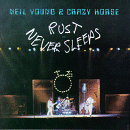
Rust Never Sleeps (see Part One) is a loose-knit concept album built around Young's conviction that an artist's reach must always exceed his grasp. The LP featured acoustic and electric versions of a tune alternately called "My My, Hey Hey (Out Of The Blue)" and "Hey Hey, My My (Into The Black)", a devastating anthem dedicated to the Sex Pistols' Johnny Rotten. Other standouts include "Sedan Delivery" and "Powderfinger", both of which Young has once offered to Lynyrd Skynyrd, as well as "Sail Away" with back vocals by Nicolette Larson.
The legend lost and found
The '80s was the decade of frustration, when most of the
"Rusties" (Neil Young's dedicated fans) felt they lost him. Young went through a
sort of musical schizophrenia, and he was sued by his record company Geffen for making records that were "not Neil Young enough". They said, "We don't
know what you're doing. We're scared! We want Neil
Young! "
Perhaps it was too late, perhaps Neil Young had
already been raped by the stale, right-winged, anticreative Eighties.
Young stills prefer the classic Crazy Horse dirty feedback. Over twenty years after Re-ac-tor he'll declare: "CSNY are like the Beatles. Crazy Horse like The Rolling Stones. And the Stones have always been my favourite band."
In 1982, Young turned to - New Wave! Trans
was not very well received by the critics, but for Young this album means as much as Tonight's
The Night. Trans includes electronically generated vocals that try to say
something but no one knows what. To Young, this work represents his struggle to understand
his own sons.Young has two
handicapped children: both have cerebral palsy and can not talk. The commercial suicide of Trans
was followed by another one - Everybody's Rockin' (1983), with rock 'n roll music
sounding as it did in the '50s. In England he then plays heavy metal at the Wembley Arena,
and the British press ponds with hard critics against him and the managers of the tour.
.................Index of books
about NEIL YOUNG
 Then, in
1985, a quick turn into country music again with Old Ways. Old Ways is the
third in a sequence of records which began with the best selling Harvest in 1972,
continued with the winsome Comes A Time in 1978, and after assorted diversions has
brought him back to the road with a squad of veteran Nashville musicians called The
International Harvesters. (An old bus and a hound called Elvis were
the blueprints of the1985 tour of this "gum chewing Orang-utang",
as Paul Rambali called him in a quite nasty article.)
Then, in
1985, a quick turn into country music again with Old Ways. Old Ways is the
third in a sequence of records which began with the best selling Harvest in 1972,
continued with the winsome Comes A Time in 1978, and after assorted diversions has
brought him back to the road with a squad of veteran Nashville musicians called The
International Harvesters. (An old bus and a hound called Elvis were
the blueprints of the1985 tour of this "gum chewing Orang-utang",
as Paul Rambali called him in a quite nasty article.)
It's a real shock to find him supporting Reagan's arms
build-up. Sure, he often steered clear of the loudmouth leftism politics of Crosby Stills
& Nash, however he had written the scorching "Ohio" after National Guardsmen
shot four students at Kent State University. And now The Loner had turned
Republican. His live show contained hymns to home, family and an America dusting off its
battered pride. A Redneck?... The legend was disappeared, and on the stage remained only
his black Gibson: Ol' black.
Young admits: "I still love rock'n'roll and I love to play the songs in my set that are sort of rock'n'roll, but I don't see a future for me there." His wife isn't on the road with him this time as she usually is - she's back at the California ranch looking after the kids. A lot of the performances find N.Y. and his International Harvesters playing to family audiences at state fairs, huge day-long gatherings of people, animals, carnival sideshows, food and drink, where everyone turns up for the entertainment in the evening. It's miles away from the crowds who've flocked over the years to see Young playing with Buffalo Springfield, Crosby Stills & Nash or his perennial backing ensemble Crazy Horse. Yet, it's fitting that Young's re-emergence in public should coincide with a wave of new groups who acknowledge a debt to his past work. Green On Red's Dan Stuart freely admits that their Gas Food Lodging LP was heavily influenced by Young's epic Zuma collection ("If your gonna steal, steal from the best," as Stuart puts it). Jason & The Scorchers play "Are You Ready For The Country", The Beat Farmers turn in a welt-raising treatment of "Powderfinger", Pete Wylie's just cut a version of "The Needle And The Damage Done" as an anti-heroin gesture, and Dream Syndicate's Steve Wynn will reminisce about Young and Crazy Horse any time you like.
By 1987 Neil had returned to his original record company Reprise and in 1989, he started his remarkable comeback with Freedom and the rock anthem "Rockin' In the Free World". The legend is back! Right now he writes some of the most inspired songs in his career without sounding like a pale copy of the new bands. As usually, he does it his own way, often with tortured noisy feedback endings to his songs. His guitar-driven songs still sound like nothing else. The so called grunge (loud, crunchy guitars far away from the glamour of the '80s) was new at this time, and groups such as Sonic Youth, Soul Asylumand Dinosaur Jr. have now been influenced by what Young had invented in the '70s.
Young had not been playing with Crazy Horse since 1985, but in 1990, they recorded the platinum-selling Ragged Glory. This album, as well as the next one (Arc-Weld, 1991), has a very dirty garage-like sound, taking (Live Rust one step further, with exploding guitars and Young singing slightly out of key. He has at the end emerged as a patriarch of the alternative-grunge movement. He says he's very inspired by Kurt Cobain, and for Mirror Ball (1995) he "borrowed" the grunge-rocking Pearl Jam as backing band. With Pearl Jam he went on an electric, much acclaimed European tour. Besides, film director Jim Jarmush invited him to compose the music of Dead Man (with Johnny Depp as William Blake, alias "the dead man"), and spent one year on tour shooting Neil Young and Crazy Horse with Super-
8 cameras (the resulting film, Year of the Horse, captures the legendary rock band with gritty realism, both onstage and off). The years of strangeness are over. The Loner has many fans throughout the world, news and rumours are constantly spread on the Internet.
In between Ragged Glory and Mirror Ball, he put the screaming guitar away for Harvest Moon in 1992 (a country follow-up to Harvest) and an "Unplugged" album in 1993. Young's acoustic outings have often been explorations of deep, abiding love. On Harvest, he was searching for a heart of gold. Once he found it, albums like Harvest Moon and, more recently, Silver & Gold, have had to do with its care and maintenance. (The Silver & Gold title song he recorded 11 times!) They are works of gentle, mellow ruminations on faith, romance, and friendship. Yes, Young works more and more on acoustic lyricism. One of the reasons for this choice is that he got TINNITUS: a constant ringing in the ears, "brought by playing so loud for so long".
 ..........................
January 31, 2010 - Neil Young was honoured with a Grammy...
... for his role as an art director!
Neil Young won his first-ever Grammy Award for "Best Boxed or Special Limited Edition Package".
This is the first-ever Grammy for the veteran rocker whose career has spanned almost half a century and who has bad-mouthed the awards ceremony for years.
Young shared the award with his co-art directors Gary Burden and Jenice Heo for 'Neil Young Archives Vol. 1 (1963-1972)'.
Young was also nominated for the best solo rock vocal Grammy Award, but lost to Bruce Springsteen, who won for 'Working On A Dream'.
Watch the NYA Vol. 1 Official Trailer!
..........................
Index of books about NEIL YOUNG



 Sound Fyles